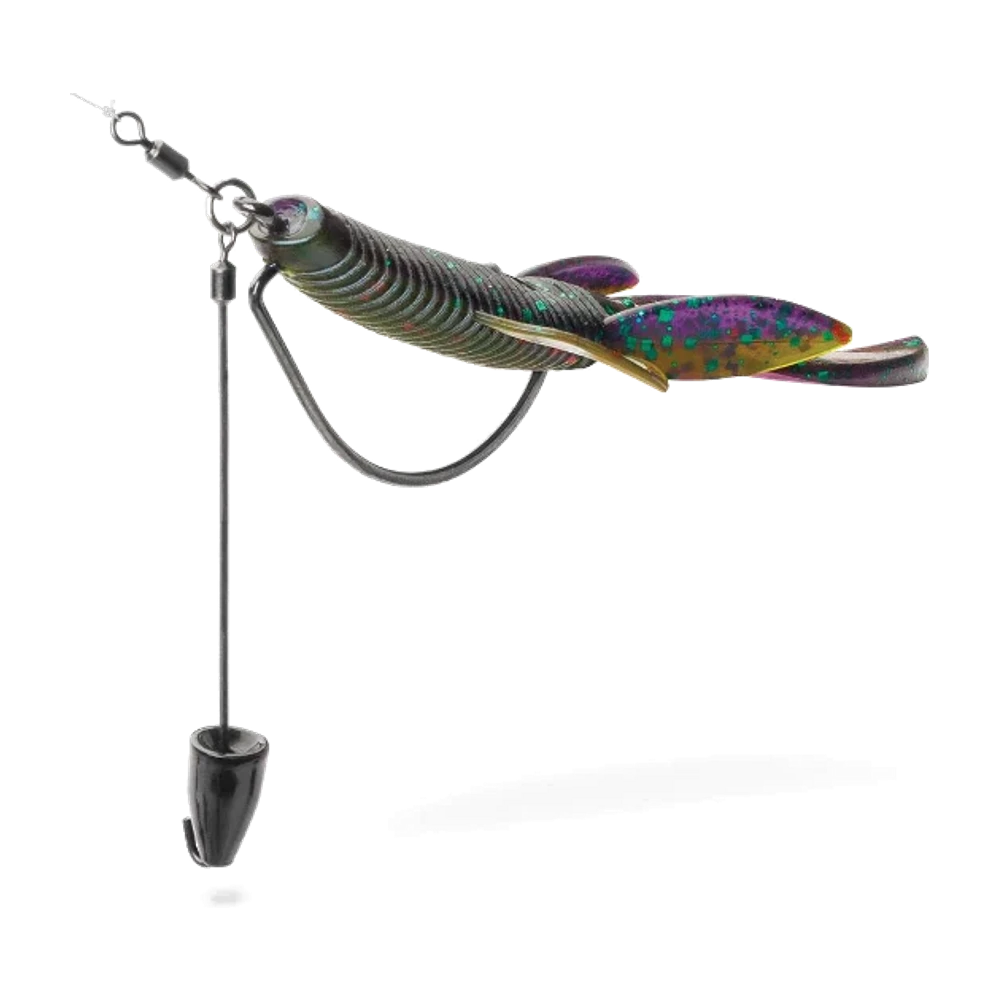
VMC Tokyo Rig: the weight on a wire, the lure free above it
Not sure this lure fits YOUR spot today? CarnaFish tells you in 10 seconds, from a photo.
You are fishing a mat of branches in eight metres of water. With a standard Texas rig, the tungsten bullet slides against the hook, the lure sticks to the bottom, wedges between two pieces of wood, and you spend half your session pulling free. With a Carolina you get the freedom back but lose the precision: the leader drifts and you no longer know where your lure is.
The Tokyo Rig solves this with a simple mechanical idea: the weight is dropped to the end of a short metal wire, below the hook. The lead holds bottom, the lure sits five to eight centimetres above it, completely free to move, and information still comes straight up the line because everything is rigidly connected.
This is a permanent-contact rig. You know at every second what your weight is tapping on — gravel, clay, wood — while your lure never touches anything.
A weight that does not interfere with the lure
On every conventional weighted rig, the weight is either inside the lure (jig head), pressed against it (Texas with a bullet), or connected by a soft line that transmits nothing (Carolina). Each solution has a flaw.
The Tokyo Rig introduces a link that is rigid but offset, and that produces three effects.
- The lure swims free. No mass restricts its appendages: the claws of a craw, the legs of a creature bait or the tail of a finesse worm move with the slightest water movement.
- Bottom contact is perfect. The weight is at the end of a metal wire: every bottom type reads distinctly in the handle, better than with a bullet turning on the line.
- The lure stays at eye level. Lifted five to eight centimetres, it rises out of the silt cloud and the leaf layer where a Texas rig disappears. A fish sitting a metre away sees it.
The wire: the real adjustment
This is the part of the rig most people underestimate. The wire is soft metal, folded at the end to retain the weights. Two adjustments are available to you.
Length. A short wire keeps the lure working just off the bottom: that is the setting for craws and for fish pinned down. A long wire (up to seven or eight centimetres) lifts the lure higher and makes it visible from further away: the setting for stained water or slightly lifted fish. Most models can be shortened with pliers.
Angle. By bending the wire slightly backwards, you tip the lure into a more horizontal position; left straight, it sits more upright. On difficult fish, that half-adjustment deserves a try before you change lure.
On the water: do not load the wire with a single big weight. Two or three smaller weights stacked up clack against each other on every pull and produce a sharp clicking. Over gravel in stained water, that noise gets you more bites than any colour change.
Choosing the weight
The weight is set by depth, wind and how dense the cover is. Simple rule: the lead must touch down definitively, but you must be able to lift it with your wrist.
| Situation | Weight on the wire |
|---|---|
| Under 3 m, no wind, cluttered margin | 3.5 to 7 g |
| 3 to 6 m, dead wood, moderate wind | 7 to 10 g |
| 6 to 10 m, or settled wind | 10 to 14 g |
| Fast drift, current, big bulky lure | 14 to 21 g |
In very clear water and on wary fish, drop a notch: a slower fall is worth more than perfect contact.
The retrieve: talking through the weight
The Tokyo Rig is fished like a bottom rig, but with a rhythm of its own.
- Cast and let it drop on a controlled slack line. The lure glides down behind the weight, completely free. That is already a bite phase.
- On contact, wait three to five seconds doing nothing. The lure settles above the weight, and its appendages keep moving.
- Lift fifteen to twenty centimetres, wrist only, and set it back down. You hear the weight land and you feel the nature of the bottom.
- Link two or three of those short lifts, then a long five-second pause.
- Drag slowly for thirty centimetres to change zone, and start again from step 2.
The bite almost always comes during the pause or just as the weight lands. It shows up as a heaviness, or as a line that starts moving off sideways. Come tight first, then lift firmly: on a Texas hook, the point has to go through the plastic.
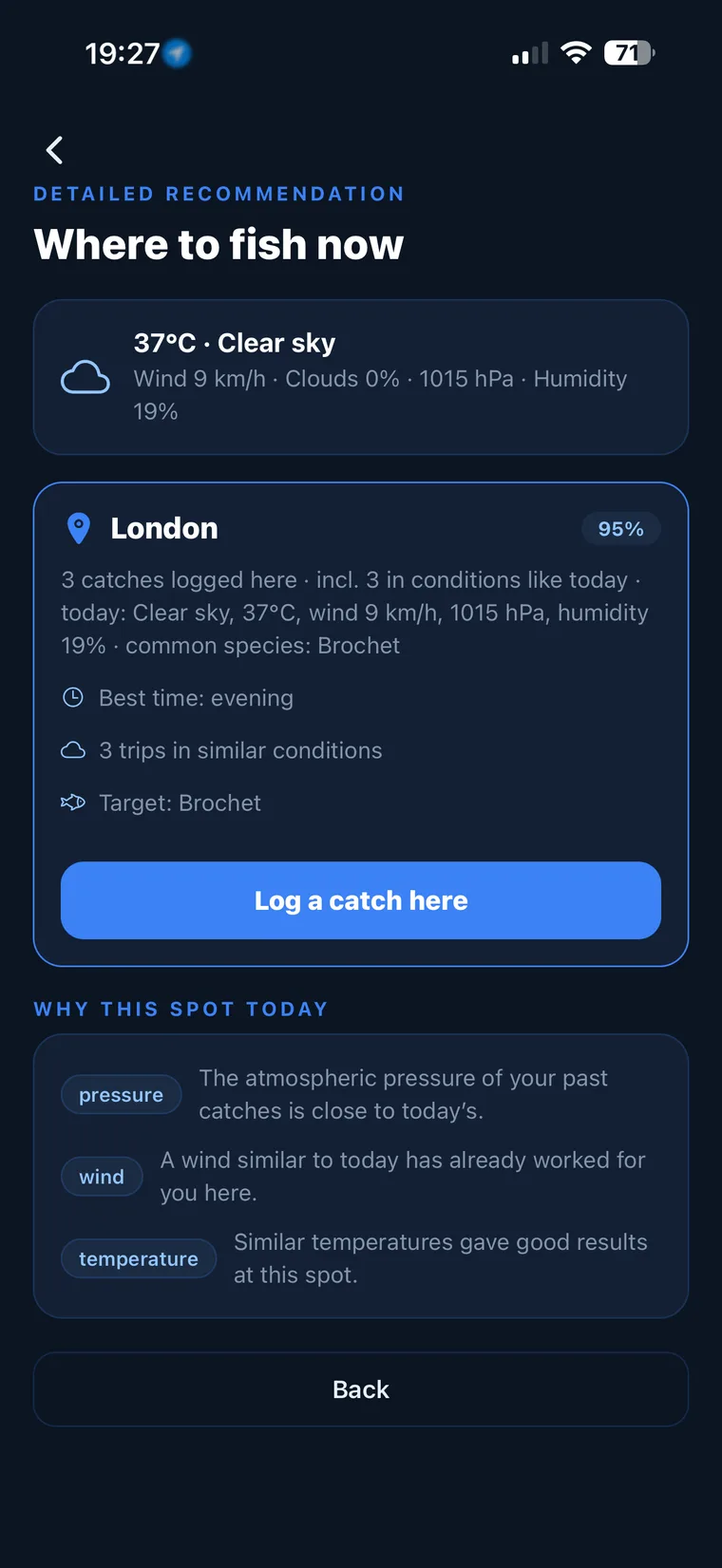
Not sure what to tie on?
Photograph your spot: CarnaFish reads the scene, cross-checks the conditions and gives you the zone, the lure and the retrieve. Free on iOS and Android.
The lures that work on it
The rig is at its best with lures that have moving appendages, because that is exactly what it showcases: craws, creature baits, big flat-tailed worms. A Zoom Brush Hog or a Strike King Rage Craw come alive on it in a way they never do on a bullet pressed against the hook.
Paddle-tail shads also work, particularly for searching with slow drags, but the gain is smaller: their tail already works on its own.
Avoid very slim, very soft lures on a long wire: they wrap around the wire on every cast and you reach the bottom with an unusable rig.
Tokyo Rig or Carolina rig
Both offset the weight, but not in the same way. The Carolina rig puts the weight on the main line, with a soft leader of fifty centimetres to a metre. The lure is completely free, but you lose direct contact: you fish in long drags, over open zones, covering ground.
The Tokyo Rig does the opposite: rigid link, short distance, maximum precision. You do not cover water, you work a spot. On an isolated brush pile or a bridge piling, a Carolina is unmanageable while the Tokyo drops to the centimetre.
Against a Texas rig, the difference is the lift: the Texas gets through dense vegetation better, the Tokyo presents better as soon as there is bulk underneath the lure. And if you want an even more static spot rig, the VMC Neko Rig plants the lure in the bottom instead of lifting it off.
Our beginner's guide to bass fishing puts these rig families in perspective. And if you are unsure what weight to use in front of a brush pile, CarnaFish analyses a photo of the spot and answers.
Key takeaways
- The weight hangs at the end of a rigid wire: the lure stays free, five to eight centimetres off the bottom.
- Excellent bottom contact, better than a sliding bullet, with spot precision to the centimetre.
- Two or three small weights stacked up produce an effective clicking in stained water.
- A rig built for lures with appendages: craws, creature baits, big worms.
- A spot rig, not a search rig — the Carolina is still better for covering ground.
FAQ
What is a Tokyo Rig?
It is a rig where the weight is fixed to the end of a short metal wire attached to the hook's ring. The lead holds bottom while the lure, mounted above, stays free to move five to eight centimetres up.
What weight should you use?
3.5 to 7 g on a shallow margin, 7 to 10 g between three and six metres, up to 14 or 21 g on a windy drift or with a big lure. The weight must touch down definitively while still being liftable with the wrist.
Can you shorten the wire?
Yes, with pliers. A short wire for a lure just off the bottom and fish pinned down, a long wire to raise it and make it visible from further away in stained water.
Which lures should you rig on it?
Ones with moving appendages above all: craws, creature baits, big flat-tailed worms. Very slim, very soft lures are to be avoided, as they wrap around the wire on the cast.
Does the Tokyo Rig get through timber?
Far better than a jig head, provided you use a Texas hook with the point buried. The weight, offset below the lure, threads between the branches and stops the lure's body wedging.
How does it differ from a Carolina rig?
The Carolina links weight to lure with a soft line and is made for covering large open zones. The Tokyo Rig uses a short, rigid link: less ground covered, but far better precision and feel.
The full bass lure guideSeason-by-season strategy: which family of lure, when, and why.Go from theory to fish
CarnaFish reads your spot from a photo and gives you the game plan: zone, lure, retrieve. Free on iOS and Android.