6th Sense FlipGill 3.8: the creature bait shaped like a small panfish
This lure shines under specific conditions. CarnaFish tells you in 10 seconds if today is one of them.
July, three in the afternoon, a raft of floating timber jammed up against a lily pad field. You know there is a fish under it, and you know it because there is no other shade for a hundred metres. The problem is not finding the fish, it is getting something into that tangle without snagging everything, and then sinking a bait credible enough that a fish parked there for two hours decides to move. The 6th Sense FlipGill answers that problem from an unusual angle: instead of a bouquet of appendages, it offers the silhouette of a small panfish.
A profile that changes how the bait reads
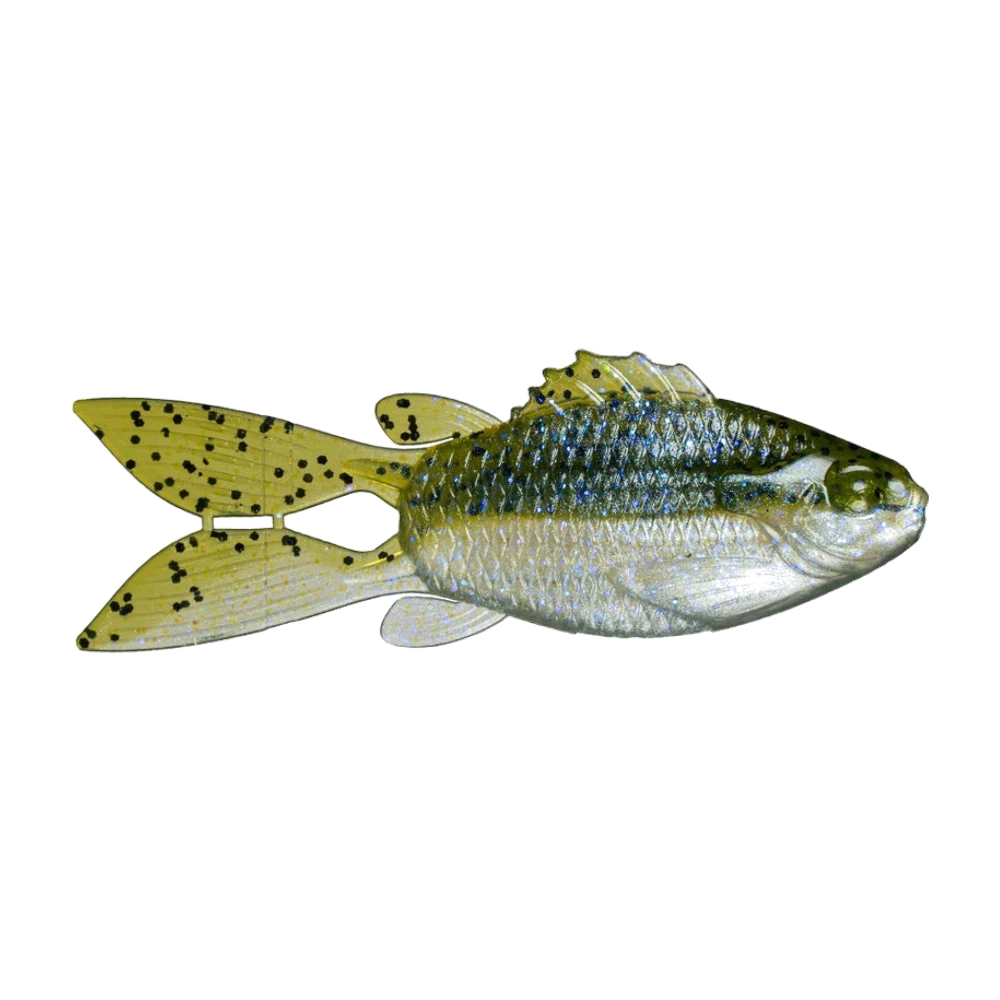
Most flipping baits imitate a crawfish or an undefined creature — big, with claws and arms that flap. The FlipGill starts from a different idea. Under cover, a bass does not only run into crawfish; mostly it runs into young panfish, bluegill, pumpkinseed and assorted fry that take shelter in exactly the same place it does. So the bait takes that shape, oval and tall, with sculpted fins and fine finishing detail.
This is not just about looks. A tall, flat body behaves nothing like a cylindrical body with appendages. It presents more surface to the water, so it brakes harder, so it glides. Where a Reaction Innovations Sweet Beaver drops fast and straight, trusting its compact bulk, the FlipGill sinks more slowly and slides off to one side as it goes. On a fish that is barely feeding, that longer fall is sometimes the only thing that was missing.
A thin body that goes into cover and back out
The second technical point is thickness. The body is deliberately slim seen head-on, which lets it slip between two stems, push through the edge of a mat and — the detail everybody forgets — come back out without dragging half the vegetation with it. A bait that goes in nicely but collects everything on the way up costs you a serious amount of time, and worse, leaves you fishing a spot you have already wrecked.
Concretely, that allows tight pitching under a low branch, inside a metre, on a flat trajectory with a quiet entry. And when the cover is genuinely closed up, punching becomes possible: heavy weight, the bait pushes through the mat under its own mass and ends up in the shade, where nobody else is fishing.
Always count the fall under your breath, even in a metre of water. Under a mat, the bite comes almost always on the way down, not afterwards. If you have not counted, you do not know whether your bait reached the bottom or is lying on a stem halfway down — and in the second case you are fishing beside the fish without knowing it.
The split tail, the bait's real adjustment
This is the most interesting quirk of the FlipGill, and the one plenty of anglers leave alone. The tail comes out of the pack as a single forked, tapered piece. You can separate it with a fingernail or a pair of scissors, and the two large fins then become independent, fluttering and undulating separately at the slightest movement of the rod tip.
So you have two baits in the same pack.
- Tail intact: compact profile, faster and straighter fall, better penetration through dense cover. That is the punching configuration.
- Tail split: far more movement in place, slowed fall, visible action even when the bait is sitting still on the bottom and all you are doing is shaking the slack. That is the configuration for a wary fish, or for a spot you intend to work for a long time.
Try both on the same piece of cover before you conclude the fish are not there.
Rigs and weights
The FlipGill is made for a stout flipping hook, point tucked back into the bait's back in a Texas rig. On a 9.7 cm body, a 3/0 or 4/0 wide gap covers it well, and above all it has to be rigid enough not to open up when you drag a fish out of a clump of lily pads. This is the last place to economise: a soft hook on this fishery costs you one fish in three.
Choosing the weight
- 7 to 10 g: sparse reed edges, light dead timber, fishing in under a metre of water. The bait keeps its gliding fall.
- 10 to 14 g: moderate cover, scattered lily pads, fishing down to two metres.
- 14 to 21 g: punching into a closed mat. At that point you are no longer after finesse, you are after getting through.
Peg the weight against the bait for punching, and leave it free when you want some separation and want the bait to glide after it hits bottom. Tungsten beats standard lead on this fishery: at the same weight it is more compact, so it punches through better and transmits bottom information more clearly.
The classic mistake
Fishing this bait too fast. A creature bait with a panfish profile does not work on a continuous retrieve, it works on the fall and in place. The reflex to break is making two pulls and then reeling in to cast somewhere else. Drop the bait, wait, shake it in place for ten seconds, lift it twenty centimetres, drop it again. A target two metres square can deserve three minutes.
Not sure what to tie on?
Photograph your spot: CarnaFish reads the scene, cross-checks the conditions and gives you the zone, the lure and the retrieve. Free on iOS and Android.
Colours by water and cover
- Clear water: a natural bluegill tone, barred flanks and blue-green shading. Since the whole point of the bait is its panfish silhouette, you may as well finish the imitation when the fish can see properly.
- Stained water: a plain or lightly flaked green pumpkin, the safe bet in moderately dirty water, readable without being loud.
- Under thick cover or in dirty water: black and blue. Under a closed mat it is nearly dark, and only the silhouette counts.
When to tie one on
This is a warm-season, shallow-water bait. As soon as the water warms and fish push up onto the banks, into cover and over the shallow flats, it starts to make sense. In cold water on deep fish it has almost no use: a Megabass Sleeper Gill for bottom work, or a standard shad, will be far more logical. Using it on sighted fish also depends on local regulations and the open season, something to check before you set out.
That still leaves the question of where the useful cover actually is on water you do not know — and that is precisely what CarnaFish saves you: photograph the spot and the AI suggests the zone, the depth and the presentation that fit the day's conditions. To get better at that reading yourself, our guide to reading a fishing spot goes through the signs to look for when you arrive at the water.
Key takeaways
- A small panfish profile, tall and flat, that glides on the fall instead of dropping straight like a compact creature bait.
- The slim body goes into cover and, more importantly, comes back out without tearing everything loose, which preserves the spot.
- The tail can be split to free two independent fins, which gives you two different baits in the same pack.
- A fall-and-sit bait: if you work it continuously, you miss the whole point of it.
FAQ
Should I split the FlipGill's tail?
Not every time. Keep it intact for punching into a dense mat, where you want a fast fall and a compact profile. Split it when you want maximum movement in place on a wary fish, or on a target you intend to fish for a long while.
What sinker weight should I use?
7 to 10 g in light cover to keep the gliding fall, 10 to 14 g in moderate cover, and 14 to 21 g to punch through a closed mat. Tungsten is more compact at the same weight, so it penetrates better.
What hook suits a 9.7 cm bait like this?
A wide gap flipping hook in heavy wire, 3/0 or 4/0 depending on the model. Stiffness matters more than the exact size, because on this fishery a hook that opens up in vegetation costs you fish directly.
Is the FlipGill any use for pike or perch?
That is not what it is for. This is a flipping bait designed for bass in cover, worked very slowly. For pike or perch, more mobile families that are easier to cover water with will be considerably more effective.
How is it different from a standard creature bait?
The shape and the fall. A Missile Baits D Bomb and its appendages displace more water and drop more decisively, while the FlipGill bets on a panfish silhouette and a gliding descent, slower and more lateral.
How many baits per pack?
Six. That is not many for a cover fishery where baits get chewed up, so plan on carrying several packs if you fish dead timber or dense vegetation regularly.
The full bass lure guideSeason-by-season strategy: which family of lure, when, and why.Go from theory to fish
CarnaFish reads your spot from a photo and gives you the game plan: zone, lure, retrieve. Free on iOS and Android.