Booyah Boo Jigs: the thick-skirted jig built for wood
This lure shines under specific conditions. CarnaFish tells you in 10 seconds if today is one of them.
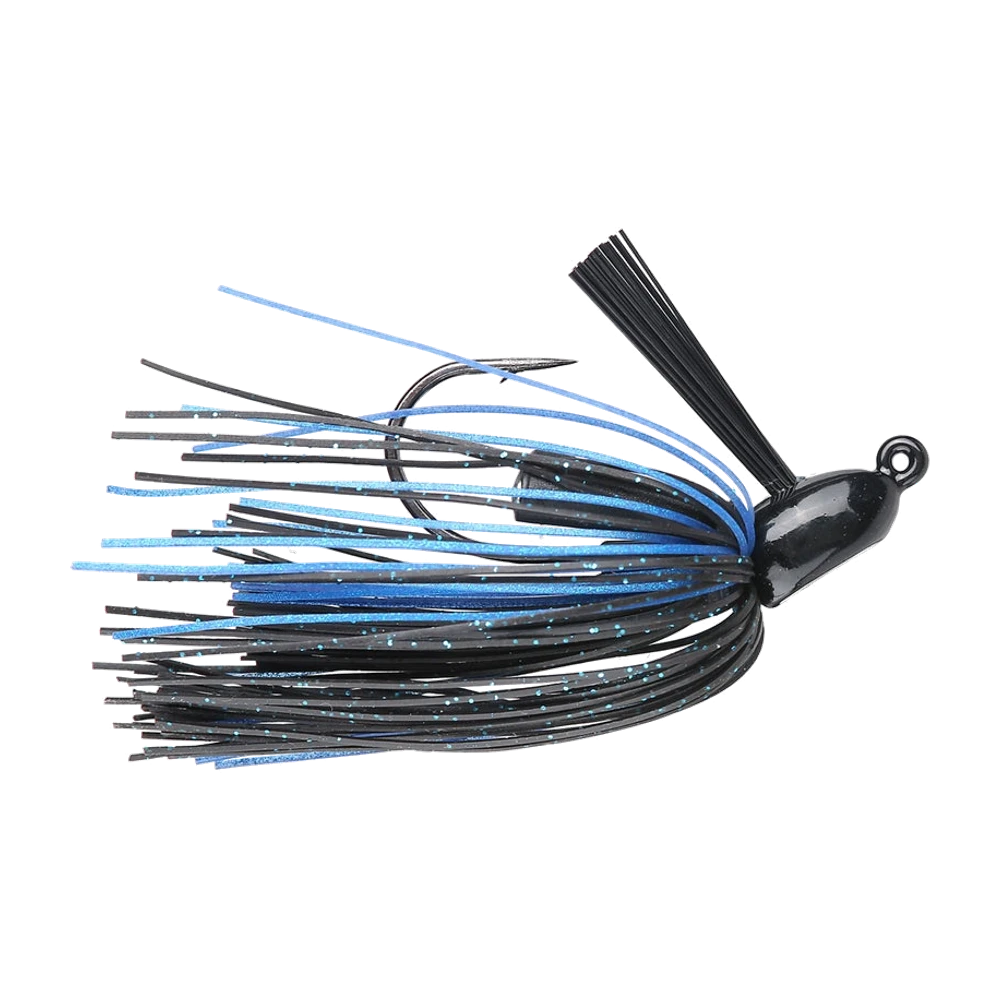
A laydown in two metres of water, three main limbs reaching out toward open water and a tangle of small branches around the trunk. You know a fish is in there. Getting it to bite isn't the problem — getting a bait in and back out is. That's exactly the brief the Booyah Boo Jig answers: a head shaped to slide through, a generous weedguard, and a hook strong enough to drag a fish out of the mess.
A head that slides instead of wedging
The detail that matters most on this jig is invisible until you set it next to another one: the head is moulded right up to the line tie, and that eye sits inline with the hook shank. There's no little step between lead and eye, no pocket for a twig or a strand of grass to catch in. When the jig touches a branch, it slides over it and keeps falling instead of stopping dead.
The inline eye also changes how the bait reacts when you pull. With a 60 or 90 degree eye, the pull lifts the nose and rotates the head. Here it works along the axis, so the jig backs out of itself and usually clears the cover without force. That's a deliberate choice: the Boo Jig is a wood and structure jig, not a bare-bottom dragging jig. For combing thirty metres of rock flat, a football head like the Strike King Tungsten Football Jig still makes more sense.
Fifty strands of silicone, and a pair of scissors
The skirt runs 50 strands of Bio-Flex silicone, and that is a lot. Straight out of the pack it's dense, it carries volume, and it slows the fall. Booyah is upfront about it: fish the jig as it comes, or trim it however you like. Both options make sense depending on the season.
In cold water a full skirt is an asset. It brakes the drop, gives a fish time to come and look, and on the pause it keeps moving on its own in the slightest current. In midsummer on active fish, that same density becomes a drag: the jig falls too slowly, you burn time on every target, and the bulk sometimes puts off smaller bass that can't get it in their mouth.
Trimming the skirt without ruining it
Only two cuts are worth making. The first is a length cut: shorten the strands so the skirt barely passes the hook bend. The jig gets more compact, the profile tighter, and your hook-up rate climbs noticeably because a fish that engulfs the skirt finds the hook straight away.
The second is thinning: pull about fifteen strands, taking them from all around rather than cutting one clump, so the skirt stays even. The jig gains fall speed and loses that broom effect that folds back over the hook on every cast. Work in stages and fish between cuts — you can always remove strands, never put them back.
Removable rattles, a real setting rather than a gimmick
A double rattle capsule is attached to the collar that clamps the skirt, and Booyah points out that it comes off. Sound is the last variable you adjust on a jig, and it's often the one that settles a tough day. In stained water the noise helps: it gives a reference point to a fish hunting on its lateral line long before it sees anything. In clear water, on bass that have already been fished, that same noise is an alarm. Pulling the capsules takes ten seconds with pliers.
Keep two identical Boo Jigs in the box, one with rattles and one without. After two refusals in a row on a spot you know holds fish, swap jigs before you swap colour: nine times out of ten it's the sound, not the shade.
How to work it, concretely
A structure jig isn't retrieved. You put it as tight to the cover as you can, watch the line through the fall — that's where the big majority of bites come — then let it sit on the bottom for a second or two. Only then do you lift it twenty or thirty centimetres and let it drop back. Three or four cycles per cast is plenty: if the fish is there, it has already reacted.
The fall should be controlled, not free. Keep light contact, enough to feel the jig touch a branch, not enough to stop it falling flat. On a completely slack line it noses over and lands with the skirt crushed; held too tight, it pendulums back toward you and leaves the strike zone.
The mistake that costs the most fish
Setting the hook on feel. On a jig dropped into wood, the first thing you feel is almost never a fish: it's a branch, a rock, the skirt folding. The real signal is different — weight that appears and doesn't go away, or a line that moves off sideways. Give half a second, take up the slack, and only then set hard with a long sweep. The 30-fibre weedguard runs well past the hook point and needs a firm set to collapse.
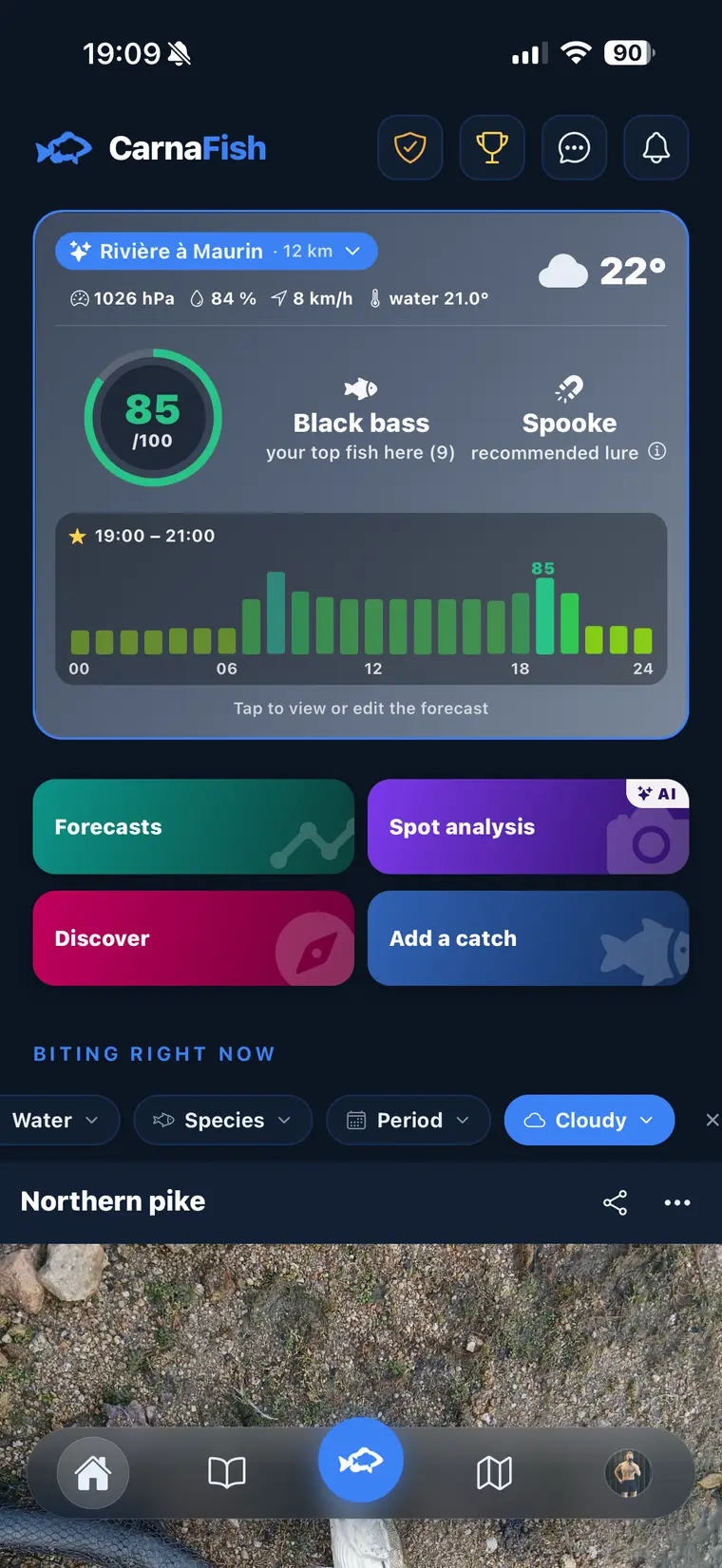
Not sure what to tie on?
Photograph your spot: CarnaFish reads the scene, cross-checks the conditions and gives you the zone, the lure and the retrieve. Free on iOS and Android.
The trailer, and the keeper that holds it
A barb is moulded straight onto the shank to lock the soft plastic in place. That's what prevents the classic jig annoyance: a trailer that creeps down toward the bend after three casts and throws the whole package out of balance.
Choose the trailer by fall speed rather than by imitation. A craw with big flat claws, like the Strike King Rage Craw, brakes the drop and kicks all the way down: ideal in cold water or on a lethargic fish. A compact chunk or a short double tail lets the jig sink fast, which you want when you're hitting twenty laydowns in a row. Same logic as on a Berkley PowerBait Flippin' Jig: the trailer sets the tempo, the head sets how well it clears cover.
For line, 30-40/100 fluorocarbon in clear water for stealth and abrasion resistance, braid in 15-20/100 as soon as you're in heavy wood and the fish has to come out fast. The big round bend Mustad UltraPoint hook with its 18 degree bend takes it all without flexing — the line gives first.
Colour by water and bottom
- Stained water or low light: Black Blue, the classic. The silhouette reads clean, and the blue gives just enough contrast for a fish to frame its strike.
- Clear water over vegetation: Green Pumpkin, which passes for a crawfish or a small sunfish and never gives the bait away to a wary fish.
- Rock and rubble bottom: browns and oranges, matching the real colour of crawfish around a moult.
A jig is a slow bait, and that's its limit: you need to know where the fish is before you cast. That's exactly what CarnaFish makes easier — a photo of the spot, and the app suggests the zone and the kind of presentation that fits the day's conditions. For tackle and typical bass targets, our beginner's guide to bass fishing covers the rest. And when you need to cover water before slowing down, a blade bait like the Booyah Covert Spinnerbait does the scouting the jig then cashes in.
Key takeaways
- The head moulded right up to the inline eye is what lets the Boo Jig slip through wood without wedging.
- A dense 50-strand skirt as it comes, worth shortening and thinning as soon as fish turn active.
- The rattles come off in ten seconds — that's a genuine setting in clear water.
- Bites come almost always on the fall, tracked on a lightly tensioned line.
FAQ
What Boo Jig weight should I start with?
The maker doesn't publish a weight chart in its copy, so work from depth. Under two metres and in wood, stay with the lightest head available for a slow fall. Past three metres, or in wind, move up one step to keep contact.
Should I trim the skirt before fishing it?
Not necessarily. In cold water the full factory skirt slows the drop and keeps working on the pause, which is an advantage. Trim it mainly in summer, when you want a compact profile and a faster fall.
What's the point of rattles if you can remove them?
They add a useful sound cue in stained water or on fish hunting from a distance. In clear water and on heavily pressured bass, that same noise pushes fish off — which is why Booyah made them detachable.
Which trailer suits a Boo Jig?
A big-clawed craw if you want to brake the fall and add movement, a compact chunk if you want to get down fast. The keeper moulded on the shank holds both without sliding, and that's the strength of this rig.
Will the Boo Jig come through thick weed?
It's built for wood and rock, not for heavy grass. The 30-fibre weedguard does its job in branches and dock pilings, but a pointed-head swim jig or a topwater bait suits a continuous weed mat better.
Why do I miss so many jig bites?
Nearly always a hookset that's too early or too soft. The weedguard brush runs past the hook point and needs a firm move to collapse it. Wait until you feel solid weight, take up the slack, then set wide and smooth.
The full bass lure guideSeason-by-season strategy: which family of lure, when, and why.Go from theory to fish
CarnaFish reads your spot from a photo and gives you the game plan: zone, lure, retrieve. Free on iOS and Android.