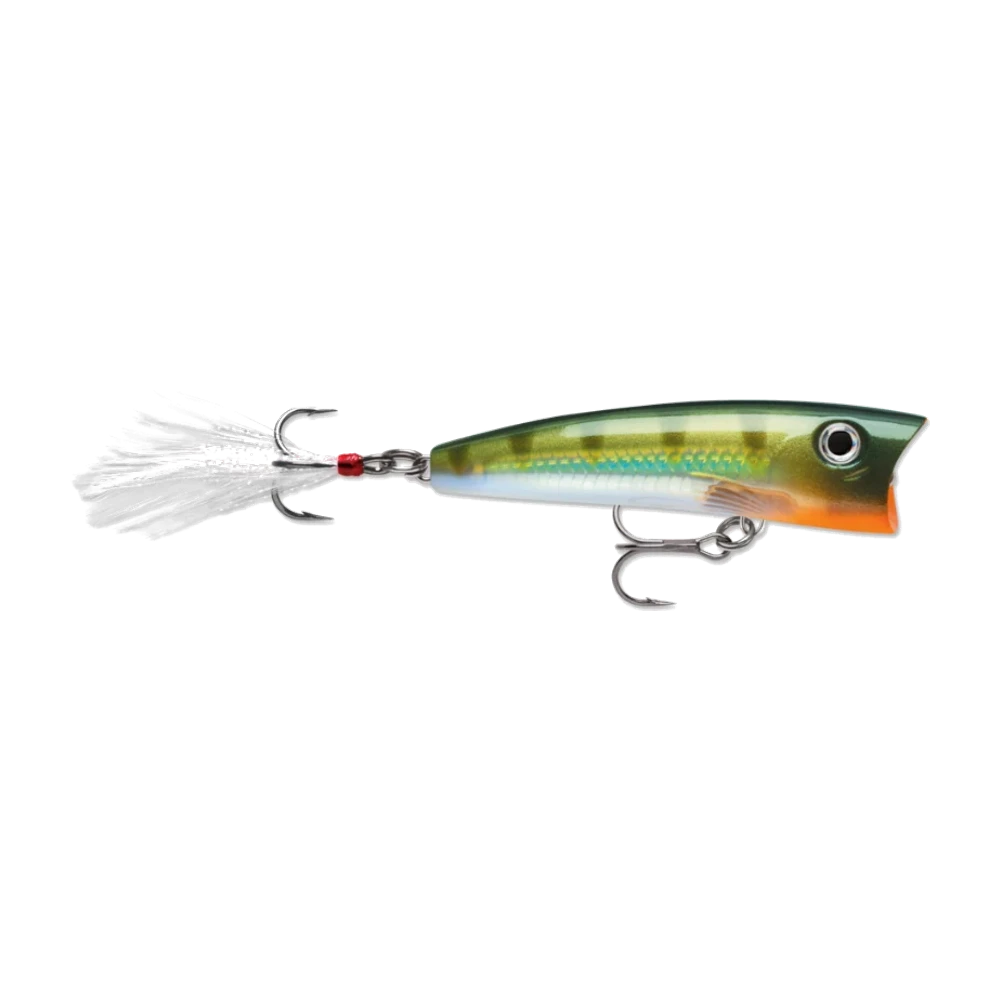
Rapala X-Rap Pop: the popper that still works when the surface gets up
Rather not fish it blind? Photograph your spot — CarnaFish cross-checks the conditions and points you the right way.
There is a precise moment when topwater fishing falls apart: when the breeze gets up and the surface goes from mirror to chop. Small, discreet poppers keep working, but nobody sees them any more. The spray is lost in the ripple, the noise drowns in the background noise, and you spend an hour working a lure the fish never located.
That is exactly the X-Rap Pop's window. Its wide cupped mouth and its weight give it enough to throw a spray that stays readable on a broken surface, and enough to reach the zone when a headwind cuts ten metres off your casts.
This is not a finesse lure. It is a calling lure, and it has to be fished as one.
A spray that stays readable in the chop
The X-Rap Pop works on three simultaneous signals, and it is their combination that makes it findable when the surface is moving.
The column of water it throws. The wide mouth shifts real volume on every pull. Where a compact popper sends up a fine vertical spray, this one lifts a sheet of water that falls back producing an echo visible from several tens of metres.
The deep sound. The cup of the mouth traps air at the moment of impact. The plop is low, it carries well underwater, and it does not blend into the ambient slapping — a fish sitting in three metres of water hears it.
The rear feather. As on many Rapala poppers, the tail treble is dressed. During the pauses the body is locked on the surface but the fibres keep breathing. It is the only movement available at the moment the fish decides.
The retrieve: two rhythms, not one
Plenty of anglers reflexively apply one rhythm all day. On this lure the state of the surface dictates the action, and there are two very different modes to know.
Calling mode, broken surface:
- Cast beyond the zone you want to cover, rod tip pointed at the water.
- Link three to five close-spaced pops, roughly one every half turn of the handle, keeping the line tight between each.
- Hold a pause of only one to two seconds, just long enough for the lure to settle.
- Go straight back into a new series. You are not after stealth, you are after being located.
Decision mode, calm surface:
- Cast and let the rings disappear, five to eight seconds.
- One clean, isolated pop, wrist only.
- Pause of three to four seconds, touching nothing.
- Two pops very close together, then a dead stop if a fish has followed without committing.
On the water: when a fish misses the lure on the surface, do not strike and do not cast again. Leave the popper still for three seconds at the exact spot of the miss, then give one tiny pop. In one case out of two the second attack is the one that sticks — casting again immediately costs you the fish every time.
Settings by venue
| Situation | Suggested line | Rhythm | Colour |
|---|---|---|---|
| Shore bass, rock, crosswind | 0.12-0.15 mm braid + 1 m of 0.35 mm fluoro | Fast series of 4-5 pops | Blue or silver-green back |
| Estuary bass, coloured water | 0.14 mm braid + 0.35 mm fluoro | Slow, well-spaced pops | White or chartreuse |
| Bass on a pond, edge of weed | 0.30 mm fluoro straight through | Isolated pop, long pauses | Natural translucent |
| Bass, overcast sky, green water | 0.30 mm fluoro straight through | Alternate 2 pops + pause | Dark back, light belly |
Two tackle points really matter. A rod of at least 2.30 m lets you keep line off the water and steer the lure without the waves taking over. And a rod tip pointed down throughout the retrieve: work it with the tip high and every pull makes the lure jump instead of digging in.

Not sure what to tie on?
Photograph your spot: CarnaFish reads the scene, cross-checks the conditions and gives you the zone, the lure and the retrieve. Free on iOS and Android.
Where it is at its best, and where it is useless
It excels on:
- Shore bass in churned-up water, over rocky plateaus at half flood, when the feeding is scattered and you need to call from a distance.
- Long pond margins with no obvious spot: the lure works as a detector, you cover water fast and you locate fish.
- Summer evenings, when surface activity starts and the area to sweep is wide.
It is unsuited to:
- Small, clear, calm waters where the volume of water displaced sends fish running. There, a compact popper does better.
- Cluttered spots under two metres wide: the lure needs a run to express its rhythm, it is not something you sneak under a branch.
- Cold water, below 12-13 °C, where surface activity collapses and a diving lure takes back every advantage.
X-Rap Pop or a compact popper
The choice is not about lure quality but about how much water you have to cover. A Megabass Pop-X is a precision tool: small volume, fine spray, educated fish on mirror water. The X-Rap Pop does the opposite — it announces itself from a distance and tolerates a broken surface the other cannot handle.
The Rebel Pop-R sits in between in freshwater, with a slimmer profile and a sharper noise. And when fish are clearly present on the surface but refusing the popper, a walking stickbait such as the Lucky Craft Gunfish 115 offers continuous sideways movement, quieter, which often tips followers over.
Our guide to sea bass fishing with lures details the tide windows where topwater beats everything else. And if you are unsure what size popper to reach for when you get to the bank, CarnaFish analyses a photo of the spot and answers.
Key takeaways
- A calling popper: wide mouth, deep sound, built to stay readable in chop.
- Two distinct rhythms — fast series when it is moving, isolated pops and pauses when it is calm.
- Rod tip down throughout the retrieve, or the lure jumps instead of digging in.
- After a miss, leave the lure still for three seconds before starting the action again.
- Too loud for a small, clear, calm water, and useless below 12-13 °C.
FAQ
Is the Rapala X-Rap Pop suitable for shore fishing for sea bass?
Yes, that is one of its best grounds. Its weight lets you cast properly into the wind and its wide spray stays visible on a churned-up surface, which is the normal situation on a rocky plateau on the flood.
Should you fish it straight through or with a leader?
In freshwater, 0.30 mm fluorocarbon straight through is enough and keeps the action simple. In the sea, go to fine braid with about a metre of 0.35 mm fluorocarbon: you gain casting distance and abrasion resistance on rock.
Why does my popper jump instead of throwing water?
Because you are working it with the rod tip high. Point the tip at the surface and make the pull with the wrist alone: the pull becomes horizontal, and the mouth digs into the water instead of pulling the lure skywards.
How long should you wait between two pops?
It depends on the surface. On broken water, one to two seconds is enough because you are trying to get located. On calm water with wary fish, go up to three or four seconds: the decision is made during the pause.
Should you strike as soon as you see the rise?
No, that is the classic surface mistake. Wait until you feel the weight of the fish in the line before striking, then follow through without a violent jerk. Striking on sight rips the lure out of the mouth one time in two.
What colour should you choose in the sea?
A blue or green back with silver flanks covers most situations on clear water. Switch to white or chartreuse when the water is coloured after a blow, and to a more translucent tone in bright sun on a flat calm sea.
The full sea bass lure guideSeason-by-season strategy: which family of lure, when, and why.Go from theory to fish
CarnaFish reads your spot from a photo and gives you the game plan: zone, lure, retrieve. Free on iOS and Android.