Evergreen JT-: the silent walking bait for pressured water
The right lure in the wrong spot still catches nothing. CarnaFish spots the zone that works, from a single photo.
On water that gets fished every weekend, topwater stops working after a few seasons. Not because fish no longer come up, but because they have learned to associate a rattle with danger. That is exactly the reasoning behind this walking bait: Evergreen describes it as completely silent and ties it explicitly to the balsa stick baits of the early years of American tournament fishing, which made no noise at all because rattle technology did not yet exist.
A name that needs clearing up
First point to settle before the numbers, because it causes confusion at the point of ordering. This bait is listed by some retailers as the JT- Topwater Walking Bait, but the manufacturer's description and its spec table call it something else: Justine, in a Justine 95 and a Justine 115. The text also notes the bait was inspired by Evergreen staff member Justin Kerr.
In that kind of situation the spec table is what counts, not the shelf label. So remember two versions, 95 and 115, and check the listed length when you buy rather than trusting the trade name alone.
The two sizes, and what really separates them
The table gives: 3-3/4 in, or 9.5 cm, at 3/8 oz, or 10.6 g, class topwater for the 95. And 4-1/2 in, or 11.4 cm, at 11/16 oz, or 19.5 g, also topwater for the 115 (1 oz = 28.35 g). The 11/16 fraction is uncommon in the trade and most likely comes from converting a round figure in grams, which is standard practice for Japanese makers.
The gap between the two versions matters more than the numbers suggest. Going from 9.5 to 11.4 cm adds only 2 centimetres of silhouette, but the weight nearly doubles. In practice the 115 casts far further and holds better in wind, while the 95 lands more discreetly and asks less of the rod. From the bank, on calm water, the 95 is often the better pick; as soon as you are in a boat covering ground, the 115 takes the lead.
Silence as a technical argument
The complete absence of a rattle is neither an oversight nor a cost saving, it is a decision, and it cuts both ways.
On the good side: on clear, heavily fished water, a silent bait gets bites where a noisy one makes followers peel off. A bass that has already watched thirty rattling walkers go over its head will follow, close to within twenty centimetres, then refuse. Remove the acoustic signal and you remove the trigger for that refusal. The fish is left judging silhouette and movement only.
On the bad side: a silent bait calls nobody in. You have to put it near the fish. In broken water, on a big lake, or as soon as chop builds, it loses ground to a noisy bait like the Evergreen Amazon Pencil Walking Bait, which plays the exact opposite card with its deep knock. They are complementary tools, not two versions of the same bait.
Silence changes how you fish, not just what you tie on. With a noisy bait you fan casts wide and let the sound do the work. With a mute bait you slow the rhythm of your casts and work on accuracy: every delivery should land within a metre of a piece of cover, an edge or a swirl. This is spot fishing, not search fishing.
Not sure what to tie on?
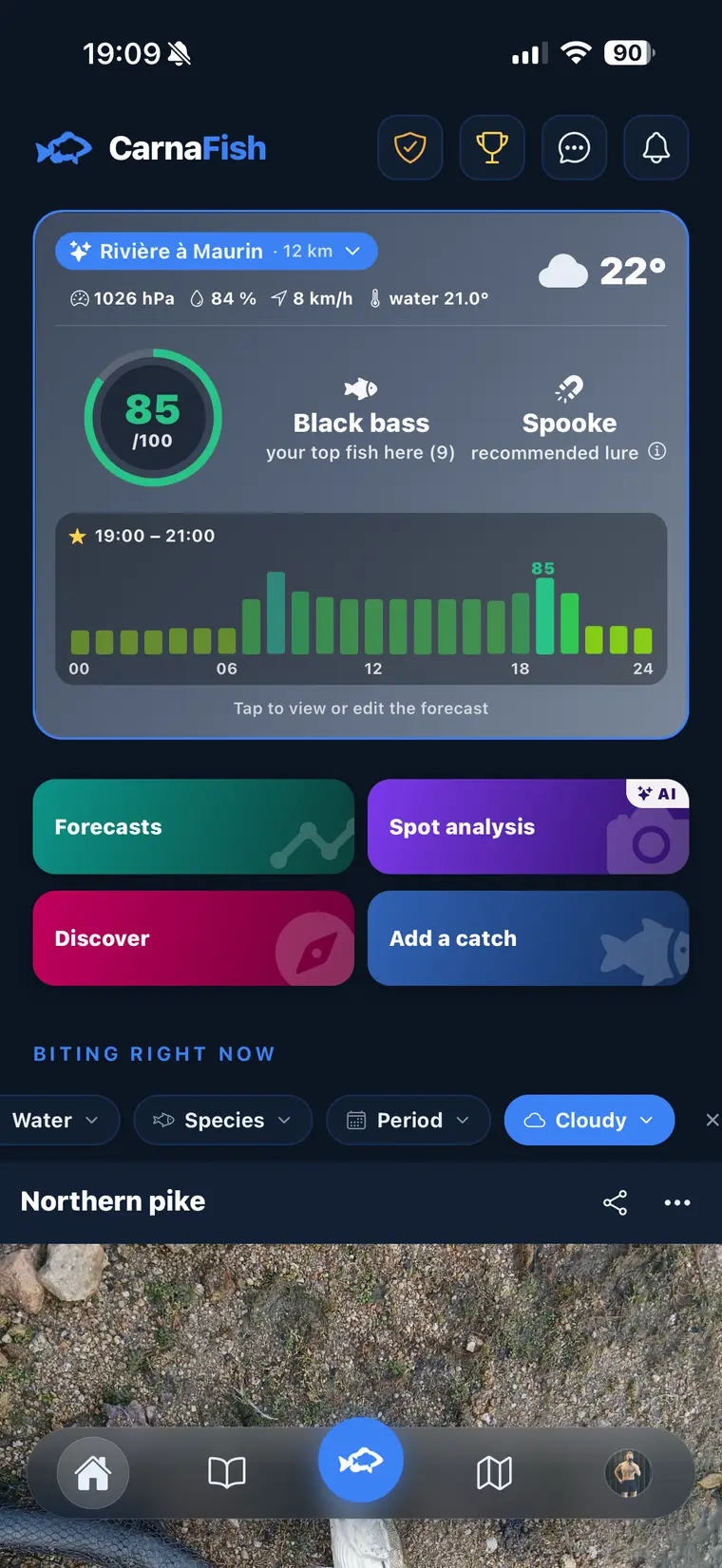
Photograph your spot: CarnaFish reads the scene, cross-checks the conditions and gives you the zone, the lure and the retrieve. Free on iOS and Android.
The 45-degree posture and the fixed weight
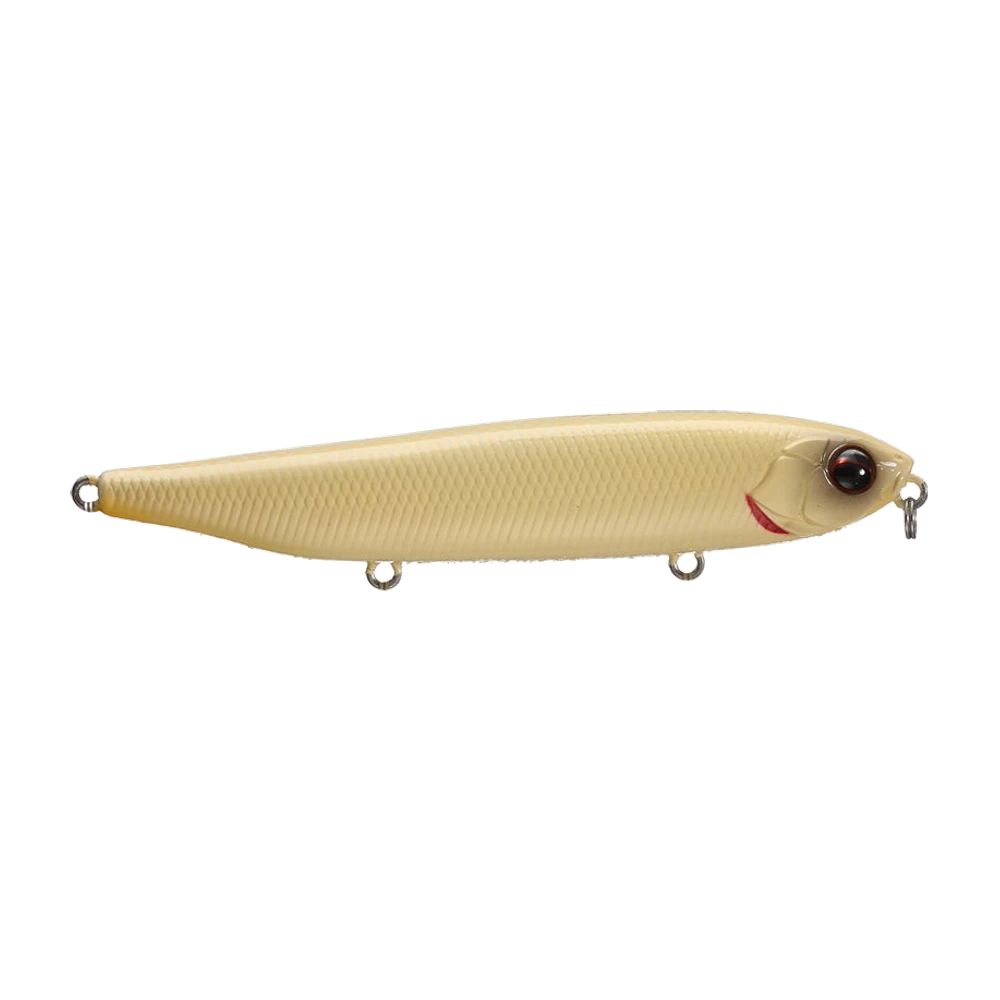
Evergreen states that at rest the bait sits nose-up at 45 degrees. That is not cosmetic: a walking bait hanging near-vertically presents a very different silhouette from one floating flat. A fish holding underneath sees a slim body angled towards the surface, exactly like a struggling baitfish rising for air. That is what you exploit on every pause.
That attitude comes from a fixed internal weighting system, the other technical choice the maker claims. Evergreen credits it with two effects: longer casting distance and reduced rolling, which keeps the trebles straight and ready to bite rather than wrapped around the body. It is worth knowing that this differs from a moving weight-transfer system, which maximises raw distance but shifts the centre of gravity in flight: a fixed weight gives a more constant trajectory and more predictable behaviour on every cast, which counts when you are aiming at a gap between two branches.
Tackle
A medium 1.90 to 2.10 m rod is enough for the 95, and a medium-heavy is more comfortable with the 115 given the near-doubled weight. Thin braid to transmit rod strokes without stretch, and a fluorocarbon leader in the 12 to 20 lb range depending on the size of fish you expect.
The part not to get wrong is the connection: a wide-gap snap or a round split ring, never a knot cinched directly onto the nose eye. On a walking bait this slim, a locked knot immediately cuts the amplitude of the zigzag and can turn a clean walk into a sideways skate.
The classic mistake
Working it too hard. The maker stresses that the walk comes with minimal effort, and you can verify that on the first series: short, soft rod strokes, almost wrist impulses, are enough to send the bait from one side to the other. Pull hard and the body comes out of the water, lands flat and loses its rhythm. Keep the rod tip low, pointed at the water, and let the bait do the work.
Colours by light
- Clear water, low light, dawn: pearl white like the one in the photo, a clean readable silhouette with no aggressive flash, which also doubles as your visual reference for tracking the bait.
- Bright light, clear water: a natural back, ayu or roach style, which does not give the bait away when a fish has time to inspect it under a high sun.
- Lightly stained water: a touch of chartreuse, which restores detectability without tipping into absurd contrast on top.
In the slim, silent walking register, the JT- plays the same tune as a Lucky Craft Sammy 100 or a Megabass Dog-X: compact walking baits built for accuracy more than reach. Against a Heddon Zara Spook, bigger and noisier, it targets a different fish — less active, warier, and usually already pressured.
That still leaves the question of whether fish are actually looking up that day. That is exactly what CarnaFish helps you settle from a photo of the spot, suggesting the zone, the depth and the lure family that match conditions. To build spot and tackle fundamentals, our beginner's guide to bass fishing remains a good entry point.
Key takeaways
- Two versions in the table: 9.5 cm at 10.6 g, and 11.4 cm at 19.5 g, both listed as topwater.
- The maker's description and table call the bait Justine 95 and Justine 115: check the length, not the trade name.
- Total silence: a decisive edge on clear, pressured water, a real handicap as soon as the surface breaks up.
- A 45-degree nose-up rest posture and a fixed weight for contained roll and trebles that stay straight.
FAQ
Why does this bait have two different names?
The manufacturer's description and spec table call it Justine, in 95 and 115 versions, while some retailer listings carry it as the JT- Topwater Walking Bait. Go by the listed length, 9.5 or 11.4 cm, rather than the trade name.
Should I pick the 95 or the 115?
The 95, at 10.6 g, lands more discreetly and suits bank fishing on calm water. The 115, at 19.5 g, casts much further and holds better in wind: it is the logical pick from a boat or on a big lake.
Is a silent bait genuinely more effective?
Not in absolute terms, only in a specific context: clear water, little surface movement, fish that see a lot of pressure. In chop, or on a big lake where you need to pull fish from distance, a noisy walking bait does better. Keep both in the box.
What is the 45-degree posture for?
It gives the motionless bait the silhouette of a baitfish labouring back towards the surface rather than a log floating flat. It is during the pauses, not during the action, that this attitude triggers the bite.
How do I get a consistent walk?
Rod tip pointed at the water, short soft wrist impulses, half a turn of the handle between strokes to take up slack. The maker claims a walk achieved with minimal effort: pull hard and the bait comes out of the water and loses its rhythm.
Should I change the trebles?
Not necessarily, but if you do, stay strictly on the same size. The nose-up attitude depends on a fixed internal weight calculated around a given set of hooks: heavier trebles drop the nose and erase the behaviour that makes the bait interesting.
The full bass lure guideSeason-by-season strategy: which family of lure, when, and why.Go from theory to fish
CarnaFish reads your spot from a photo and gives you the game plan: zone, lure, retrieve. Free on iOS and Android.