Evergreen Bow Worm Noodle: a needle-thin worm for educated bass
Rather not fish it blind? Photograph your spot — CarnaFish cross-checks the conditions and points you the right way.
There are lakes where everyone throws the same baits all year, and where bass end up refusing a normal-diameter worm before they have even watched it work. Not because it is too big in absolute terms — because it takes up too much room. The Evergreen Bow Worm Noodle answers that exact problem with a counter-intuitive geometry: keep the length, which pulls fish from a distance, and delete the volume, which pushes them away up close.
Long on one axis, invisible on the other
The manufacturer's table is unusually short: two lengths, 8 in or 20.3 cm and 12 in or 30.5 cm, with ten pieces per pack for the first and eight for the second. That is all. No weight listed, no class column, so nothing that lets anyone state with certainty whether the body floats, sinks or sits neutral. We will not claim a buoyancy the description does not give: in practice your rig decides, which is probably why the maker leans so hard on the list of rigs.
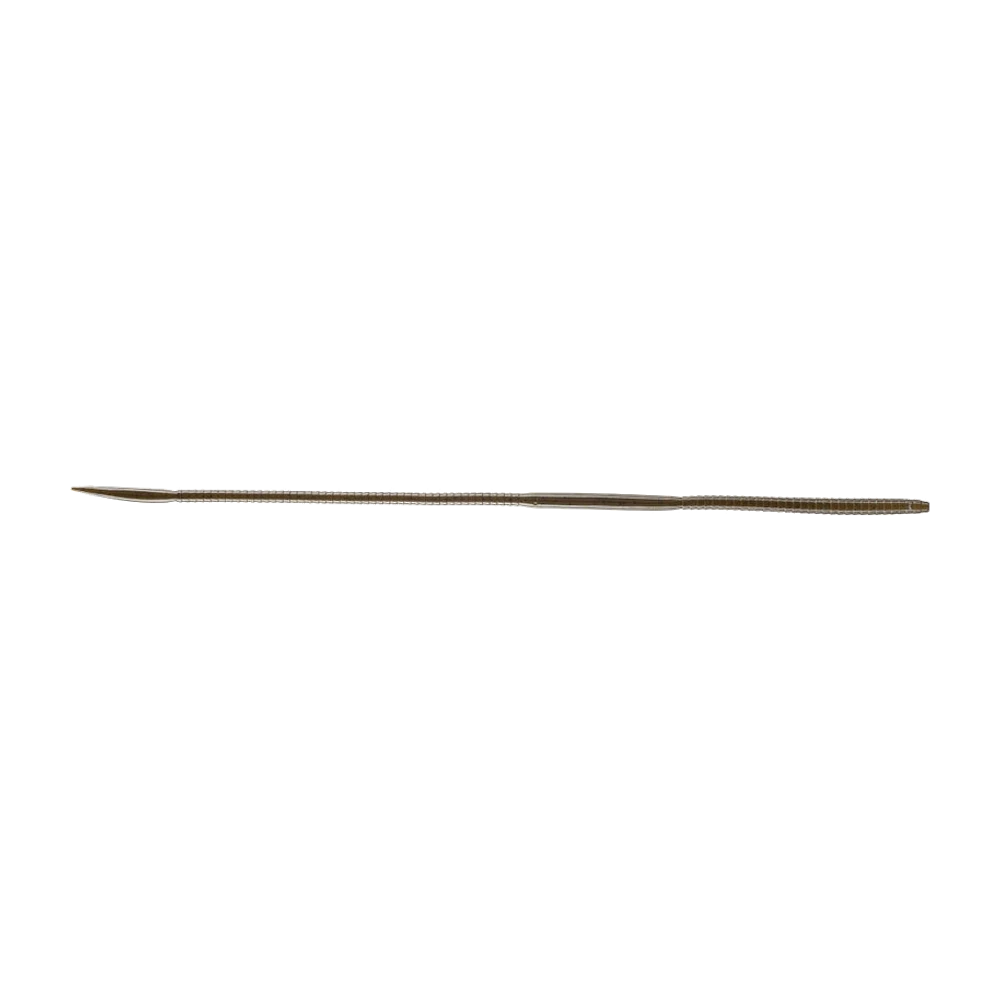
The real data point is in the photo: the diameter. A ribbed body a fraction of the thickness of a normal worm, near-constant over almost its whole length, pointed at one end and squared off at the other. A 30 cm worm that thin weighs almost nothing and displaces almost no water, and that is the whole point. Seen from a distance or side-on, it shows a long silhouette that registers. Seen up close by a wary fish, it presents no alarming mass at all.
What that profile changes in the water
A thin body has no rigidity of its own. The direct consequence: it never holds the same shape for two seconds running. A single twitch of the rod tip sends an undulation down its full length, and even weak current animates it on its own during a pause. The action is disorderly and unpredictable, very different from the even, readable roll of a thick flat-tail worm.
The other side of that thinness, and it deserves to be said plainly: durability. A body this narrow tears at the hook anchor point faster than a normal-diameter worm. On a wacky rig, a rubber O-ring is not a gadget but a requirement if you want more than two or three fish per bait. That is the price of the profile.
Evergreen also claims a scent blend combining shrimp, squid and baitfish. On a slow presentation where a fish has time to hold the bait before you set, that is not a detail: it buys the half-second that turns a refusal into a committed bite.
On heavily pressured spots, do not work it. Cast, let it sink on a tight line, then do nothing at all for a full ten seconds. A worm this thin keeps moving long after your usual bait has gone still — and that dead time is exactly when the bite comes.
Four rigs and what each one is for
Weightless and wacky
The most obvious use for the 8 in. Hooked in the middle, with no weight, it falls flat while both ends undulate at once. Keep it for shallow water and calm conditions: with no mass, casting range is short and wind makes life hard. A light-wire wacky hook in size 1 or 1/0, no bigger, or the weight of the metal crushes the body.
Drop shot
The rig where the length works best, and the only one where the 12 in really earns its place. Nose-hooked 20-40 cm above the weight, those 30 cm of body hang and ripple without you touching anything. On a fish marked on the sonar that is refusing everything, it is the hardest presentation to ignore.
Shaky head
A light 2 to 5 g head, worm hooked through the nose, worked with wrist vibrations that never move the head. The body wriggles in place right on the bottom. Effective over hard, clean bottom, far less so in vegetation where this thin profile tangles.
Carolina
For covering a wide flat while keeping a thin bait behind a heavy weight. The long leader lets the worm drift freely above the bottom while the sinker does the contact work. It is the rig that lets you cover ground without giving up subtlety.
The classic mistake
Rigging this worm on a hook that is too big or too heavy, out of an instinct to play safe on the hookset. An oversized hook on a body this thin does three things, all bad: it kills the undulation by stiffening the anchor zone, it tears the plastic on the first fish, and it weighs down a bait whose whole value is its lightness. Drop one size from your usual choice and compensate with thin braid and a sweeping hookset rather than a sharp strike.
Not sure what to tie on?
Photograph your spot: CarnaFish reads the scene, cross-checks the conditions and gives you the zone, the lure and the retrieve. Free on iOS and Android.
Colours by water and bottom
- Clear water, gravel or rock bottom: Green Pumpkin, the safe pick that blends into nearly every natural substrate without ever standing out.
- Clear water, hard bottom, bright light: a translucent brown like the one in the photo, which passes light and gives a ghostly silhouette rather than a hard outline.
- Stained water or low light: Black Blue, because a thin worm needs strong contrast to stay detectable when visibility drops.
Colour matters less here than on a hard bait: at this diameter, silhouette and movement do the work, and colour only tunes the contrast.
Next to a Zoom Trick Worm or a Roboworm Straight Tail, the Bow Worm Noodle is not playing the same tune: both of those are normal-diameter worms built for a readable roll. The Bow Worm pushes further into subtlety, and pays for it in casting ease and durability. It is a last-resort bait for a fish that has already refused everything else, not a worm to tie on by default in the morning.
Of course you still have to be fishing the right place before you worry about the right worm, and that is exactly what CarnaFish is for: from a photo of the spot, the app suggests the zone, the depth and the type of presentation that match the conditions. To build the finesse and spot-reading fundamentals, our beginner's guide to bass fishing starts from scratch.
Key takeaways
- Two listed lengths, 20.3 cm / 8 in and 30.5 cm / 12 in, ten and eight per pack, with no weight or buoyancy class published.
- A tiny diameter for the length: a silhouette that pulls from a distance, a volume that does not spook up close.
- The body keeps moving long after you stop working it — that is when you should be expecting the bite.
- Light-wire hook and an O-ring on the wacky rig, or the body tears on the first or second fish.
FAQ
Should I buy the 8 in or the 12 in?
The 8 in covers most situations and casts far more easily weightless. The 12 in earns its place mainly on a drop shot or a Carolina rig, where the length hangs and works without you having to propel it.
Does this worm float?
The manufacturer gives neither weight nor buoyancy class in its table, only length and pack count, so there is no way to state it. In practice the rig you choose — weightless, jighead, drop shot — fully drives how it behaves in the water column.
How many per pack?
Ten for the 8 in and eight for the 12 in, according to the manufacturer's table. Given how fragile a body this thin is, that is a count worth putting in perspective over an active day.
Why does my worm tear so quickly?
That is the acknowledged limit of this profile. Use an O-ring on the wacky rig, drop a hook size, and move the hook point a few millimetres rather than re-piercing the same hole after each fish.
Is this a beginner's bait?
No. It demands a slow presentation, fine bite detection and a careful rig. Start with a normal-diameter worm like the Yamamoto Kut Tail Worm, and keep this one for fish that are already refusing everything else.
Can it be fished in weed?
Badly. A body this thin and this long wraps around stems and folds back onto the hook. Keep it for hard bottom, clean breaks and open edges, and switch to a thicker Texas-rigged worm as soon as the vegetation thickens.
The full bass lure guideSeason-by-season strategy: which family of lure, when, and why.Go from theory to fish
CarnaFish reads your spot from a photo and gives you the game plan: zone, lure, retrieve. Free on iOS and Android.