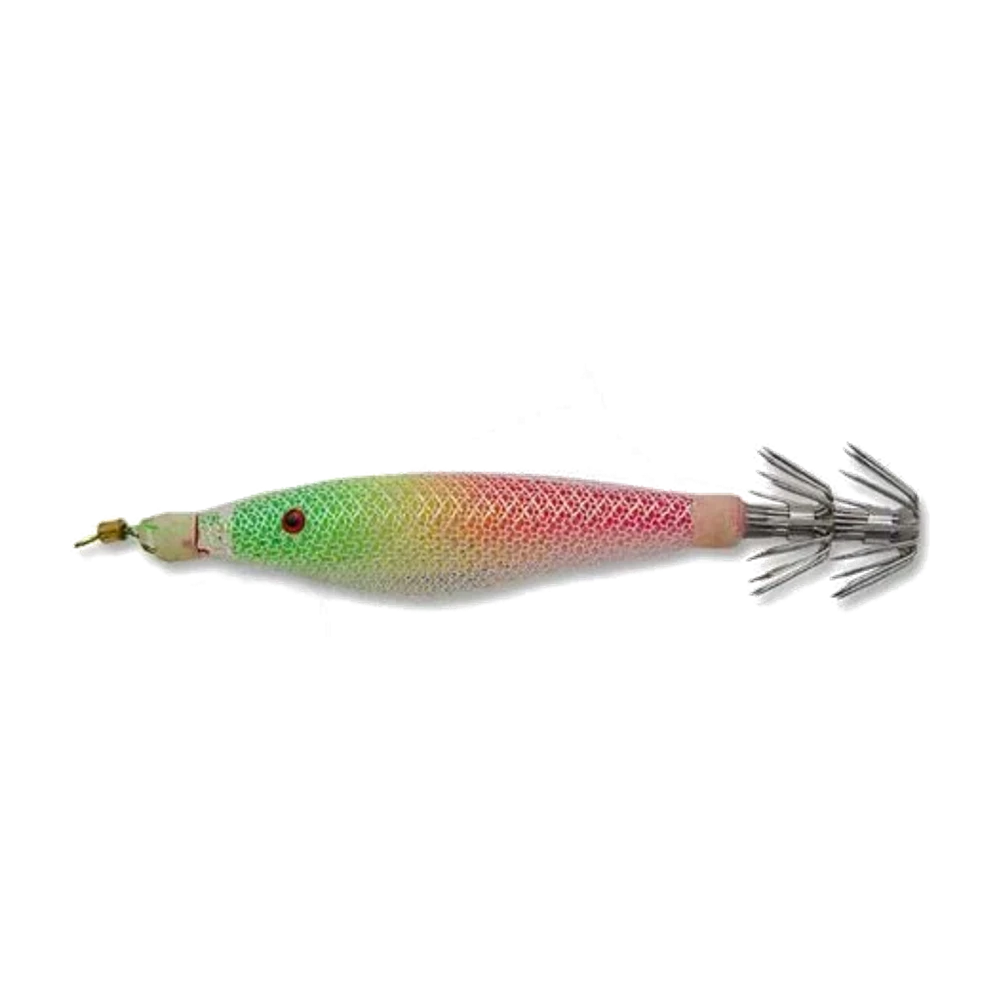
Flashmer Squid Jig: shore eging, where the sink does all the work
The right lure in the wrong spot still catches nothing. CarnaFish spots the zone that works, from a single photo.
A harbour wall in November, night has just fallen, the streetlights lay rings of light on black water. On the concrete, dried ink stains: somebody caught here, and recently. You pull out your usual bass lure and wind it straight back. You will catch nothing — not because there are no fish, but because what is feeding under that halo is not a fish.
Let us be clear straight away: a squid jig is not a bass lure. It is a cephalopod lure, built for cuttlefish and squid, and it is worked nothing like a fish-imitating lure. Confusing the two is the main reason so many anglers buy a squid jig, try it twice, and leave it in the bottom of the box.
This page explains how to actually fish it.
What a squid jig is, and why it has no hook
Look at a squid jig: at the rear it carries one or two crowns of fine pins angled upward, with no barb and no piercing point in the usual sense. That is not a manufacturing saving, it is the whole principle of the lure.
A cephalopod does not attack by biting. It shoots out its two hunting tentacles, grabs the prey and pulls it back against its body, squeezing. The pins do not pierce it: they engage in the suckers and the tissue the moment it hauls the prey in. The practical consequences are all counter-intuitive:
- There is no sharp hookset. A big sweep of the rod tears the soft flesh and loses the animal. You tighten, you lift progressively, and you hold.
- Never give slack during the fight. One second of loose line and the animal frees itself. Set the drag soft and pump slowly and continuously.
- Body attitude matters. The jig must sink with its nose slightly raised and stay stable: that attitude is what puts the crowns in the right place when the animal grabs from behind.
Size and sink rate: the two settings that actually matter
Squid jigs are measured in "go", the traditional Japanese unit. Common sizes run from 2.0 to 3.5, and the number refers to body size, not weight.
| Size | Context | Indicative sink rate |
|---|---|---|
| 2.0 to 2.5 | sheltered harbour, shallow water, wary animals | slow, around 5 to 7 s/m |
| 3.0 | all-round, harbour wall and coast, 3 to 10 m | medium, around 3 to 4 s/m |
| 3.5 | depth, current, wind | fast, around 2 to 3 s/m |
Sink rate is the parameter anglers look at last when it should come first. The cephalopod attacks during the descent, almost never during the jerk. A sink that is too fast gives it no time to commit; a sink that is too slow lets current drift the lure out of the zone.
The cloth wrapping the body and the colour of the base underneath come next: orange or pink base when the water is churned or the light is low, natural base and discreet cloth in clear water by day.
The jerk sequence, step by step
- Cast and let it sink while counting, line semi-tight, down to the bottom or to the depth you have identified.
- Give two to four sharp jerks close together, rod tip up, taking up the slack between each one. The jig darts upward in a zigzag.
- Stop everything and let it drop back. This is the decisive phase. Follow the descent with the rod tip without ever coming properly tight, and count five to fifteen seconds depending on depth.
- Come back into contact. Nine bites out of ten show up here, and never as a thump: the line moves off sideways, or stays inexplicably tight, or the weight you expected has changed.
- Lift progressively, with no sharp snatch, and pump slowly, keeping the line tight the whole way to the net.
If nothing happens after three cycles, change the number of jerks before you change the jig: two soft jerks and three sharp ones produce completely different paths.
On the water: under a harbour streetlight, do not fish the ring of light — fish its edge. Cephalopods hold in the shadow right beside it and hunt the small prey drawn to the light, moving into the lit zone and back out. A jig sinking right on the shadow-light border gets grabbed far more often than one in the middle, and you cannot see it from the wall either — which is exactly right.
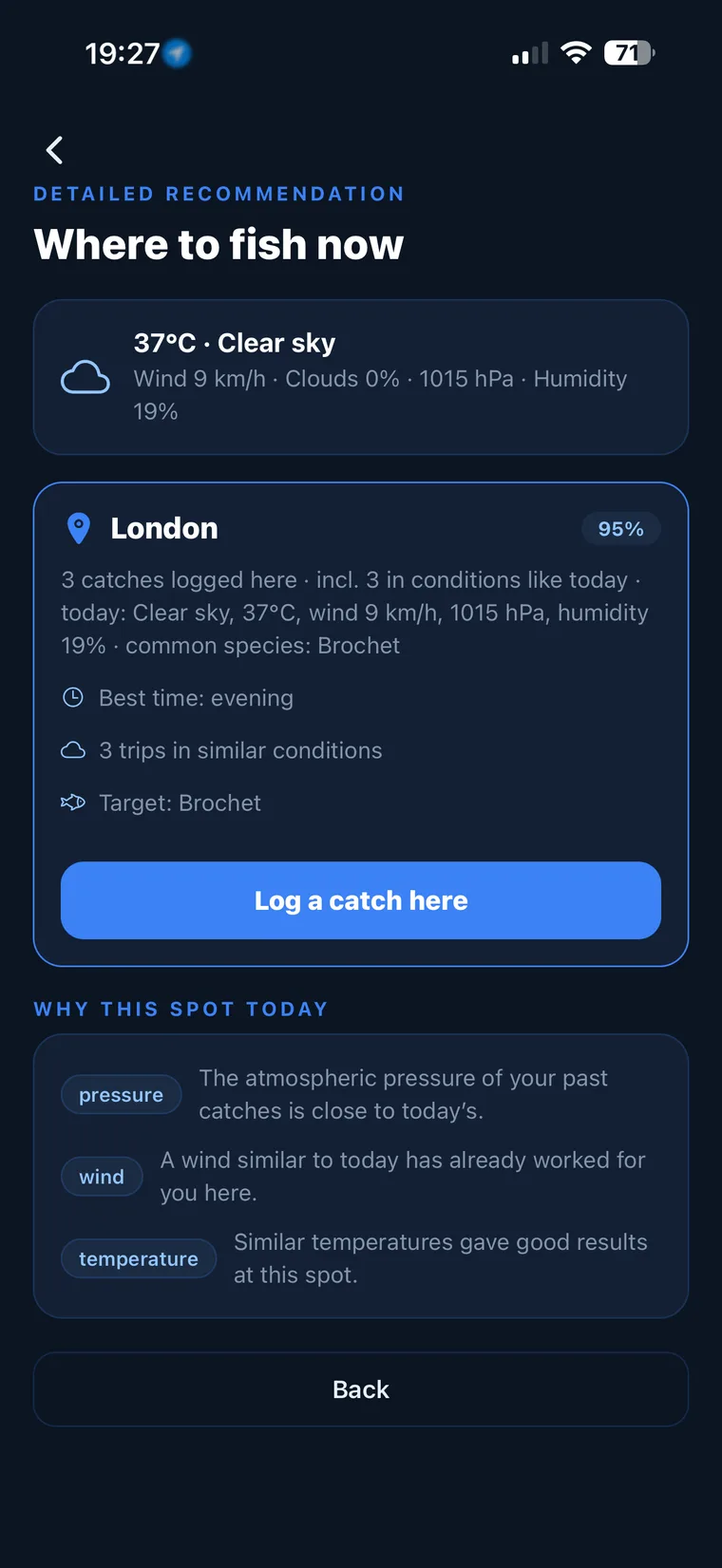
Not sure what to tie on?
Photograph your spot: CarnaFish reads the scene, cross-checks the conditions and gives you the zone, the lure and the retrieve. Free on iOS and Android.
Where and when to fish a squid jig from shore
The spots that produce:
- Harbour walls and jetties, especially those fringed with rock armour and weed.
- Posidonia or eelgrass beds in the Mediterranean and on the Atlantic coast, which are both hunting and spawning grounds.
- Rocky drop-offs close to shore, where you can drop the jig straight down.
The windows:
- Autumn and winter for squid, often at night or at the end of the day.
- Late winter and spring for cuttlefish, which move up into shallow water, mostly by day.
- Tide changes and low-light hours, as almost everywhere in the sea.
And the limits: a squid jig is useless in strong current, in water heavily coloured after a blow, or over bare sand with no weed or structure.
Squid jig or squid-imitating lure: do not confuse them
This is a very common mix-up on the tackle shop wall, and it deserves clearing up.
A lure like the Savage Gear 3D Swim Squid imitates a squid to fool a predatory fish: it has piercing hooks, you retrieve it, and its target is a bass, a pollack or a pelagic. A squid jig does the opposite: it imitates a shrimp or a small fish to fool the cephalopod itself, with crowns of pins instead of hooks and a sequence of darts and drops.
The two look vaguely alike on a display rack and have absolutely nothing in common in use. If you are heading out on a harbour wall for bass, take a soft sandeel like the Flashmer Eel Tail; if you are going for cuttlefish or squid, it is the squid jig and nothing else. Plenty of anglers carry both and switch depending on what they see in the water.
Our guide to reading a fishing spot helps you pick out the weed edges and breaks that concentrate these animals. And if you are unsure which end of a harbour wall to start on, CarnaFish analyses a photo of the spot and answers.
Key takeaways
- A squid jig catches cuttlefish and squid, not fish: its crowns engage when the animal squeezes, they do not pierce.
- The attack happens during the descent, not during the jerk. Count your sink seconds.
- Two to four sharp jerks, then five to fifteen seconds of guided descent. Never a steady retrieve.
- No sharp hookset, no slack during the fight: constant tension all the way to the net.
- Spots: harbour walls, weed beds, nearby drop-offs. Autumn-winter for squid, late winter and spring for cuttlefish.
FAQ
What size squid jig should I start with?
The 3.0 is the do-everything size: it sinks fast enough to fish three to ten metres, casts properly and suits both cuttlefish and squid. Keep 2.5s for sheltered harbours and 3.5s for depth or current.
Why does a squid jig have no hooks?
Because a cephalopod does not bite: it grabs with its tentacles and squeezes against its body. The upturned crowns of pins engage in the suckers at that moment, which makes any sharp hookset pointless and even counter-productive.
How do you work a squid jig from shore?
Let it sink while counting, give two to four upward rod jerks, then stop everything and follow the drop back down for five to fifteen seconds. Almost every bite comes in that sinking phase.
When do you fish for cuttlefish and squid?
Squid mainly in autumn and winter, often at night near lit areas. Cuttlefish more in late winter and spring, by day, when they move up into shallow weed to spawn.
Can you catch a bass on a squid jig?
It happens by accident and it is not the point: neither the shape of the crowns nor the dart-and-drop sequence is built for a fish. If you are after bass on the same spot, rig a soft sandeel or a suitable hard lure.
What gear do you need for shore eging?
A fine, long rod, 2.4 to 2.7 m, with a sensitive tip to give clean jerks and follow the drop. Add fine braid, a 0.20 to 0.25 mm fluorocarbon leader and a soft drag setting so you do not tear the flesh.
The full sea bass lure guideSeason-by-season strategy: which family of lure, when, and why.Go from theory to fish
CarnaFish reads your spot from a photo and gives you the game plan: zone, lure, retrieve. Free on iOS and Android.