Jackson Egi Squid: the squid jig is fished on the drop, not on the pull
The right lure in the wrong spot still catches nothing. CarnaFish spots the zone that works, from a single photo.
A squid jig is not fished like a predator lure, and that is the first thing to understand before you buy one. The target here is neither a sea bass nor a pike: it is cephalopods — cuttlefish in spring, squid through autumn and winter. The whole technique, known as eging, follows from the way they hunt.
A squid does not attack by charging. It slides underneath its prey, rises with it, and wraps it in its tentacles while the prey is sinking. Which means one simple thing: if your egi does not spend time falling, you catch nothing. The vast majority of eging bites come during the drop, and a good share of them are never felt — you see them on the line.
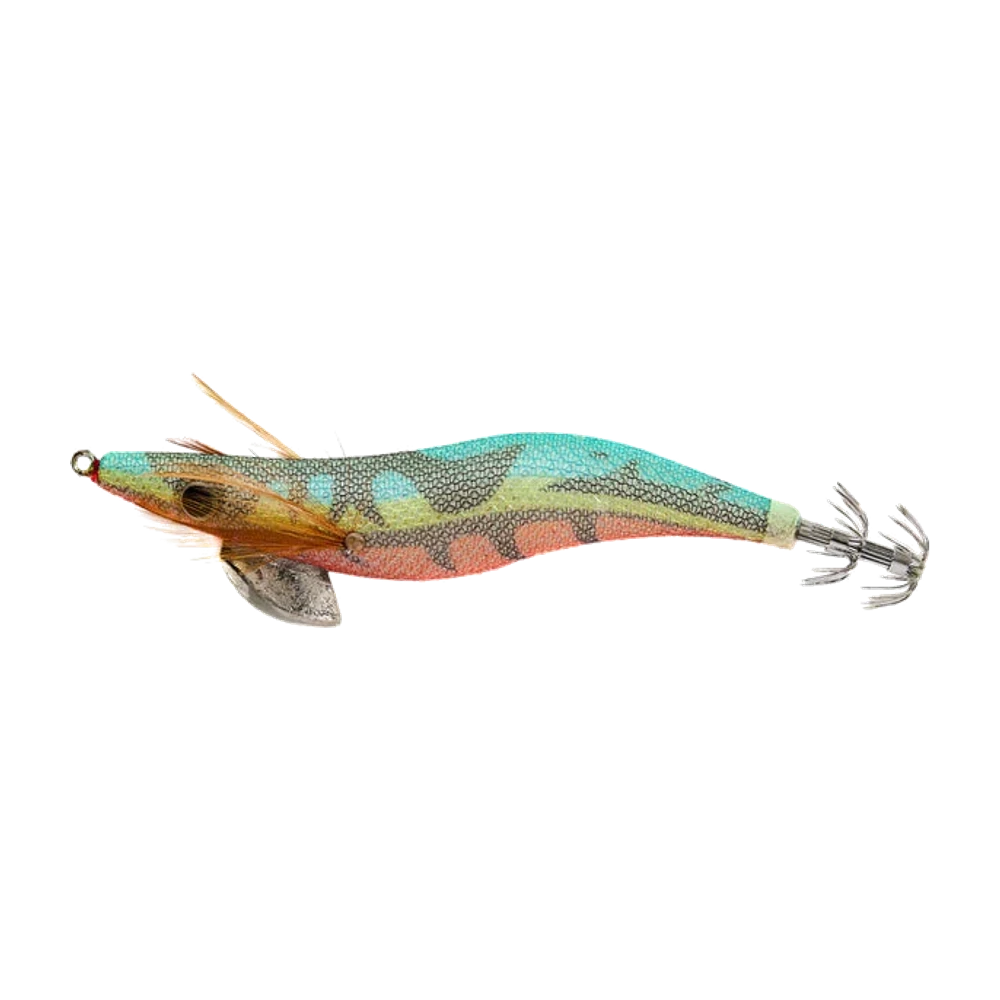
Jackson's Egi Squid is a classic shore-sized jig whose main strength lies in how evenly it sinks and how quickly it gets going again after a sweep.
What makes a good squid jig
Four parameters shape the behaviour of any egi, and this one is no exception.
- Size, given in "go" (号). A 2.5 has a body around 7.5 cm, a 3.0 around 9 cm, a 3.5 around 10.5 cm. That is the unit that matters, not the grams.
- Sink rate, usually stated in seconds per metre. A standard shore jig drops in three to four seconds per metre. Slower and it stays visible for longer; faster and it reaches the bottom without being seen.
- Sink posture. A properly tuned jig sinks nose slightly up, body roughly horizontal. If it noses down or spirals on the way, the squid refuses: it aims for the back of its prey and never finds its angle.
- The cloth covering, which holds water, dulls reflections and sets the perceived colour. Underneath, a painted or metallic base provides the flash.
The crown of spikes at the back is not a hook: it has no barb and does not penetrate. It catches tentacles when the cephalopod clamps down. A violent hookset is therefore pointless, and actually counterproductive.
The retrieve: shakuri, sweep then let it fall
- Cast and let it sink to the bottom, line free but under control. Count the seconds: you will then know what depth you are fishing on every following cast.
- Tighten the line by taking up the slack, rod low.
- Give two to four sharp upward sweeps, wide ones, rod from 9 to 11 o'clock, reeling in between each. The jig darts upward in a zigzag.
- Give line back immediately and let it drop again on a semi-tight line. Count again: five, ten, fifteen seconds depending on the depth.
- Watch the line during the drop. A line that stops going down, slides sideways, or goes slack too early: that is a bite.
- Set by tightening firmly, never by ripping. A sharp snap tears the tentacles and the squid comes off.
- Bring it in smoothly, never giving slack. A squid holds on by traction: the slightest let-off frees it.
On the water: on a spot you do not know, change neither colour nor size before you have varied one single thing — the sink time. Three casts letting it go all the way to the bottom, three casts allowing only half that time, three casts high in the water column. Cephalopods settle on a precise layer and rarely change their minds within the hour; it is that layer you need to find, not the right shade.
Choosing size and colour
| Situation | Size | Base / cloth |
|---|---|---|
| Cuttlefish in spring, 2 to 5 m, clear water | 3.0 to 3.5 | Orange base, natural cloth |
| Squid in autumn, small fish | 2.5 to 3.0 | Pink base, white or brown cloth |
| Weed bed, low light | 3.0 | Gold base, olive cloth |
| Strong current or deeper than 6 m | 3.5 | Dark base, fast sink |
| Very clear water, heavy fishing pressure | 2.5 | Natural cloth, discreet base |
Colour logic in eging is unusual: the base often matters more than the cloth. In low light or stained water, a gold or orange base stays readable; in bright light and clear water, a discreet base under natural cloth avoids refusals.
For tackle, an 8 to 9 foot rod rated 7-25 g with a lively tip, fine 0.06 to 0.10 mm braid so you can read the line, and a metre of 0.20 to 0.25 mm fluorocarbon leader. Thin braid is not a luxury: it is what makes drop bites visible.

Not sure what to tie on?
Photograph your spot: CarnaFish reads the scene, cross-checks the conditions and gives you the zone, the lure and the retrieve. Free on iOS and Android.
Where it works, and its limits
Its ground:
- Posidonia beds and mixed sand-and-rock bottoms, in 2 to 8 m, in the Mediterranean as much as on rocky Atlantic coasts.
- Breakwaters, harbours and rocky points reachable on foot, where there is enough depth at the end of the cast.
- Spring for cuttlefish, when they move up onto the shallows to spawn.
- Autumn and early winter for squid, especially at dusk and through the first part of the night.
Its limits, which you have to accept:
- This is not a predator lure. A sea bass may occasionally hit a squid jig, but neither its shape, nor its barbless crown, nor its retrieve are built for one. If you are after bass, take a bass lure.
- Over heavy structure, the crown snags easily as soon as the drop is poorly controlled.
- In strong current, a standard shore jig drifts and loses its posture; you then need a fast-sink model, or a different spot.
- At midday in summer, in flat clear water, activity is low whatever jig you tie on.
Squid jig or soft squid imitation
Beware a common mix-up. A Savage Gear 3D Swim Squid is a squid-shaped lure built to catch predators: it imitates the cephalopod, it is fished straight or vertically, and it carries real hooks. The squid jig does the exact opposite: it imitates a shrimp or a small fish in order to catch the cephalopod itself.
The two look alike on the rack and have nothing in common on the water. If you are heading out for bass off the breakwater, what you want is a Jackson Pin Tail Tune or a minnow, not an egi.
Our guide to reading a fishing spot helps you pick out the weed edges and drop-offs that concentrate cephalopods. And if you are unsure what depth to work from an unfamiliar breakwater, CarnaFish analyses a photo of the spot and answers.
Key takeaways
- Eging targets cuttlefish and squid, not predators: the whole technique follows from that.
- The bite comes during the drop and is seen on the line more than it is felt.
- Two to four sharp sweeps, then a long controlled drop. That is all.
- Set by tightening progressively, never with a snap: the crown has no barbs.
- The first variable to change is sink time, not colour.
FAQ
Will a squid jig catch sea bass or other predators?
Very rarely, and never reliably. Its barbless crown is designed to grip tentacles, not to hook a fish. For bass, a minnow or a stickbait will be far more effective.
What does the size in "go" mean?
It is the Japanese unit for squid jig size: a 2.5 has a body around 7.5 cm, a 3.0 around 9 cm, a 3.5 around 10.5 cm. That is the figure printed on the packet, not the length in centimetres.
How do I know a squid has taken on the drop?
By watching the line: it stops paying out, slides sideways, or goes unusually slack. Fine braid in a visible colour makes those signals far easier to read than thick mono.
Do I need a hard hookset?
No. A firm, progressive tightening is enough. A violent set tears the tentacles and the cephalopod comes off, since it holds on purely through the pull it applies itself.
What is the best season?
Spring for cuttlefish, when they move up into shallow water, and autumn into early winter for squid. In both cases, dusk and the first part of the night are the most productive windows.
What colour should I start with?
Start with an orange or pink base under a natural cloth, which covers most shore situations. Change the base before you change the cloth: it is the base that determines real visibility at depth.
The full sea bass lure guideSeason-by-season strategy: which family of lure, when, and why.Go from theory to fish
CarnaFish reads your spot from a photo and gives you the game plan: zone, lure, retrieve. Free on iOS and Android.