Lake Fork Pro Craw: the craw that always rigs straight
Not sure this lure fits YOUR spot today? CarnaFish tells you in 10 seconds, from a photo.
A soft craw rigged crooked is a bait that spins, a leader twisted after ten casts and bites you never work out. The fault is almost never the angler: it's the body shape, which gives you no reference for hooking straight. The Lake Fork Pro Craw, designed with MLF pro Jeff Sprague, tackles the subject from exactly that angle — a hook pocket cut into the middle of the back that imposes the position.
The central groove, a detail that solves a real problem
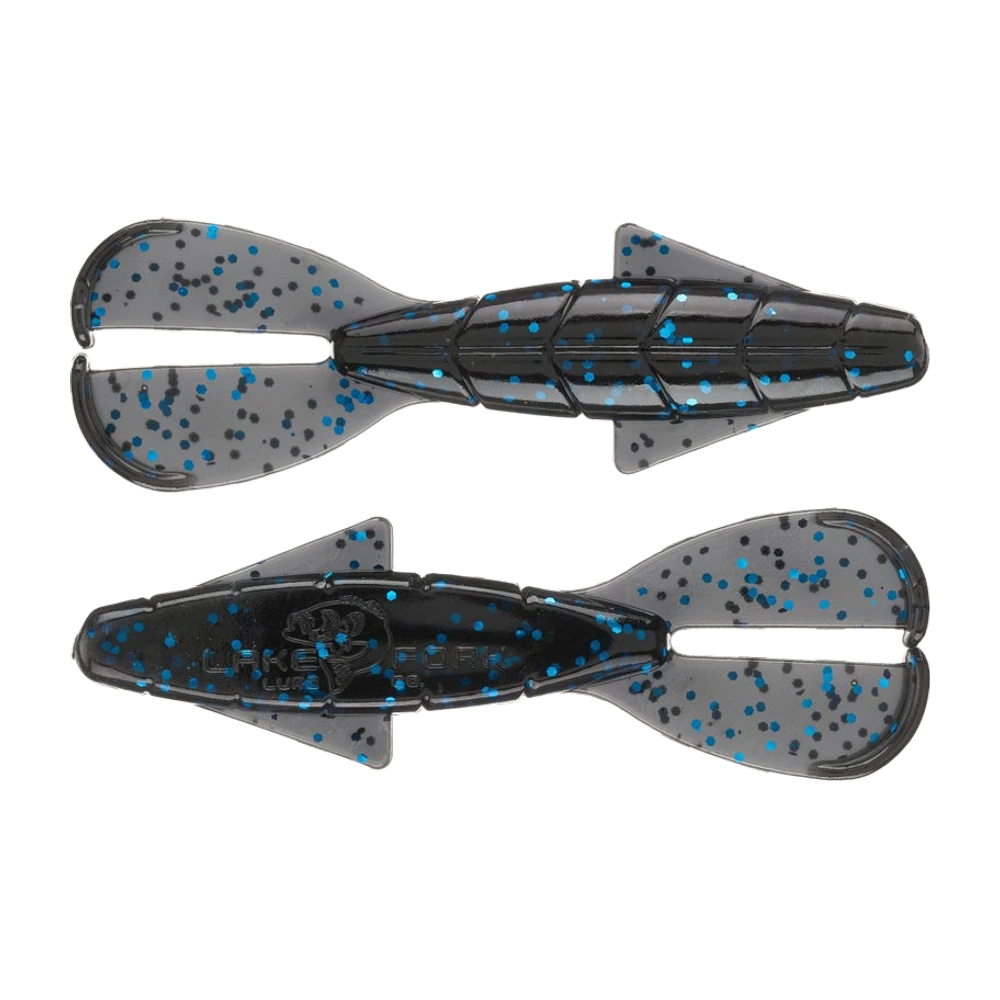
Lake Fork describes a wide oval body with a hook pocket centred on the back, and explains that this construction guarantees perfectly straight rigging for any application. That's not decoration. On a round-bodied craw you hook by eye: a millimetre off to the left, and the hook axis no longer matches the body axis. The bait tracks slightly sideways, starts rotating as soon as you speed up, and your whole leader twists.
The groove acts as a guide: you tuck the point into it after passing through the body, and the hook ends up mechanically in line. Secondary benefit, the point sits in a recess instead of resting on a domed surface, so it picks up less vegetation without needing to be buried in the plastic.
Before casting, lay the rigged bait on your palm, hook up, and look at it head on. If the point isn't exactly in line with the groove, pull it off and start again. Thirty seconds of checking beats an hour fishing a bait that spins.
The two flat appendages, and what they actually do
Lake Fork claims a flapping action produced by two flanged claw-like appendages. The photo confirms it: each appendage is a wide leaf-shaped paddle, translucent, with a thickened bead of material around the outer edge.
That flange isn't accidental. A thin flat paddle folds under water pressure and ends up pinned against the body; a thickened rim gives it rigidity around the perimeter while keeping a supple membrane in the middle. The result is an appendage that flexes without collapsing, and flaps instead of trailing. Same logic as on a Strike King Rage Craw, but with a wider, flatter profile.
Practical consequence: this kind of appendage works as soon as the bait moves, even slowly. No need for sharp rod snaps — a steady pull is enough to get both paddles going. At a dead stop, on the other hand, the Pro Craw does nothing spectacular: it doesn't stand its claws up vertically like a Keitech Crazy Flapper. Worth knowing when you choose between the two.
What Lake Fork doesn't publish
Point of honesty: the description gives no measurements at all. No length, no weight, no pack count. That's awkward on a craw, because the choice rests almost entirely on size — a buzzbait trailer and a Texas-rig craw are nowhere near the same scale. If several sizes exist, there's no way to tell you which from the available source: check the retailer's listing before ordering.
Lake Fork also mentions a patented technology and a custom-formulated plastic, without detailing composition or hardness. So we know it's an in-house formula, but not whether it's softer or firmer than a standard plastic. Better said plainly than embroidered.
Not sure what to tie on?
Photograph your spot: CarnaFish reads the scene, cross-checks the conditions and gives you the zone, the lure and the retrieve. Free on iOS and Android.
Five listed rigs, and how to approach them
Texas and Carolina, the two basics
Texas rigged, point tucked into the dorsal groove, the Pro Craw becomes a cover bait: cast at the foot of structure, dropped on a controlled line, then worked back with short pulls. On a Carolina, the bait works freely behind the weight, well off the bottom, over big flats. The Carolina rig is still the best way to cover a wide area without losing presentation finesse.
Jig trailer, the most obvious use
Behind a bottom jig, the two flat appendages replace a standard craw's tail and add flap to a skirt that only breathes. Paired with a football head jig like the Keitech Tungsten Football Jig V2, you get a package that drags on the bottom while sending a constant signal.
Buzzbait and bladed jig trailers
This is the least practised use on this side of the Atlantic, and yet Lake Fork lists it explicitly. Behind a buzzbait, the trailer mostly serves to slow things down: the two paddles create drag, which keeps the blade on the surface at a slower speed, so you stay longer in the strike zone. Behind a bladed jig like the Z-Man ChatterBait JackHammer, the role changes: the trailer stabilises the swim and adds a flap offset from the blade's own beat.
In both cases, rig the Pro Craw appendages down if you want lift, up if you want the package to sink faster. It isn't carved in stone, but it's a setting you can test in two casts.
The mistake to avoid
Choosing the Pro Craw for a dead-stick presentation. A bait whose action depends on two paddles flapping needs water flowing over them. If your day boils down to dropping the bait on the bottom and waiting, take a craw with floating claws that stand up at rest: you'll have an active silhouette during the long pauses, which the Pro Craw doesn't give you.
Colour by water and bottom type
- Stained water or low light: the blue-flaked black of the photographed sample, a safe bet that gives a clean silhouette with a little sparkle and no excess.
- Clear water over gravel: green pumpkin, the tone that blends into weed and rock and that a fish can study without getting suspicious.
- Rocky bottom in summer: crawfish brown, when crawfish are active and bass hunt them between the stones.
Lake Fork advertises a broad range built to match local forage without naming the colours in its description: reason by conditions rather than by trade reference.
Picking the right craw doesn't help if the spot holds no crawfish. That's exactly what CarnaFish makes easier: a photo of the spot, and the app suggests a zone, a depth and a presentation suited to current conditions. To build tackle and spot-reading fundamentals for bass, our beginner's guide to bass fishing is a good starting point.
Key takeaways
- The hook pocket centred on the back is the bait's real argument: it forces straight rigging and prevents line twist.
- The two flanged flat appendages flap as soon as the bait moves, but do nothing at a dead stop.
- Lake Fork publishes no length, no weight and no pack count: check the size on the retailer's listing before buying.
- Five uses claimed by the brand, two of which are rarely practised in Europe: buzzbait trailer and bladed jig trailer.
FAQ
What size is the Lake Fork Pro Craw?
The maker's description gives no length and no weight. That's a genuine gap on this kind of bait, where size drives almost the whole choice. Check the figure on the retailer's listing before ordering, and don't trust any value quoted without a source.
Why does my soft craw twist my leader?
Because it's rigged slightly off: the hook axis doesn't line up with the body axis, so the bait rotates on the retrieve. That's exactly the problem the Pro Craw's dorsal groove is meant to remove, by guiding the point into line.
Does this bait move on its own at rest?
No, or barely. Its action comes from the two flat appendages flapping, which needs water flow. For a dead-stick presentation on the bottom, a craw with floating claws that stand vertical will be more interesting.
Can it be used as a bladed jig trailer?
Yes, Lake Fork lists that use explicitly. The trailer stabilises the blade's swim and adds a flap of its own, offset from the bladed jig's vibration. It's a good way to widen the profile without slowing the retrieve too much.
How does a trailer change a buzzbait?
It brakes it. The Pro Craw's two paddles create drag, which keeps the buzzbait's blade on the surface at a slower speed. You stay longer in the strike zone, which matters enormously with a fish that follows without committing.
Is it suited to heavily pressured water?
That's Lake Fork's stated intent, presenting the Pro Craw as a bait for high-pressure situations. The reasoning holds: a natural, steady movement often gets through better than an exaggerated action on a fish that has seen everything.
The full bass lure guideSeason-by-season strategy: which family of lure, when, and why.Go from theory to fish
CarnaFish reads your spot from a photo and gives you the game plan: zone, lure, retrieve. Free on iOS and Android.