Googan Zinger: the Colorado-willow spinnerbait for shallow cover
Rather not fish it blind? Photograph your spot — CarnaFish cross-checks the conditions and points you the right way.
A cluttered bank, a metre of water, stumps and drowned branches every three metres. You can't run a crankbait through that without donating hooks to it, and a soft plastic would cost you an hour to cover what you want to cover in twenty minutes. The spinnerbait has handled that job for fifty years, and the Googan Zinger takes the most versatile recipe in the category: a Colorado blade that thumps, a willow that flashes, and a frame that takes the knocks.
Why the Colorado-willow pairing works almost everywhere
A spinnerbait is first and foremost a choice of blades, and that choice decides what the lure says underwater. A Colorado blade, round and cupped, turns slow and wide: it moves a lot of water and puts out a low-frequency thump a fish picks up on its lateral line without seeing a thing. A willow blade, long and tapered, spins fast and tight: it vibrates little but throws a lot of light.
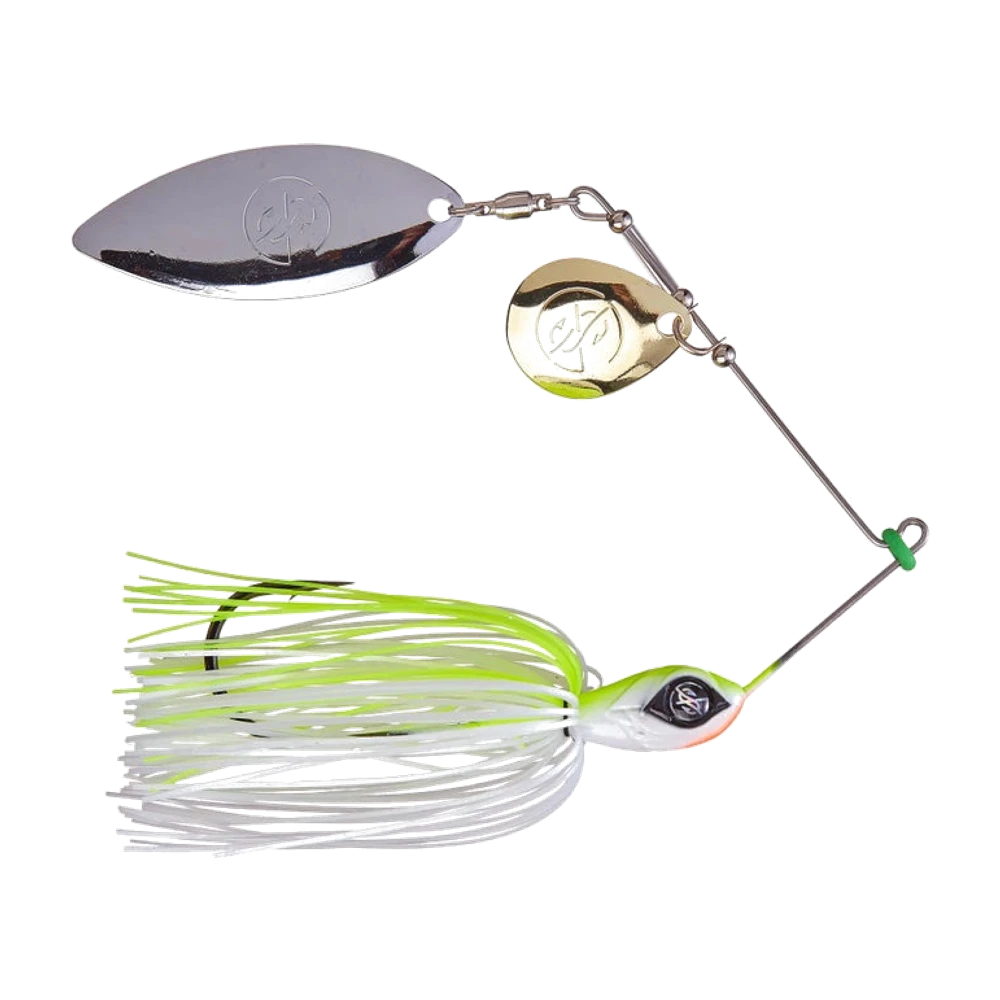
The Zinger carries both: the Colorado forward on the arm, the willow at the rear on a swivel. On the sample photographed, the Colorado is gold and the willow nickel, which also doubles the range of reflections. Googan claims a balance of flash and vibration that covers clear and stained water alike, and that's the classic argument for this configuration - classic because it happens to be true. If you were only allowed one spinnerbait in the box, this would be it rather than a double willow or a double Colorado.
The details that actually matter
The brand's copy insists on four points, and unusually they aren't filler.
The heavy wire frame does two jobs at once: it survives forcing through timber without bending out of shape, and it transmits more vibration. A soft arm absorbs the blade's work; a stiff one sends it back to your hand, so you know at all times whether the lure is running or has picked up a leaf.
The hand-tied silicone skirt, built without a centre band, behaves differently from one crimped on with a rubber collar. The strands open wider on the pause and close on the pull, giving a pulse a glued skirt reproduces poorly. It also lasts longer, which is no small thing on a lure meant to rub against wood all day.
The banded line eye is the smartest detail in the lot, and it's clearly visible in the photo as a green collar. On a standard spinnerbait, repeated pulls eventually walk the knot down the upper arm, where it jams against a bend in the wire and gets cut. The band holds the knot at the top of the eye. That's three cents of rubber saving you a break-off on the best fish of the day.
The twin trailer keeper holds a soft trailer in place for dozens of casts instead of letting it ride up the frame after three. And the hook is a Mustad, a serious name.
What the manufacturer doesn't say
It has to be flagged, because it's awkward at the point of purchase: Googan publishes no spec table for the Zinger. No stated weight, no length, no blade sizes. And weight is the single most important figure on a spinnerbait: it dictates running depth, minimum retrieve speed and the rod you need.
In practice spinnerbaits of this format run between 10 and 18 g / 3/8 to 5/8 oz, but that's a family range, not a manufacturer figure, and it should be treated as such. Check the packaging or the retailer's grid before ordering: a 3/8 oz and a 3/4 oz are not the same lure and not the same rod.
The retrieve rule for a spinnerbait fits in one sentence: reel as slowly as you can while still feeling the blade turn in the rod. The moment the vibration disappears, you're too slow; the moment it only comes in bursts, the lure has picked something up.
Where and how to fish it
Shallow cover first
Googan says so explicitly, and it's this lure's natural ground: docks, stumps, brush piles, grass beds, laydowns. The technique is to pass as close to the obstruction as you can, deliberately hitting it if need be. A spinnerbait that clips a branch deflects, veers off for half a second, then starts swimming again - and that deflection is exactly what triggers the bite. Aiming fifty centimetres off the stump is giving away the whole point.
Slow rolling over grass
When fish are deeper or less active, let the lure sink two or three seconds after it lands, then reel very slowly, shaving the top of the vegetation. The Colorado, which keeps turning at low speed, is what makes that rhythm possible: a double willow would stall and drop into the weed.
The classic mistake
Setting the hook by lifting the rod the moment you feel a knock. On a spinnerbait, fish often strike from the side and miss the skirt half the time. If you lift, you take the lure out of the zone. Keep reeling at the same pace: nine times in ten the fish comes back within a second and hooks itself against the loaded rod.

Not sure what to tie on?
Photograph your spot: CarnaFish reads the scene, cross-checks the conditions and gives you the zone, the lure and the retrieve. Free on iOS and Android.
What about pike?
In Europe the spinnerbait is at least as well known as a pike lure as a bass lure, and the Zinger is no exception: a skirt-and-blades package in a metre of water over a weed bed is a presentation pike respond to very well. One caveat though: there's no wire leader supplied, and the wire frame, however strong, doesn't protect the knot. On a pike spot, always add a 20 to 30 cm steel or titanium leader.
Colour by water clarity
- Lightly stained water: the white and chartreuse photographed here, with one silver and one gold blade, which stays readable without being garish.
- Clear water: plain white or grey-blue with two silver blades, imitating a baitfish school rather than grabbing the eye.
- Dirty water or overcast skies: bright chartreuse, or black with copper blades, leaning on the Colorado's thump rather than on flash.
Lure choice never replaces reading the spot, and that's exactly what CarnaFish makes easier: a photo of the spot, and the app suggests the zone, the depth and the type of presentation suited to the day's conditions - enough to tell whether that bank deserves a spinnerbait or something quieter. To go further on blades and silhouettes, our guide to choosing a pike lure runs through the families worth knowing.
Key takeaways
- The Colorado-front, willow-rear pairing is the most versatile in the category: thump in stained water, flash in clear.
- The real assets are the stiff frame, the hand-tied skirt and the band that stops the knot sliding down the arm.
- The manufacturer publishes neither weight nor length: check the retailer's grid before buying.
- Hitting the cover on purpose is the technique, not an accident: the deflection is what triggers the strike.
FAQ
What weight should I pick for this spinnerbait?
There's no answering that from the manufacturer's data, since no spec table is published. Read the label of the exact model you buy: the usual range in this format runs 10 to 18 g / 3/8 to 5/8 oz, and weight completely changes the running depth.
Do I need to add a soft trailer?
Not necessarily, but the twin trailer keeper exists for it. A trailer adds bulk, slows the drop and increases lift, which helps a lot when slow rolling over grass.
How fast should a Colorado-willow spinnerbait be retrieved?
As slowly as you can while still feeling the blade turn in the rod. The Colorado lets you drop lower in speed than a double willow, which stalls when you slow down too much.
What is the band at the line tie for?
It stops the knot sliding down the upper arm of the frame. Without it, the knot eventually jams against a bend in the wire and gets cut, producing a break-off at the worst possible moment.
Is the Zinger any good for pike?
Yes, a spinnerbait in a metre of water above a weed bed is a deadly presentation for them. Add a steel or titanium leader without fail, as none is supplied.
How does it differ from a double willow spinnerbait?
A double willow flashes more and is retrieved faster, which makes it the better tool in clear water on active fish. The Colorado-willow accepts slower speeds and stays readable in stained water, much like the Booyah Covert in a neighbouring register.
The full bass lure guideSeason-by-season strategy: which family of lure, when, and why.Go from theory to fish
CarnaFish reads your spot from a photo and gives you the game plan: zone, lure, retrieve. Free on iOS and Android.