Ima Suspending Vibration: the lipless crank that stops without sinking
Not sure this lure fits YOUR spot today? CarnaFish tells you in 10 seconds, from a photo.
Everyone knows the structural flaw of a lipless crankbait without saying it out loud: the moment you stop reeling, it drops. Over a weed bed topping out at 1 m, that means every pause ends in the salad, and you spend half the day clearing hooks instead of fishing. Ima built the Suspending Vibration around exactly that problem — a vibrating bait that stays where it is when you stop the retrieve.
A lipless that does not sink, and what that implies
Ima states it plainly: unlike almost every lipless on the market, this model suspends between 3 and 4 feet below the surface, that is 0.9 to 1.2 m. And that detail has to be read correctly, because the maker's table puts those figures in a column headed "Depth". This is not a maximum running depth as on a lipped crankbait: it is the water level at which the bait settles and holds still once you stop working it.
The practical consequence matters. On a conventional lipless, the pause is a gamble: you never know exactly where the bait will be when you start again. Here, the pause becomes a presentation in its own right. You can stop for three seconds above a weed bed, let the bait hang in mid-water, and start again without having collected a handful of pondweed.
The other consequence gets mentioned less often: a suspending lipless is not fished like a conventional one. The whole technique of a vibrating bait usually rests on alternating a fast retrieve with a vertical drop, the classic yo-yo. With this bait, that drop does not exist beyond the suspension zone. You have to think jerkbait as much as lipless, which Ima owns: the maker describes it as part lipless crankbait and part jerkbait.
The specs and where the model comes from
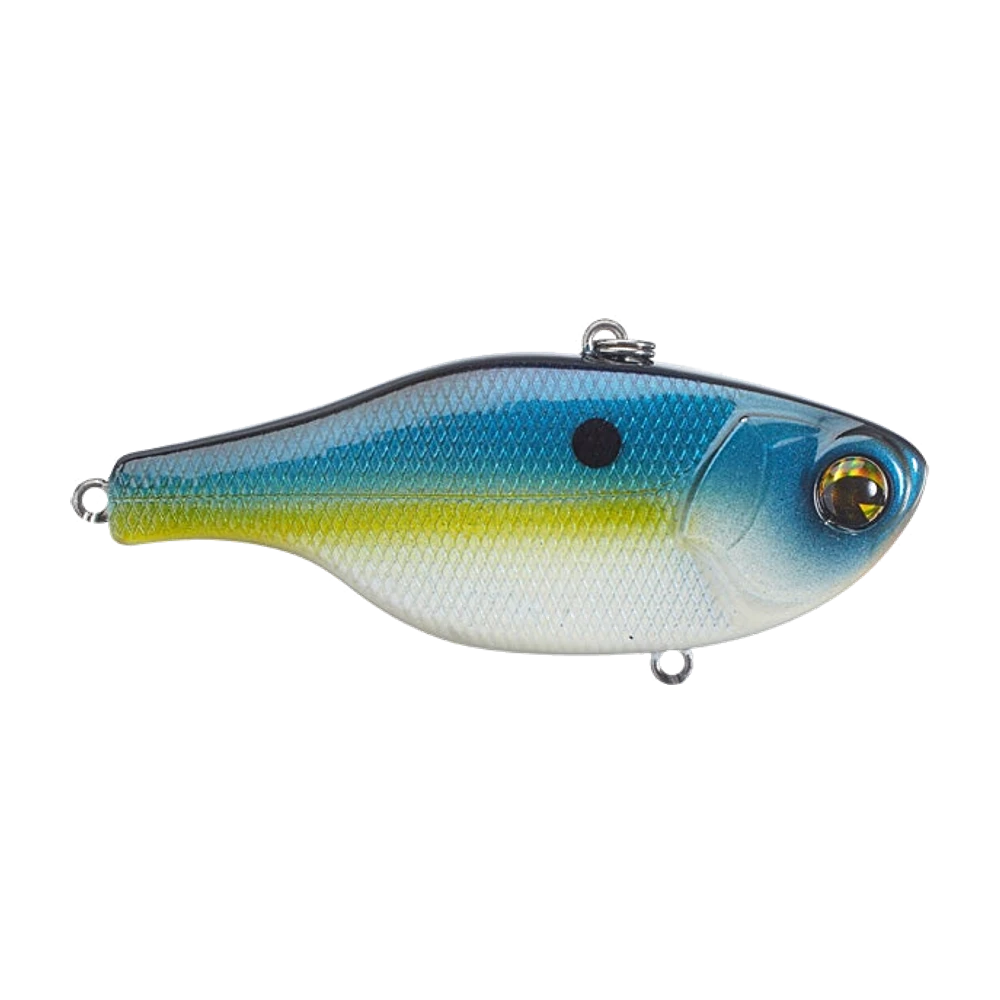
The table gives one line: 2.75 in, 3/8 oz, 3-4 ft. Converted, that is 7 cm for about 10.5 g, plus the suspension band already mentioned. It is an in-between size, compact enough not to spook a perch, heavy enough to cast a long way in a crosswind.
Ima states that this bait derives from its Rock N Vibe lipless, with a body enlarged by 15%. That is not just catalogue trivia: a bulkier body at a comparable weight is mechanically a less dense bait, which goes some way to explaining the neutral buoyancy. If you already know the Rock N Vibe, expect the same family of vibration one notch up in size.
The stated action is a tight, pulsating vibration, not a wide roll. That is the usual signature of a tall, flat-sided lipless: high frequency, low amplitude, a continuous signal that carries well in cold water.
The habit to build with this bait: count your pause out loud. One, two, three. An angler who says "I paused" has usually let less than a second go by before starting again, because stillness is uncomfortable. On a suspending lipless, it is the third second that draws the bite, not the first.
Where this bait really earns its keep
Over vegetation
This is its home ground, and Ima names it explicitly: grass, rock, wood. As soon as you have a weed carpet topping out at 1.5 or 2 m, you can run the bait just above it, work in pauses, and never touch the weed. A fish holding in the vegetation sees a bait stopping dead on the ceiling above it — a situation it is not used to.
On inactive fish
The maker insists on this point, and it is consistent with the bait's mechanics: the pause is there to trigger fish that will not chase. In cold water a bass or a zander often refuses to run down a fast prey item but will readily take one that stops within reach. A conventional lipless cannot offer that without dropping out of the zone.
Searching flats
At 10.5 g for 7 cm, the cast is long and the bait drops quickly to its suspension band. Over a large 2 to 3 m flat you cover plenty of water on a straight retrieve, then switch to pause mode as soon as a bottom feature or a sonar return justifies it.
The rig, and what not to change
Ima fits sticky-sharp trebles and stout stainless steel split rings from the factory. If you swap the hooks, watch the weight very closely: a suspending lipless is balanced to the gram, and heavier trebles make it sink, which cancels the model's only point. Tie a supple snap or a loop knot to the dorsal tie, and stay on 0.25 to 0.30 mm fluorocarbon for discretion. Where pike are present a wire leader becomes necessary, with the same caveat: it adds weight at the front and slightly changes the bait's attitude.
Not sure what to tie on?
Photograph your spot: CarnaFish reads the scene, cross-checks the conditions and gives you the zone, the lure and the retrieve. Free on iOS and Android.
Colour by water
- Lightly stained water: the blue pattern with a black back and chartreuse band shown in the photo. The blue flank stays natural while the yellow band gives the contrast point a fish can aim at.
- Clear water: a roach or bleak finish, natural and low in contrast, letting the vibration do the attracting rather than the colour.
- Murky or high water: a solid red or a plain dark tone. On a lipless, colour matters less than the vibration signal, but under 50 cm of visibility a readable silhouette helps the fish strike accurately.
Where it sits next to conventional lipless cranks
If you want the clean vertical drop and the traditional yo-yo, a Jackall TN 70 or a Lucky Craft Bevy Vibration do exactly that, and do it well. The Suspending Vibration is not competing with them: it covers the opposite situation, the one where the drop is a handicap. For an even finer vibration aimed at perch, the DUO Realis Vibration 62 drops a notch in size.
Knowing how high the weed tops out is half the job with this kind of bait. That is exactly what CarnaFish helps you rough out: a photo of the spot, and the app suggests the zone to work and a presentation consistent with the depth and the cover. If you plan to use it for zander, our beginner's guide to zander lure fishing breaks down the spots and activity windows worth targeting first.
Key takeaways
- 7 cm for 10.5 g, with one unique trait: it suspends between 0.9 and 1.2 m instead of sinking on the stop.
- The table's "Depth" column gives the suspension band, not a maximum diving depth.
- Its niche is the long pause above a weed bed and the inactive fish that refuses to chase.
- Do not swap the trebles for heavier ones: the neutral balance is precise and easily lost.
FAQ
What does a suspending lipless actually change?
An ordinary lipless sinks the moment you stop reeling. This one settles between 0.9 and 1.2 m and stays there. You can therefore pause for several seconds above an obstacle without the bait dropping into it.
What depth does this bait work at?
It settles between 0.9 and 1.2 m below the surface, 3 to 4 feet. On a fast retrieve it runs slightly higher; on the stop it returns to that balance point.
Can it be yo-yoed like a conventional lipless?
Not really, and that is the logic of the model: there is no clean vertical drop. Replace the yo-yo with a retrieve broken up by distinct pauses, thinking jerkbait rather than vibrating bait.
Is it suitable for perch and zander?
Yes. A 7 cm tight-vibrating bait is a very effective size for both species across Europe, and the ability to suspend is a real asset in cold water, when fish stop chasing.
Do the factory hooks need replacing?
Not necessarily, Ima fits sticky-sharp trebles and stainless split rings. If you do swap them, match the original weight exactly: heavier trebles make the bait sink and remove its only distinguishing feature.
How long should the pause be?
Between one and three seconds, and closer to three than to one in cold water. A long stop feels uncomfortable in practice, but it is precisely what this bait is built to allow.
The full bass lure guideSeason-by-season strategy: which family of lure, when, and why.Go from theory to fish
CarnaFish reads your spot from a photo and gives you the game plan: zone, lure, retrieve. Free on iOS and Android.