Evergreen JXJ Minnow: 4.5 cm of jointed body darting under the surface
This lure shines under specific conditions. CarnaFish tells you in 10 seconds if today is one of them.
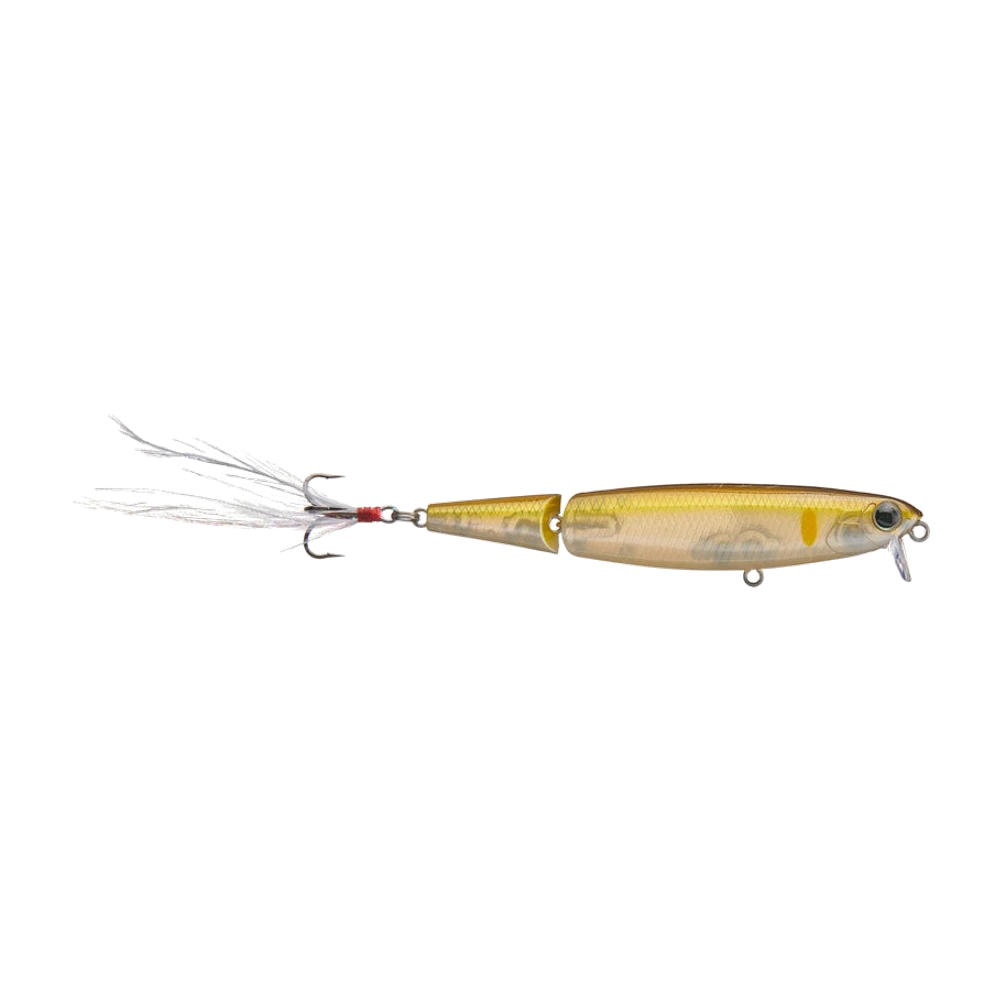
A 4.5 cm hard minnow that weighs 4.4 g should not really exist. At that size most minnows top out at two or three grams, blow off line in the mildest crosswind and cast ten metres on a good day. The Evergreen JXJ Minnow takes the opposite route: a short but dense body, jointed into two segments, that casts properly and slashes left and right with every turn of the handle. It is a tough-day bait, not a water-covering bait.
What the spec table says, and what it leaves out
Evergreen lists a single line for this model: 1.8 in, or 4.5 cm, for 5/32 oz, which converts to 4.4 g. The class column reads Slow-Floating — the lure does come back up, just lazily, and that single word drives most of the retrieve work described below.
That size-to-weight ratio deserves a moment. Four and a half grams is the weight of a typical 7 cm jerkbait, packed here into a body two thirds as long. Two consequences follow directly. The lure casts well for its format, including into a moderate headwind, and its buoyancy is necessarily sluggish. A slow floater is not a hard floater: it does not pop back up in a second, it climbs gently, and that slowness is something you can use.
The manufacturer copy contradicts itself slightly. It files the JXJ under wakebaits — the family that leaves a V on the surface — while describing, in the same sentence, a darting action below the surface and a shallow diving range. Those are not the same lure. In practice, read the table line and the diving mention as the primary source: treat the JXJ as a subsurface bait that can, on a very slow retrieve, ride high enough to throw a wake. Speed up even slightly and it slips just underneath, working between ten and thirty centimetres down. That matters when you buy it: do not expect a genuine topwater like an Evergreen Shower Blows, which never leaves the ceiling.
The dart comes from the reel, not the rod
The announced mechanism is simple and that is its strength: the lure tips one way then the other with every turn of the handle, with no rod input at all. You reel, it slaloms. That is very different from a rigid jerkbait like a Lucky Craft Pointer 78, which needs sharp rod snaps to break out of its track.
The micro-joint does the heavy lifting. By splitting the body into two short segments, it stops the lure from holding a straight escape line: the rear section always follows with a slight delay and then kicks out of the axis, producing disorderly behaviour on an otherwise steady retrieve. That is exactly what a small fish does when it panics without knowing where to go, and it is what a one-piece body never produces, however well shaped. A Rapala Jointed exploits the same principle, but on a completely different scale of size and speed.
Cadence rule: if you can feel the lure in the rod, you are reeling too fast. The JXJ works when the handle turns slowly and the only thing reaching the blank is a soft, vague buzz. The moment you feel firm resistance, it has left its working range.
Where and when to pull it out
The maker makes one concrete point: the lure stays usable over very shallow ground thanks to its slow-floating build and its limited diving range. That is its real home. Banks with half a metre of water, the tops of humps, cluttered pond ends, dock edges where a diving bait would find timber in two casts. The JXJ gets through, and if it does touch something, slackening off brings it back up.
It is also rated for both fresh and saltwater. At 4.5 cm with small trebles, this is exactly the format that triggers along the coast when fish are herding fry and refuse anything over six centimetres. In Europe it is a very good perch calibre too: a decent perch swallows a lure of this length without hesitation, and the disorderly action of a jointed body suits it far better than a tidy wobble.
The limit should be stated plainly: at this size and with these hooks, it is not a pike bait. You will hook pike on it, inevitably, but a size 10 treble on light line is not terminal tackle that holds an eight-kilo fish. If the spot is known to hold them, change lure rather than hope.
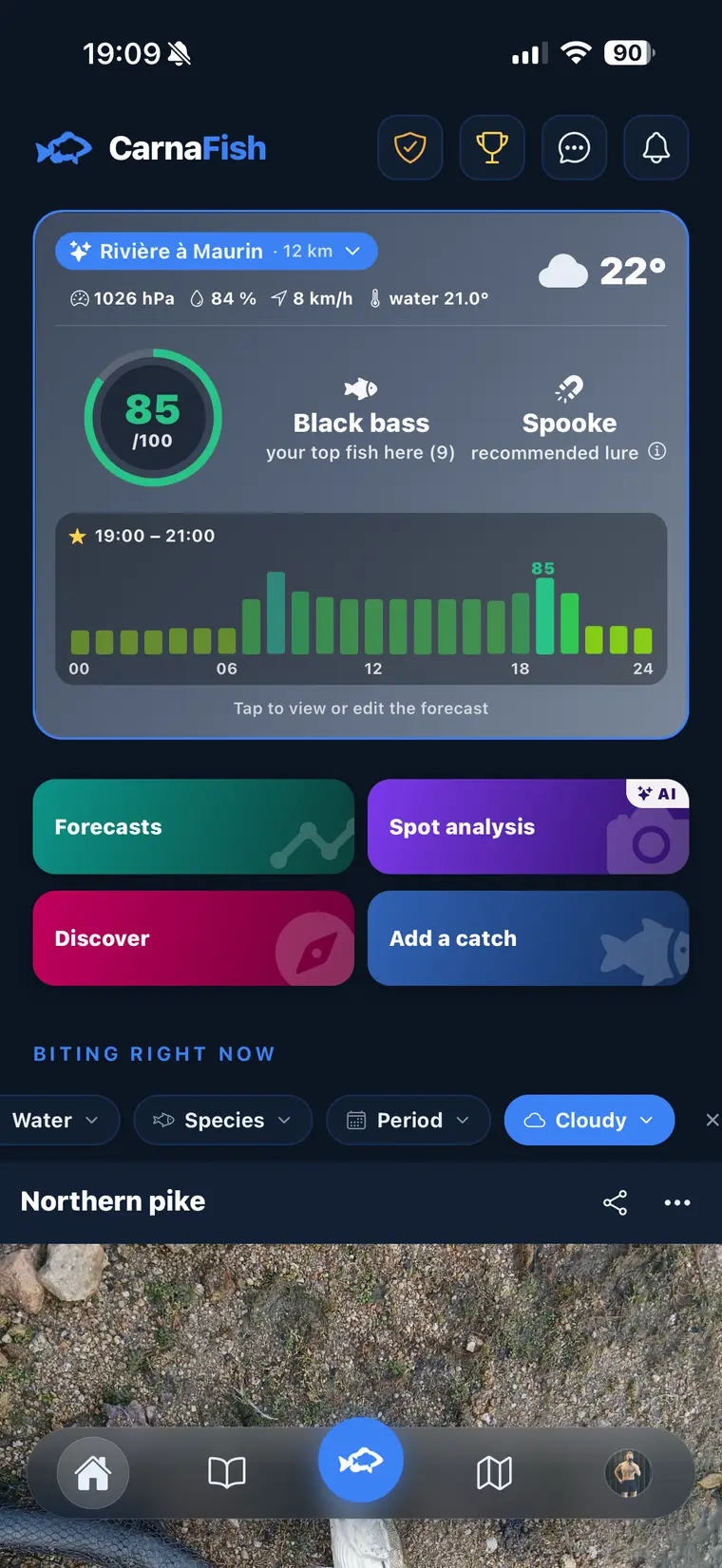
Not sure what to tie on?
Photograph your spot: CarnaFish reads the scene, cross-checks the conditions and gives you the zone, the lure and the retrieve. Free on iOS and Android.
The stock hooks and what they imply
The JXJ ships with two trebles of different sizes: a size 8 up front and a size 10 at the rear, the latter dressed with feathers and bright tinsel strands. That is not decoration. A dressed hook keeps moving once the lure stops: the fibres open and close in the slightest current, which gives the bait residual animation during pauses, precisely when it is rising and doing nothing else.
The size gap between the two trebles also has a mechanical reason. A size 10 at the back means less mass at the end of a jointed body, so less risk of the rear section being dragged along and killing the darting rhythm. If you replace the stock hooks, keep that size offset or you change the balance of the lure.
For line, 20 to 25/100 fluorocarbon tied direct is plenty and stays discreet. A very fine snap is acceptable if you swap lures often, but avoid heavy ones: on a 4.4 g body, a few tenths of a gram at the nose are enough to weigh the head down and alter the attitude.
The classic mistake
Working it with the rod like a jerkbait. The reflex is understandable — it has the silhouette of a minnow — but on a micro-jointed body a sharp snap throws the rear section further than the front one, and the lure comes back folded, often with the rear treble caught in the line. Two or three of those per session are enough to ruin it. Let the handle do the job and keep the rod for stops and very gentle restarts.
Colors by water condition
- Clear water: a translucent natural finish, olive or gold back over pearl flanks, like the one shown on this page. Under bright light and on sighted fish, that is what gets eaten.
- Against the light or lightly stained water: a dark back, which gives a clean silhouette seen from below. In those conditions the outline matters, not the detail of the pattern.
- Overcast skies or slightly coloured water: a bright belly, white or strong pearl, which returns what little light there is and stays visible over the last few metres.
The right lure never replaces reading the spot properly, and that is exactly what CarnaFish does: one photo of the water and the AI suggests the zone to attack, the depth to target and the lure type that fits the day. To get the most out of a format this small, our guide to perch fishing with lures covers the holding spots and retrieve rhythms that go with it.
Key takeaways
- One size only in the catalogue: 4.5 cm / 1.8 in for 4.4 g / 5/32 oz, listed as Slow-Floating in the maker's table.
- The copy calls it a wakebait but describes a subsurface action: treat it as a subsurface bait that can throw a wake at very low speed.
- The dart comes from the handle, not the rod — a sharp snap folds the lure back on itself.
- The stock hooks are deliberately unequal, size 8 front and size 10 feathered rear; keep that offset if you change them.
FAQ
Is the JXJ Minnow a topwater lure?
Not really. The maker presents it as a wakebait but describes, in the same text, a subsurface darting action and a shallow diving range. In practice it works a few centimetres below the ceiling and only throws a wake if you reel very slowly.
What are its exact size and weight?
The spec table lists a single version: 1.8 in, or 4.5 cm, for 5/32 oz, which is 4.4 g. That is dense for the length, which is why it casts well despite the small format.
Should I work it with the rod?
No, and that is the most common mistake. The lure tips from side to side with every turn of the handle. A sharp rod snap misaligns the two segments and usually ends with the rear treble caught in the line.
Is it a perch bait?
Yes, that is one of its best uses in Europe. A 4.5 cm body and a disorderly action match what a perch is looking for, and the stock trebles are the right calibre for that species.
Why is the rear treble feathered?
Because the fibres keep moving once the lure stops. Since the JXJ is a slow floater, it climbs gently during pauses, and the dressing gives it residual movement at exactly that moment.
What line should I use with it?
Fluorocarbon in 20 to 25/100 tied direct works well. Avoid heavy snaps: on a 4.4 g body, a few tenths of a gram at the nose are enough to drop the head and spoil the swimming attitude.
The full bass lure guideSeason-by-season strategy: which family of lure, when, and why.Go from theory to fish
CarnaFish reads your spot from a photo and gives you the game plan: zone, lure, retrieve. Free on iOS and Android.