Imakatsu Gillroid Minnie: the little bluegill with four setups
Rather not fish it blind? Photograph your spot — CarnaFish cross-checks the conditions and points you the right way.
Late June, the bluegills are glued to their beds along the shallow flat and the bass circle without ever straying far. Show them a slender shad and they will watch it go by. What they are keyed on is a tall, round silhouette moving slowly and slightly sideways, like a sunfish that never saw it coming. The Imakatsu Gillroid Minnie is built for exactly that scene — and it ships with everything needed to build four different swims out of one body.
One body, two tails, three noses
Imakatsu calls this model the "Little Giant" of the Gillroid series: it carries over the modular design of the original in a heavily reduced size that, by the maker's own account, fishes much more like a crankbait than like a big swimbait. The box holds two interchangeable soft tails — a boot tail and a flat tail — two diving bills of different geometry, and a solid cap meant to replace the bill once it is removed. On the attachment side there are two ties: a conventional one at the nose, and a second one under the chin.
The spec table is worth reading all the way through, because it lists two lengths for the same bait: 3-1/2 in, or 8.9 cm, rigged with the boot tail, and 3-1/8 in, or 7.9 cm, with the flat tail. Stated weight is 1/2 oz, about 14 g, and the buoyancy class given is slow-floating. That is the only density figure Imakatsu provides, and it applies to the bait as it comes out of the box, with no added weight.
The four setups, one by one
Standard lip with the boot tail
This is the setup closest to a crankbait. Imakatsu states a running depth of up to 4 ft, roughly 1.2 m, and a tight wobble comparable to a flat-sided crankbait. The bait deflects off whatever cover it hits, which makes this the configuration to pick when you want to grind a laydown or scrape a rock face. It also asks the least of you: cast, retrieve steadily, and the bait does the work.
Wind lip with the flat tail
The second bill, set at a steeper angle, keeps the bait far higher in the column: around 2 ft, or 0.6 m. Paired with the flat tail it holds a smoother, more continuous glide than the tight wobble of the first setup. This is the configuration for shallow flats and for fish that refuse an aggressive swim — typically a 1 m shelf where you want neither to snag nor to spook.
No lip, cap in place, boot tail
Strip the bill off completely, insert the cap built for it, screw the boot tail back on, and the Gillroid Minnie turns into a wakebait. It throws a V-shaped wake on the surface, exactly the signal you want at first light on flat water. All this setup asks for is a slow, constant retrieve — speed it up and the V breaks apart, taking the whole point with it.
With a weight under the chin
The second eyelet, the one under the jaw, is not a pulling point: it is there to carry a small weight. The bait then shifts from slow-floating to slow-sinking, and fishes as a glidebait, gliding horizontally between soft sweeps of the rod. It is the most technical of the four configurations, and the one that lets you reach a fish sitting just under the surface without changing lures.
The cap is not an optional accessory. Imakatsu spells it out: fish without a bill and without the cap inserted, and the body fills with water through the bill slot. A waterlogged bait no longer swims, no longer floats, and takes an evening to dry out. Check it every time you change configuration, not once and for all.
What the body actually brings
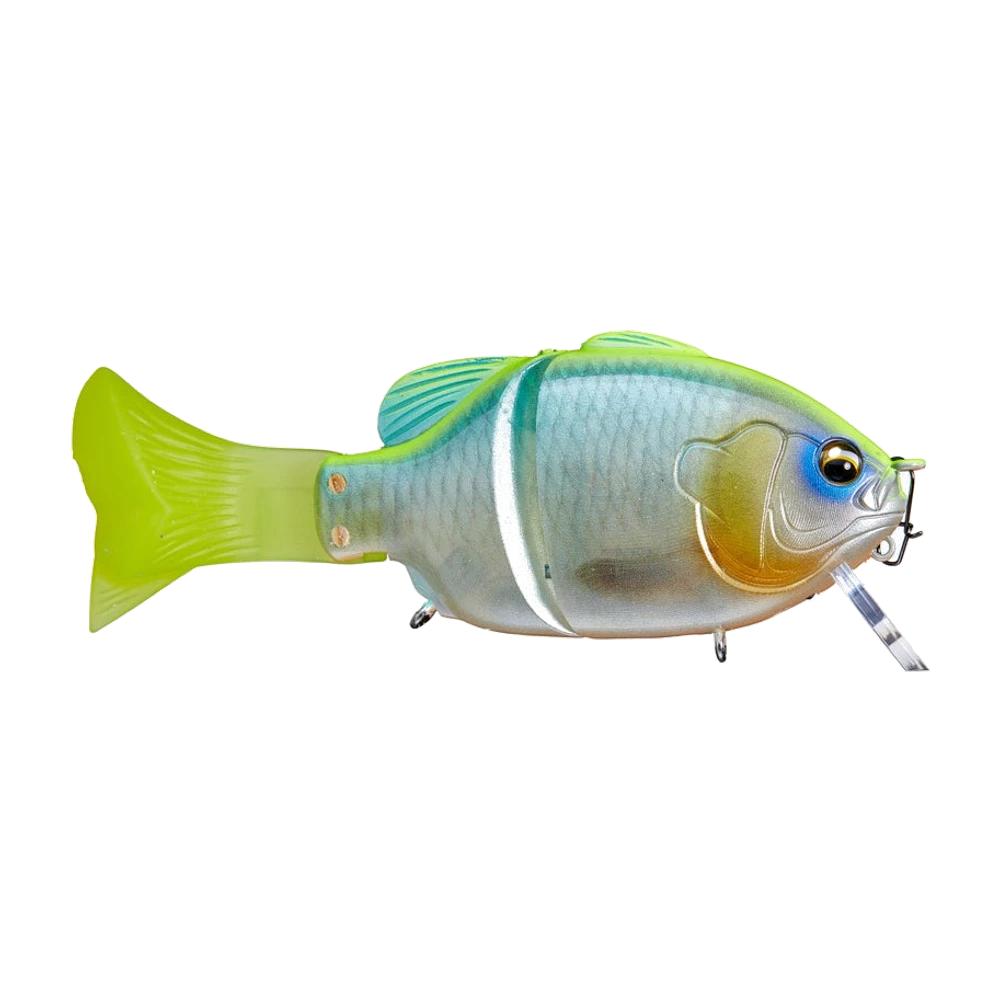
The Gillroid Minnie is a bluegill imitation, not a shad in disguise. The difference is in the profile: a tall, laterally compressed body offers a large flank surface that reflects light over its whole height and pushes more water at the same speed than a streamlined body does. The moulded fins and the raised gill plates are finish work, not swim work — they are what shows at a standstill, and standstills matter when a bass comes in for a close look.
The point worth underlining is the hardware. Imakatsu claims it fits the largest treble in its class onto this small body, and the intent is plain: a 9 cm bait draws a 1.5 kg bass just as readily as a 3 kg fish, and it is on the second one that undersized hooks let go. If you swap the factory trebles, do not size down just because the bait is small.
Where and when to use it
Its natural ground is structured shallow water: scattered weed, laydowns, stumps, riprap, dock edges. The useful depth band runs from the surface to 1.2 m, which leaves no room for ambiguity: this is not a deep search bait, and no configuration will take it lower. If the fish are sitting at 3 m, pick something else.
The obvious season is the one when sunfish are visible and active, in warm water. Across southern Europe that covers most of the summer and the start of autumn on reservoirs and ponds. A tall, wide bait also holds up very well in lightly stained water, where its silhouette stays readable while a thin shad simply disappears.
Rig and tackle
A medium-heavy casting rod, 20 to 30 lb braid and a 0.30 to 0.40 mm fluorocarbon leader make a coherent setup: the bait weighs 14 g, which casts easily, but it is fished in contact with cover and you need to be able to pull a fish out of a brush pile. Tie a snap or a loop knot to the nose tie — a knot cinched straight onto the eyelet chokes the lip's amplitude, exactly as it does on a conventional crankbait.
Keep the spare parts in a dedicated pouch. Two tails, two bills, one cap: this is precisely the kind of small hardware that ends up at the bottom of a bag or in the water. A modular bait with half its modules missing is just an ordinary bait.
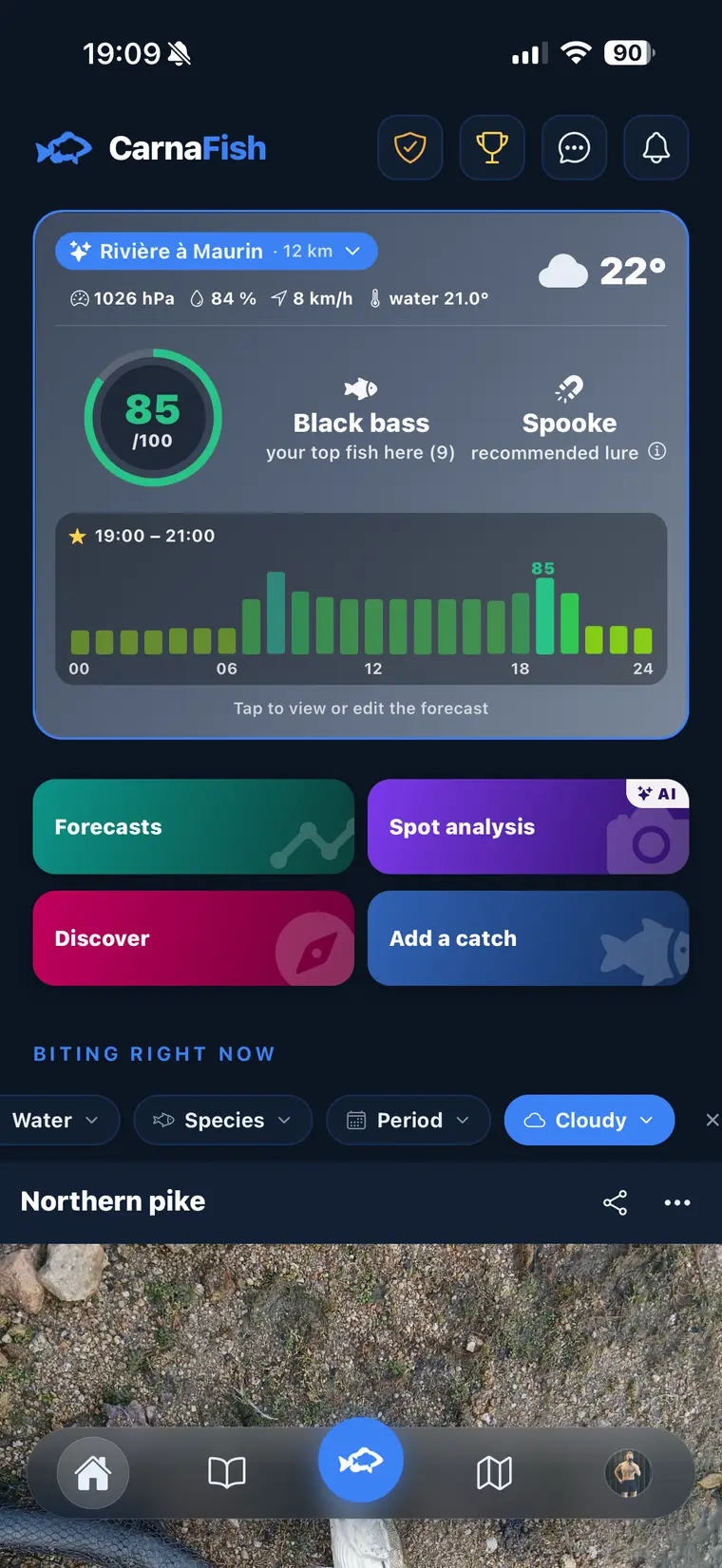
Not sure what to tie on?
Photograph your spot: CarnaFish reads the scene, cross-checks the conditions and gives you the zone, the lure and the retrieve. Free on iOS and Android.
Colour by water clarity
- Clear water: a natural bluegill pattern, with the green and copper tones of the real sunfish. That is the register where this bait is most credible, since it copies a specific prey.
- Lightly stained water: the blue and chartreuse finish shown in the photo, where the back and tail cut clearly against a silver flank. The vertical white bar gives an approaching fish a visual aiming point.
- Low light or dark water: a dark, plain tone that works on the cut of the silhouette against the sky rather than on colour detail.
A specialist's bait, not a Swiss army knife
The Gillroid Minnie does not replace a Megabass Magdraft for covering a big open flat, nor an Imakatsu Javallon when you need to work inside heavy cover. It fills a narrow niche: shallow edges where bluegill is the dominant prey, and where changing the swim without changing lures saves time. Weighted as a glidebait, it compares to an Ima Hound Glide, with a far taller profile.
Picking the right configuration assumes you already know what depth and bottom type you are fishing. That is exactly what CarnaFish makes easier: a photo of the spot, and the app suggests a zone to work and a presentation suited to the day's conditions. For tackle and spot fundamentals, our beginner's guide to bass fishing covers what you need before stepping into modular baits.
Key takeaways
- One body, four swims: standard lip down to 1.2 m, wind lip at 0.6 m, lipless as a surface wakebait, chin-weighted as a slow-sinking glidebait.
- Length depends on the tail fitted: 8.9 cm with the boot tail, 7.9 cm with the flat tail, around 14 g either way.
- Slow-floating as sold; only a weight under the jaw makes it sink.
- The cap is mandatory as soon as the bill comes off, or the body fills with water.
FAQ
How deep does the Gillroid Minnie run?
Up to about 1.2 m with the standard lip and around 0.6 m with the wind lip. With no bill it stays on the surface. No configuration takes it deeper — this is a shallow-water bait.
Does the Gillroid Minnie float or sink?
Imakatsu rates it slow-floating as sold. It only becomes slow-sinking if you attach a small weight to the eyelet under the chin, which turns it into a glidebait.
What is the difference between the boot tail and the flat tail?
The boot tail gives a pronounced kick and stretches the bait to 8.9 cm; the flat tail brings it back to 7.9 cm and keeps a smoother glide, better suited to the wind lip and to wary fish.
Do I really need the cap when I remove the bill?
Yes, and it is not a detail. Imakatsu states that without the cap, water enters through the bill slot and fills the body. The bait then loses both its buoyancy and its swim.
Is this bait any good for pike or perch?
It was designed for bass and imitates a sunfish. A trophy perch may hit it, but that is not its target, and for pike you would need a longer bait and a wire leader anyway.
Can it be used as a fast search bait?
Not really. It weighs 14 g for 9 cm, which casts well, but its narrow depth band and slow rhythm make it a bait for identified spots rather than for covering water. To cover ground fast, a conventional crankbait stays more efficient.
The full bass lure guideSeason-by-season strategy: which family of lure, when, and why.Go from theory to fish
CarnaFish reads your spot from a photo and gives you the game plan: zone, lure, retrieve. Free on iOS and Android.