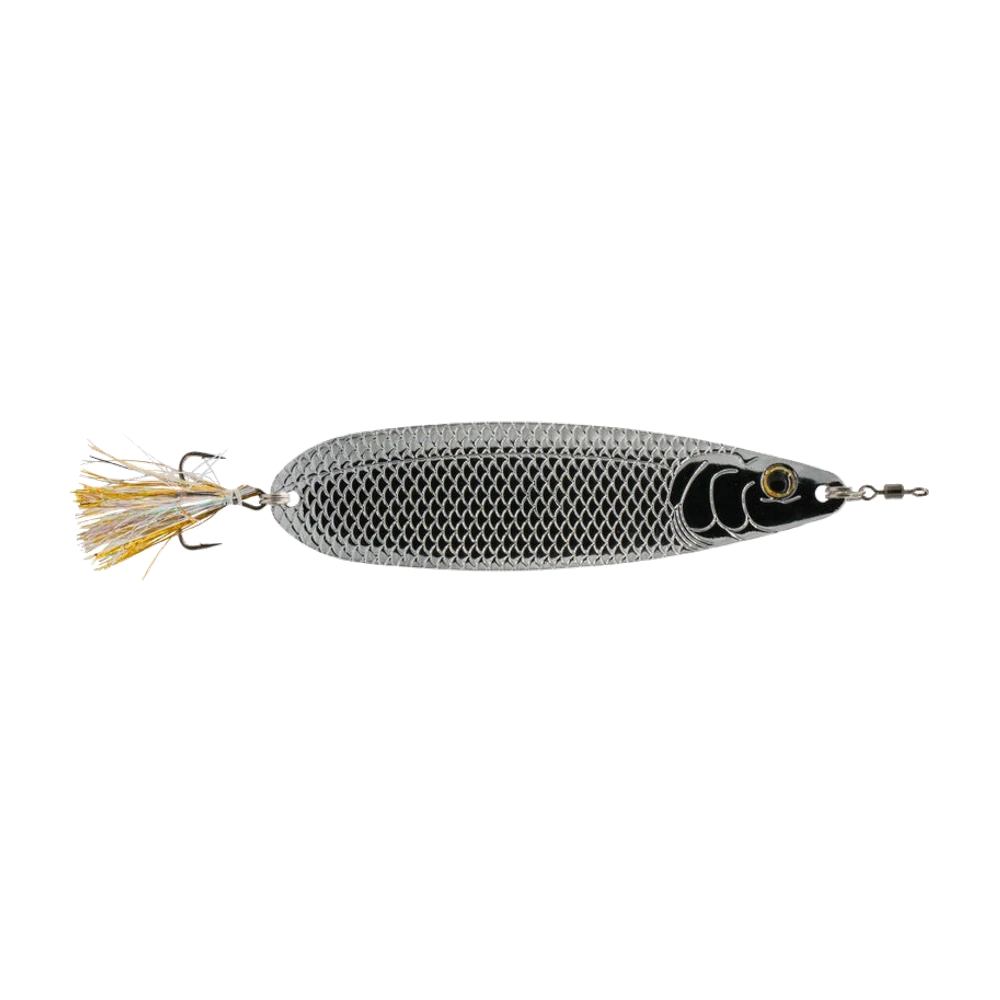
6th Sense Flutter Spoon 120: the spoon that flutters on the fall
The right lure in the wrong spot still catches nothing. CarnaFish spots the zone that works, from a single photo.
Late summer on a reservoir: the sonar shows a cloud of baitfish at seven metres and a few heavy, motionless returns hanging just below it. You have already run a deep crankbait through them and touched nothing. The fish are there, they just will not chase. That is exactly the situation a flutter spoon was built for — a bait you do not retrieve, you drop.
A heavy body and a wide blade, two choices that fight each other
The Flutter Spoon 120 measures 12 cm for roughly 31 g. That ratio is deliberately odd: it is a lot of metal for a blade that broad. The weight is there for the cast — a wide, light spoon kites in the slightest wind and never clears twenty metres, while this one flies and sinks quickly to the depth you want. The width is there for the fall: the moment you kill the tension, the blade lays flat, loses its axis and starts turning over on itself as it goes down.
The result is a slow fall relative to the mass. A heavy, narrow casting spoon like the Luhr-Jensen Krocodile sinks nose down and cuts straight through the water column. The Flutter Spoon 120 stays far longer at the fish's level, throwing flashes sideways in every direction. Same metal, completely different lure.
The cadence: lift hard, then do nothing
The basic move has two beats. Let the spoon reach the depth you want, then rip the rod up sharply — a metre or two of line, fast enough to make the blade break free. Then stop. Lower the rod at the same speed the lure falls, keeping just enough contact to feel it, never pulling.
The bite lives there. Fish almost never hit on the lift: they follow, position underneath, and take the blade while it flutters above them. That is why strikes are usually detected late, as a line that slides off sideways or stops sinking earlier than it should.
Count your fall time under your breath, two or three casts in a row. The moment one descent stops a second earlier than the last ones, set the hook: nine times out of ten a fish has eaten the spoon without you feeling a thing in the rod.
The mistake that costs the most bites
Keeping the braid tight on the way down. It is the natural reflex — you want to feel the lure — but a spoon held by the line does not flutter: it pendulums back toward you in an arc, nose first, and loses the exact quality you picked it for. Dumping line completely has the opposite problem, with a belly of slack that makes any hookset impossible. The right setting sits between the two: the rod follows the fall, the line stays soft but visible.
The other common error is insisting in the wrong place. Over flat, featureless bottom this spoon is useless. It needs structure that concentrates fish.
Where and when to pull it out
Its home water is fish suspended over deep structure: a hard drop-off, a shelf that falls away, an old river channel, a tree standing in ten metres of water. The best windows are post-spawn and late summer, when bass group up offshore and feed on schools of already grown baitfish — a 10 to 12 cm meal is nothing excessive then.
In European waters the other legitimate use of this spoon is vertical work on pike and big reservoir predators, over the same kind of structure. The motion is identical, simply shorter and closer to the bottom. It is not a perch bait and not a shallow-river bait: at 31 g it has no business in less than three metres of water.
Rig, line and hooks
Three constraints set the rig. First, line twist: a blade that spins as it sinks passes that rotation straight into the line. A ball-bearing snap swivel between leader and spoon is not an option, it is a requirement — without it your fluorocarbon is scrap after an hour.
Second, detection: you want braid, 20 to 30 lb, so you can see the bite on the line rather than feel it. A monofilament main line absorbs everything and you simply miss the falling strikes.
Third, hookset shock: a metre of 40 to 50 lb fluorocarbon leader absorbs the brutal pull of a fish running sideways at ten metres and protects the braid against rock edges. On a pike spot, swap it for wire or titanium.
The stock treble comes dressed with a bright tinsel that extends the blade visually without adding mass — keep it as long as it is intact, then simply replace the hook with the same size. And check that the rear split ring lets the treble pivot freely: a bound hook costs you fish on the way in.
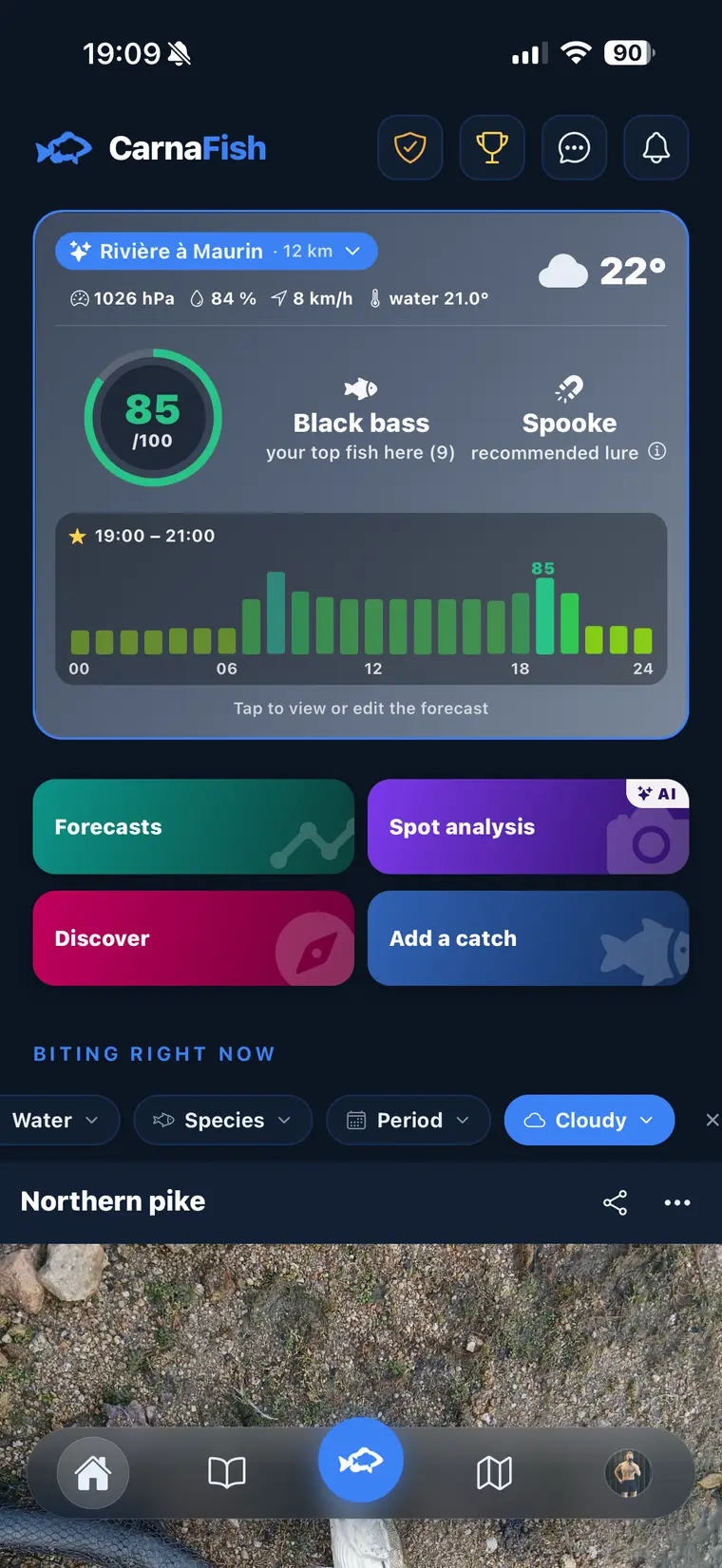
Not sure what to tie on?
Photograph your spot: CarnaFish reads the scene, cross-checks the conditions and gives you the zone, the lure and the retrieve. Free on iOS and Android.
Colors by water and light
- Clear water, full sun: translucent silver finishes, the closest thing to a real baitfish. That is the default any time you can see bottom at two metres.
- Overcast or deep water: a blue back over a white flank, which keeps a readable contrast when light fades below eight metres.
- Lightly stained water: a chartreuse back stays detectable without turning gaudy. Beyond genuinely muddy water the spoon is the wrong tool altogether: move to a lipless vibration like the Heddon Sonar, which works on sound.
A situational bait, not a search bait
The Flutter Spoon 120 does not find fish, it converts them. So you need to have located them first — on sonar, or by reading the structure from the bank. To cover the same stretch, a 6th Sense Provoke sweeps far more water, and to hold a true vertical line on the bottom a Savage Gear Monster Vertical stays more precise. The flutter spoon owns the middle slot: above the bottom, on fish you have seen.
That is exactly where CarnaFish saves time: a photo of the spot, and the app suggests the zone, the depth to target and a presentation suited to the day's conditions — enough to tell whether you are standing on structure that justifies a flutter spoon before you cast. To learn to read those drop-offs without electronics, our guide to reading a fishing spot covers the clues you can see from shore.
Key takeaways
- The bite comes on the free fall, not the lift: the descent is the part you have to get right.
- Braid to see the bite, a heavy fluorocarbon leader to absorb the hookset, a ball-bearing snap against line twist.
- Strictly situational: fish suspended over deep structure, 3 to 12 m. Pointless over flat bottom or in the shallows.
- A tight line on the drop kills the flutter and turns the spoon into a dead pendulum.
FAQ
How deep should I fish the Flutter Spoon 120?
Between 3 and 12 metres, over fish you have marked or over obvious structure. In less than three metres of water its 31 g reach bottom before the blade has had time to flutter, and the whole point is lost.
Do I need sonar to use it?
Not strictly, but it changes a lot, because this spoon is fished on fish suspended at a precise height. Without electronics, concentrate on obvious structure: a reservoir drop-off, a rocky point that plunges, the lip of an old channel.
Why is this spoon twisting my line?
Because a blade that rotates on the fall passes that spin straight into the leader. A ball-bearing snap swivel fixes it completely. Without one, fresh fluorocarbon is unusable after a single session.
Does the Flutter Spoon 120 work on pike?
Yes, fished vertically or semi-vertically over deep structure, with the same lift-and-drop motion. Use a wire or titanium leader in that case, because a pike eating a 12 cm lure usually ends up with its jaws right at the knot.
Should I keep the stock tinsel treble?
Keep it while the tinsel is in good shape: it extends the silhouette without adding weight, so without speeding up the fall. Once it is stripped, a standard treble in the same size is fine, since the attraction comes mainly from the blade's movement.
How is this different from a classic casting spoon?
A narrow, heavy casting spoon sinks nose down and cuts quickly through the water column. The Flutter Spoon 120's wide profile lays flat and flutters, which keeps it at the fish's level far longer while throwing sideways flashes.
The full bass lure guideSeason-by-season strategy: which family of lure, when, and why.Go from theory to fish
CarnaFish reads your spot from a photo and gives you the game plan: zone, lure, retrieve. Free on iOS and Android.