Keitech Tungsten Guard Spin Jig: the finesse jig for pressured water
Rather not fish it blind? Photograph your spot — CarnaFish cross-checks the conditions and points you the right way.
There are lakes where the 14 g / 0.5 oz jig with a full skirt simply stops producing. Not because the fish are gone, but because the ones left have watched two hundred go past since spring. Keitech's Tungsten Guard Spin Jig is built for that context: the brand presents it as a finesse jig aimed at heavily pressured water, with a compact design meant to mimic small forage species rather than a full-size crawfish.
What "finesse" actually means on a jig
On a jig, finesse isn't about a material or a colour: it's about displaced volume. A short skirt and a tucked-in head give a silhouette a fish can inhale in one gulp, without the physical commitment a big flipping jig demands. On water where everyone fishes, that's often the only variable still worth changing.
The trade-off is real: a compact jig sorts fish less. You'll catch more, but more small ones too, and you'll get cleaned out more often by a bass heading for cover. That's the deal you accept with finesse.
What Keitech publishes, and what the name doesn't say
First, the description contains no spec table. No length, no weight list, no hook size, no strand count. That's unusual on a jig, so check the weight on the retailer's listing before ordering — especially on a finesse model, where going from 5 to 10 g / 0.18 to 0.35 oz changes the fishing completely.
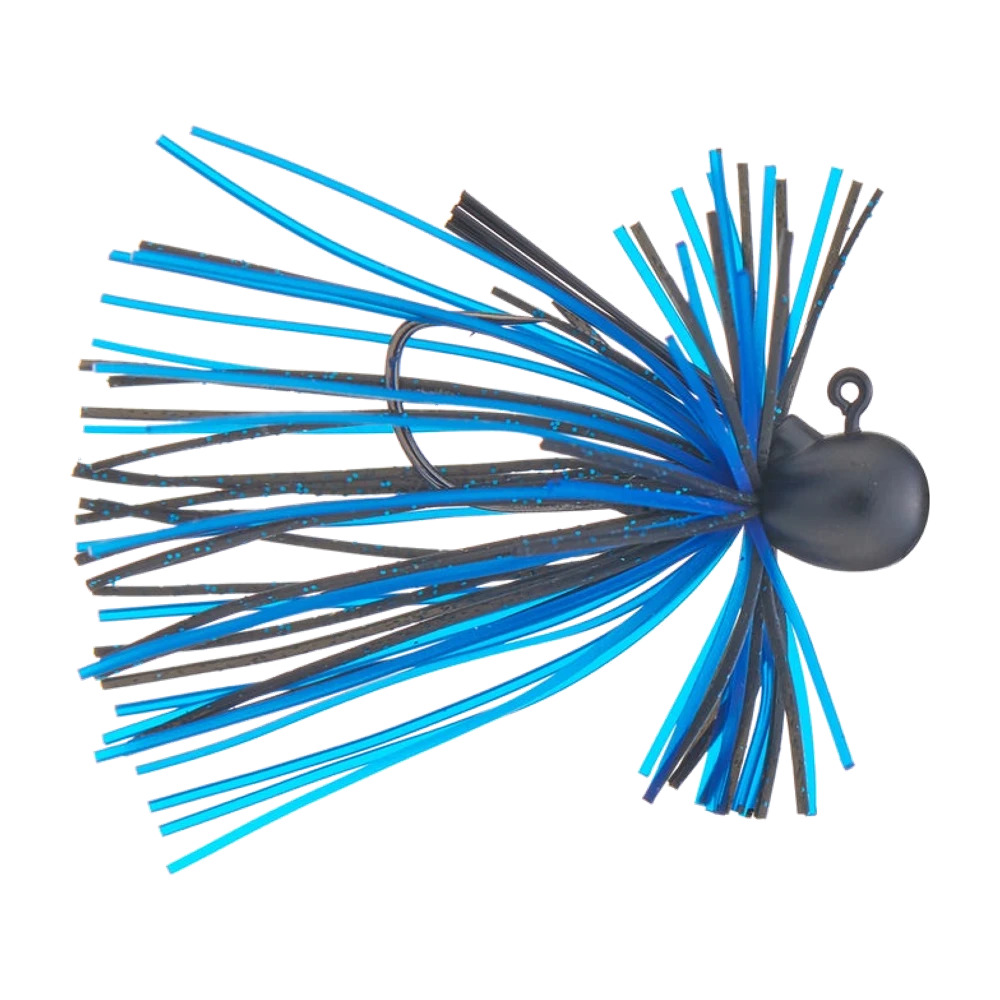
Second, the word "Spin" in the name. Keitech's description mentions no blade and no spinning component at all, and the photographed sample doesn't carry one either. A model name is not a spec sheet: if you want a bladed jig, this isn't where to look. What is described is a tungsten head, a skirt and a fiber weed guard.
The tungsten head, for feel rather than fall rate
Keitech is explicit about why tungsten matters here: it increases sensitivity while the jig is hopped or slowly dragged across the bottom. That's not a sink-rate argument, it's an information argument. On a light jig it's arguably more useful than on a heavy one: when you fish fine, the gap between "I just moved from sand to gravel" and "a fish just picked it up" is tiny, and a dense, hard material carries that nuance far better than lead.
Two retrieves follow from it. The short hop: lift the jig 10 to 20 cm / 4 to 8 in and let it drop back on a semi-slack line. The slow drag: never lift it at all, crawl it with the rod tip and feel every stone. The first suits clean bottoms, the second hard bottoms where fish are pinned down.
On a finesse jig, the bite is almost always a change in weight, never a thump. If you wait for the sharp knock of a big jig you'll miss half your fish. The moment the jig feels heavier or lighter than it did a second ago, tighten and set.
The weed guard that collapses easily
This is the best-documented build detail Keitech gives, and the most important one on this kind of jig. The weed guard uses fine fibers: it cuts down on hang-ups, but it's soft enough to collapse with minimal force.
Why does that matter? Because a finesse jig gets fished on a softer rod, thinner line and a gentler hookset than a flipping jig. A stiff guard built for 20 lb braid and a heavy rod would block the point on half your sets. Here the compromise sits on the right side: slightly less protection, far more fish hooked. This jig clears a rock edge, sparse grass, scattered wood — but not the heart of a sunken tree.
The jighead wacky rig Keitech points to
It's the most interesting line in the description and the one most easily skipped: Keitech presents this jig as an excellent alternative to the standard heads used for the jighead wacky technique. The method is worth explaining, because it stays uncommon in Europe.
Classic wacky means hooking a straight worm dead centre, with no weight, and letting it drop: both ends shimmy on the way down. Jighead wacky keeps that principle but swaps the bare hook for a weighted head. Three immediate consequences: the fall becomes faster and more vertical, the bait reaches the bottom and stays there instead of drifting, and you can hop it on the spot while both ends keep flapping. It's deadly on a vertical target — a bridge piling, a rock slide, a dock edge — where an unweighted wacky drifts too far.
To rig it, hook a straight worm like a Yamamoto Senko 4 through the middle, or run an O-ring if you want your baits to last. The standard wacky rig is still the right place to understand the logic before adding weight.
The mistake that ruins this jig
Hanging a big trailer off it. The reflex is understandable — we're used to dressing a jig — but it cancels the only reason to buy this model: the compact profile. Put a 10 cm / 4 in trailer behind a finesse head and you have an ordinary, badly balanced jig. Stick to a short trailer, a small chunk or a compact craw. Second mistake: setting the hook like you would on a heavy jig. The soft guard and small hook need no shoulder in it; tighten, follow through, let the rod work.
Not sure what to tie on?
Photograph your spot: CarnaFish reads the scene, cross-checks the conditions and gives you the zone, the lure and the retrieve. Free on iOS and Android.
Colour by water clarity
Keitech doesn't detail its colour range in the description, so reason by conditions.
- Clear water over gravel: green pumpkin, the safe pick when fish have time to look.
- Stained water or low cloud: the black and blue of the photographed sample, a readable silhouette with no flash.
- Rocky bottom in summer: crawfish brown, when crawfish are active and bass hunt them between the stones.
In finesse, contrast matters more than exact hue: get the silhouette right first, adjust colour second.
Where it sits in a jig box
This Guard Spin Jig doesn't replace a classic bottom jig like the Keitech Tungsten Football Jig V2, which targets deep water with a hundred-strand skirt. It plays a different register, the small-volume one that still gets bites when nothing else does — the same ground as the Z-Man TRD (Ned Rig), with a skirt added and some ability to clear light cover.
Good finesse fishing starts with picking the spot, not the jig. That's exactly what CarnaFish makes easier: a photo of the spot, and the app suggests a zone, a depth and a presentation suited to the day's conditions. To sharpen your water reading before you even tie on, our guide to reading a fishing spot lays out the method.
Key takeaways
- An openly finesse jig: compact profile, designed by Keitech for heavily pressured water and to imitate small forage.
- The description publishes no weight, no length and no hook size — check the weight with the retailer before buying.
- The "Spin" in the name matches no blade described by Keitech: don't count on a vibrating component.
- The fine-fiber weed guard collapses with minimal force, which makes this a jig built for finesse hooksets, not heavy wood.
FAQ
Does this jig have a spinner blade?
Nothing in Keitech's description mentions a blade or any spinning component, and the photographed sample doesn't carry one. "Spin" is part of the trade name, not of the technical description. Take it for what it is: a skirted finesse jig.
What weight should I choose?
Keitech publishes no weight grid, so go by the retailer's listing. On a finesse jig, start with the lightest weight that still keeps you in bottom contact: that's what preserves the slow fall rate finesse fishing is built on.
What is the jighead wacky rig Keitech mentions?
It's a wacky rig — a straight worm hooked through the middle — mounted on a weighted head instead of a bare hook. The fall becomes more vertical, the bait holds bottom, and both ends of the worm keep flapping. Keitech presents this jig as a good alternative to the standard heads used for it.
Can I fish it in dense vegetation?
Better not. The fine-fiber weed guard is designed to collapse under minimal force, so it protects against a light snag but not against thick weed or a sunken tree. For that, a flipping jig with a stiff guard remains the right tool.
What trailer should I run on it?
A short one that extends the skirt without doubling the volume: a small chunk or a compact craw. Putting a big trailer on a finesse head removes the only reason you picked this jig, and unbalances it on the fall.
Is it a good first jig for a beginner?
Not necessarily. A finesse jig asks you to feel very subtle bites and fish slowly, which isn't the easiest start. This model earns its place when you come back to water where you've stopped getting bites.
The full bass lure guideSeason-by-season strategy: which family of lure, when, and why.Go from theory to fish
CarnaFish reads your spot from a photo and gives you the game plan: zone, lure, retrieve. Free on iOS and Android.