LiveTarget Live Craw: the weighted crawfish that rocks on the fall
Not sure this lure fits YOUR spot today? CarnaFish tells you in 10 seconds, from a photo.
A crawfish caught out away from its rock does not really swim: it jets backwards in bursts of its tail, drops, fails to settle properly and starts again. It is clumsy, noisy movement — exactly the kind of signal a bass or a zander sitting on hard bottom does not let pass. LiveTarget's Live Craw is built around that precise scene, not around a calm crawfish walking the bottom.
A bait built for the fall, not the retrieve
The description is clear about the intent: the bait is designed to trigger reaction strikes on the fall, and the maker specifies that it is most effective used as a slow-falling jig. Two other uses are stated: short twitches that create erratic action, and a very slow retrieve in the manner of a crankbait.
The internal mechanics are worth spelling out, because they drive everything. An internal weight is deliberately placed off the axis to throw the bait off balance. The stated result: a characteristic wobble as the crawfish settles after a twitch or a pull, and a light clicking sound produced by that weight in motion. In other words, the Live Craw works and makes noise on its own at the moment you are doing nothing.
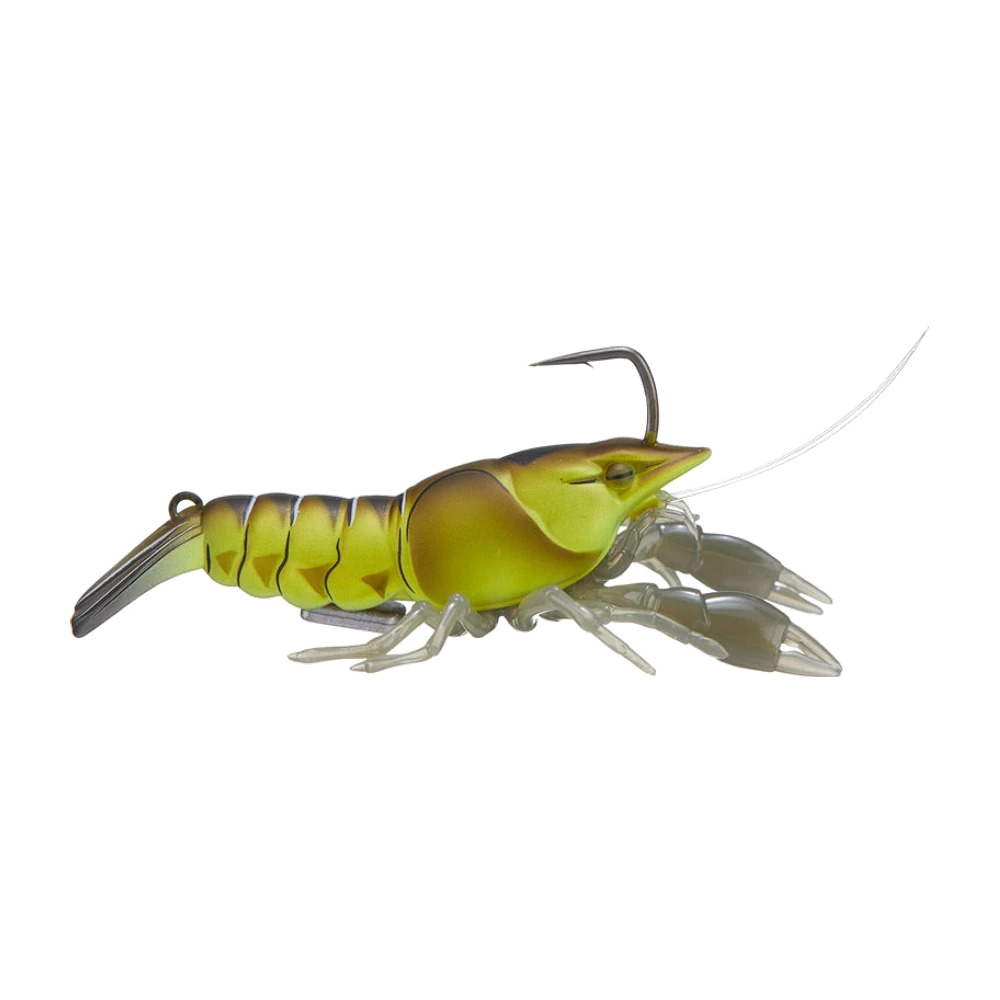
One honest note about the source: the manufacturer's text visibly mixes two products and repeatedly names a Live Shrimp in the middle of a passage devoted to the Live Craw. So we go with the table, which lists only the Live Craw, and with what can be verified in the photograph.
What the table says, and what it does not
The table header is precise and must be read in full: Length of Body. That is not the overall length of the bait with claws and antennae, but the body alone.
- Live Craw 2.5 in: 6.4 cm of body.
- Live Craw 3 in: 7.6 cm of body.
With the claws held forward and the antennae trailing, the real footprint in a box is considerably larger. That is a useful practical figure: a 3 in takes up the room of a 12 cm bait.
The table carries no weight column and no class column. No total mass is published. The maker does, however, explicitly state that two additional belly weights of 2.5 g and 5.5 g are included, snapping on and off to tune the action and the rate of fall to the mood of the fish. In the photograph, one of those weights is fitted under the belly, between the legs.
Tuning the fall rate, the real lever
That is where a day is won or lost. With no belly weight, the crawfish sinks as slowly as it can and the internal weight's wobble has all the time it needs to express itself: that is the setting for lethargic fish, cold water and shallow depths. With the 2.5 g weight you gain casting distance and some hold in a little current. With the 5.5 g you drop quickly onto a deep break, but you lose part of the rocking motion.
Change the weight before you change the colour. Three quarters of the refusals on this bait come from a fall rate that does not match the activity of the moment, not from a colour problem. And unlike swapping baits, it takes ten seconds at the water's edge.
The three retrieves to know
The tight free fall. Cast, let it drop on a just-tight line and watch the slack. It is the most productive presentation and also the one where most bites are missed: a crawfish intercepted on the drop is barely felt.
Twitch and pause. One sharp twenty-centimetre pull, then nothing for three seconds. The bait tips, wobbles, clicks and settles. The strike comes during that return to balance.
The very slow retrieve. Listed by the maker as a possible use: bring the bait back grazing the bottom like a slow crankbait. Handy for covering a big gravel flat when you do not yet know where the fish are.
Hook and leader
The bait is built around a single 2x Mustad Ultra Point O'Shaughnessy hook with a TitanX coating, reinforced inside the body. The manufacturer highlights that coating's corrosion resistance, aimed at saltwater use. For us the practical interest lies elsewhere: a hook anchored in the body does not pull out after three fish, which is the classic failing of soft crawfish.
Point riding up and line tie set at the tail end: the bait is pulled backwards, exactly like a fleeing crawfish. Fluorocarbon of 0.25 to 0.30 mm is enough for bass and zander; add a short wire leader if the spot genuinely holds pike.
Legs, claws and antennae are TPE, a plastic the maker describes as durable enough that no replacement legs are offered. That remains to be judged over time, but it is clearly a tougher material than the plastisol of a conventional soft crawfish.
Not sure what to tie on?
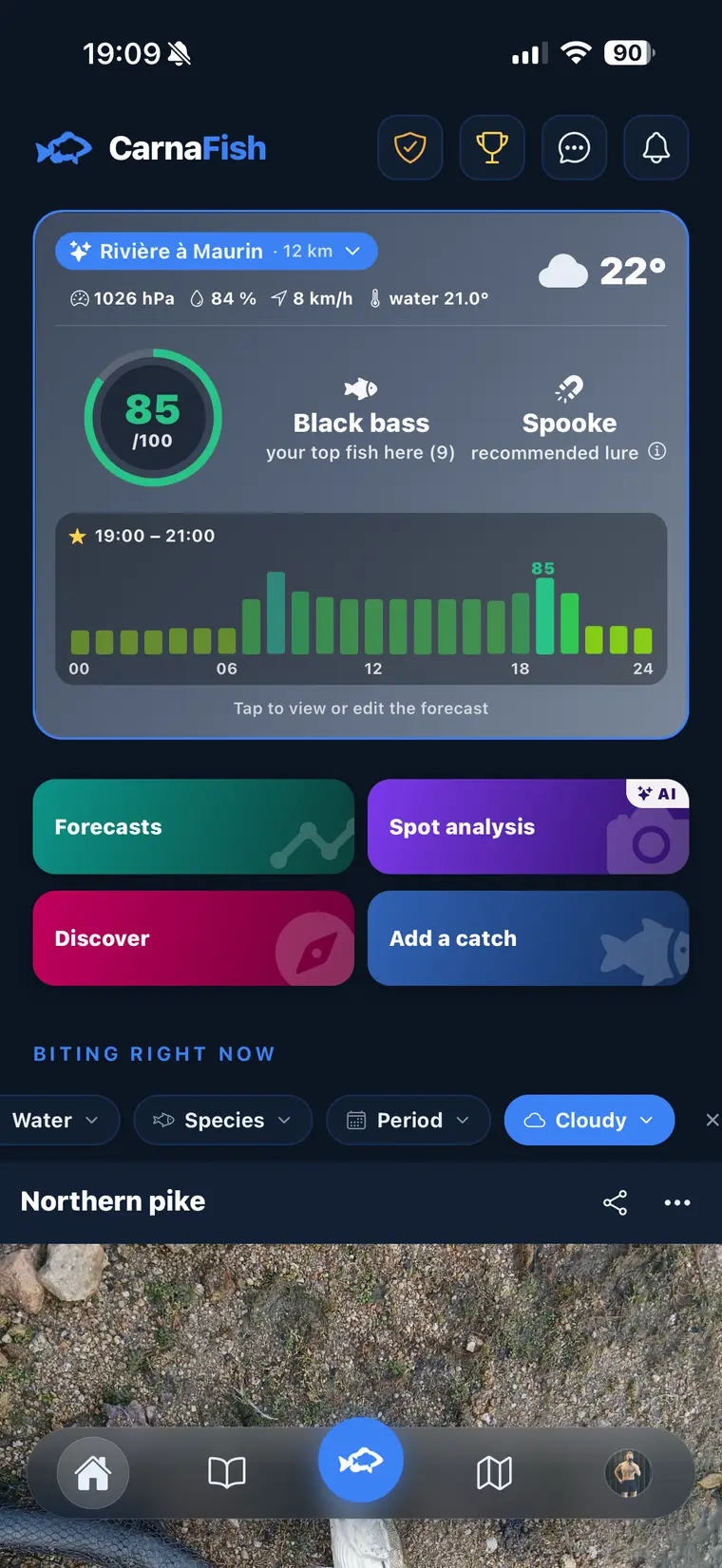
Photograph your spot: CarnaFish reads the scene, cross-checks the conditions and gives you the zone, the lure and the retrieve. Free on iOS and Android.
Colour by bottom type
- Gravel bottom, slightly stained water: the olive chartreuse of the unit photographed, which copies the livery of an American crawfish in season.
- Spring, cool water: a red brown, the shade of crawfish just after moulting, and the one bass actively hunt at that time of year.
- Very clear water, educated fish: a translucent natural, more discreet, letting the wobble and the click do the work instead of the colour.
When to prefer a soft crawfish
The Live Craw is not a do-everything bait. In a tangle of branches, a Texas-rigged soft crawfish such as a Strike King Rage Craw will go where an exposed single hook snags. For finesse fishing on a ned head, a Savage Gear Ned Craw stays better suited. The Live Craw takes over on clean hard bottom, where its off-balance fall and its clicking are both visible and audible — and against a Molix Real Craw, what it mainly brings is that adjustable belly weight.
Knowing whether the bottom in front of you is a gravel flat or a jumble of deadwood changes the bait choice completely. That is precisely what CarnaFish offers from a photo of the spot, suggesting the zone and the presentation that fit. To dig into reading a swim, our guide to reading a fishing spot lays out the clues to look for.
Key takeaways
- The table gives a body length: 6.4 cm and 7.6 cm, claws and antennae excluded.
- No total weight is published, but two snap-on belly weights of 2.5 g and 5.5 g are supplied.
- The off-centre internal weight makes the bait rock and click on the pause: that is when the bite comes.
- A single reinforced Mustad hook anchored in the body, far more durable than a soft crawfish.
FAQ
Which Live Craw size should I choose?
The 2.5 in, 6.4 cm of body, covers most situations for bass and zander. Step up to the 3 in, 7.6 cm, for bigger fish or where the crawfish in your water run large.
How much does the Live Craw weigh?
The manufacturer publishes no total mass, neither in the table nor in the text. The only figures given are those of the two supplied belly weights, 2.5 g and 5.5 g. If you need the exact weight, put the bait on a scale.
What are the belly weights for?
To tune the rate of fall and the amplitude of the movement. With no weight, the descent is slowest and the wobble most pronounced; with 5.5 g you drop quickly onto a deep spot at the cost of some rocking.
Is the Live Craw any good for zander?
Yes, the maker explicitly names zander among the bottom-feeding predators it targets. A slow fall down a gravel break followed by long pauses matches the way it hunts.
Why is the line tie at the tail end?
Because a fleeing crawfish goes backwards. The bait is therefore pulled in reverse, claws forward, reproducing the prey's real movement and presenting the claws to the predator.
Do the legs and claws break?
They are TPE, a material the maker describes as tough enough that no replacement legs are offered. It is clearly stronger than a conventional soft crawfish, without being indestructible.
The full bass lure guideSeason-by-season strategy: which family of lure, when, and why.Go from theory to fish
CarnaFish reads your spot from a photo and gives you the game plan: zone, lure, retrieve. Free on iOS and Android.