Lucky Craft Wander 80: the sinking pencil that works below the surface
The right lure in the wrong spot still catches nothing. CarnaFish spots the zone that works, from a single photo.
Some days the fish feed high without ever breaking the surface. You see dull boils, chases ten centimetres under the mirror, and your topwater stickbait only earns refusals in the last metre. The Wander 80 is built for exactly that layer: the first few dozen centimetres below the surface, too high for a crankbait, too low for a topwater. And because Lucky Craft lists it as sinking, it does not fish the way its silhouette suggests at all.
A pencil that sinks, not a walking bait
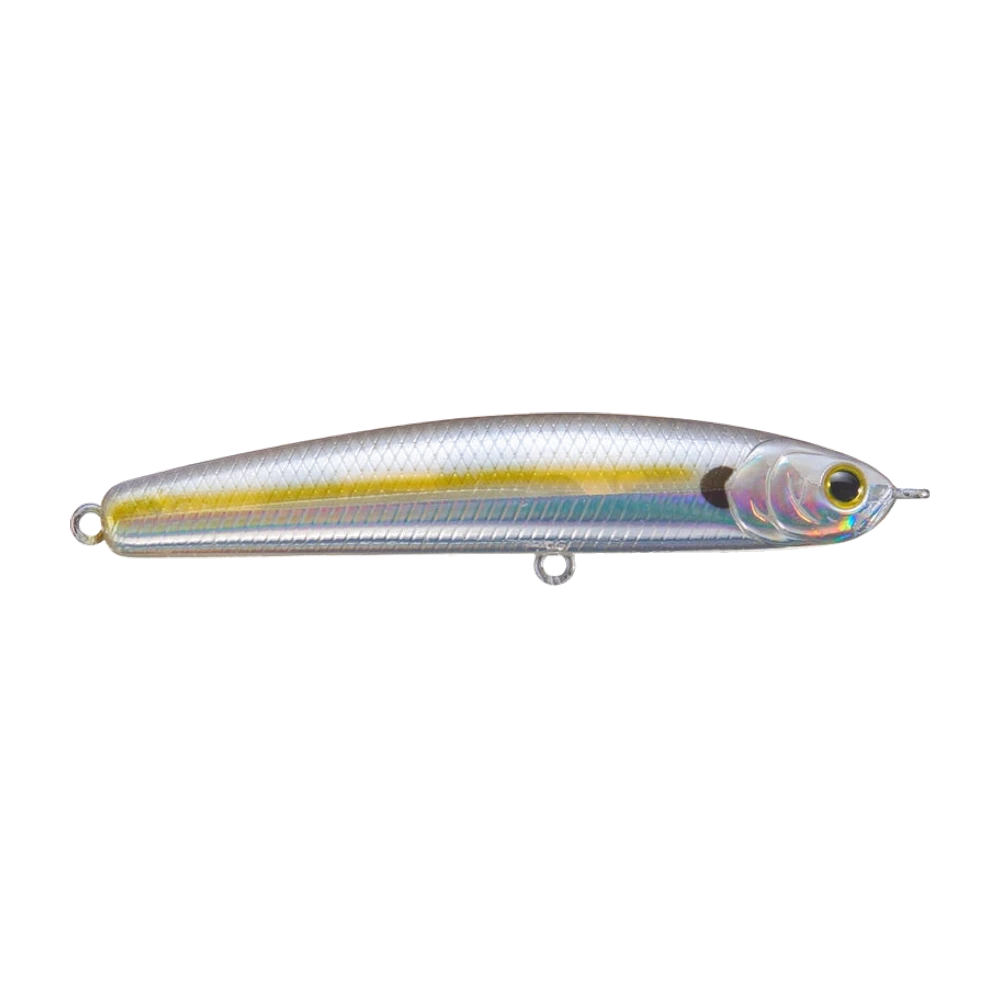
This is the first misunderstanding to clear up, because everything else follows from it. The shape of the Wander 80 — slim body, no lip, nose line tie — is exactly that of a topwater pencil. But Lucky Craft's own copy ties it to its lipless and jigging minnow concept, and the spec table lists it plainly as Sinking, with a stated running depth of subsurface. In other words, this bait is not meant to walk across the mirror, it is meant to wander under it.
Buy it expecting a walker, work it like a Sammy, and you will decide it does not work: the bait sinks during the pause, it will not hold position, and a topwater cadence simply does not suit it. Everything changes once you take it for what it is — a small lipless sinking minnow whose depth you pick with a count, not with a lip.
The numbers fit in one line: 7.9 cm / 3-1/8 in for 10.6 g / 3/8 oz. That is a high density for an 8 cm bait, roughly twice what a floating minnow of the same length weighs. In practice it means two things. It casts a long way for its size, even into a crosswind, and it drops fast when you let it.
The horizontal fall is the real argument
Lucky Craft is specific on one point: the Wander 80 is built to fall horizontally and to hold a natural posture by wobbling its body on the way down. That is not a cosmetic detail. Most sinking hard baits drop nose-first or tail-first, descending stiff and diagonal in an attitude no baitfish ever adopts unless it is dead. A bait that falls flat while rolling slowly on its axis looks like a stunned minnow losing its balance without having given up yet.
Most of your bites will come during that phase, and that is also the phase where you feel nothing at all. The fish does not pull; it rises, inhales and swims off horizontally. All you get is a slack line that stops sinking or starts sliding sideways. Watch your line, not your rod tip.
The second stated behaviour is the body roll on the retrieve. Wound slowly, the Wander throws off lateral flashes without ever blowing out. It is not a wide crankbait wobble, it is a tight shimmer — the kind of signal that still gets through on fish that have already seen plenty of lures.
Two ways to fish it
The subsurface straight retrieve
The simplest one, and often the best when fish are active. Cast, count no more than two seconds, then wind slowly with the rod held high. The bait then works in the top 20 to 50 cm, rolling as it comes. Keep the speed slower than feels right: this lure needs no speed to come alive, and extra speed only lifts it out of its layer.
Count down, then dart
This is the use the maker puts forward: let it sink to the depth you want, then twitch it to trigger sharp sideways darts. Count under your breath with the line completely slack — a tight line during the drop kills the flat fall and swings the bait back towards you. Over 3 to 4 m of water, a five to eight second count already puts you in the lower half of the column.
Then two or three short rod-tip strokes, wrist only, followed by a long pause. The darts are crisp because there is no lip to brake them; the pause restarts the flat fall. That twitch-twitch-pause cycle is the real retrieve for the Wander, far more than a straight wind.
The classic mistake
Working it too big. Half-metre sweeps make the bait climb and break the fall-then-dart sequence instead of linking the two. The Wander 80 carries 10.6 g on 8 cm of body: it reacts to very little energy. If your line whips the air on every stroke, you are pulling three times too hard.
The trap with this bait is the pause. It feels like wasted time, so you start winding again after a second. Count to four every single time for the first few hours and watch when the bites land: nine times out of ten it is inside the pause you kept cutting short.
Hooks, knot and leader
The Wander 80 ships with two size #8 trebles. That is fine wire for an 8 cm bait and it calls for two habits. First, a soft drag setting: a #8 buried in the bony jaw of a good bass will open if you clamp down. Second, regular point checks, because the bait's roll puts the hooks against rock and wood far more often than a lipped lure, which keeps its trebles tucked behind the diving bill.
For the connection, a small snap or a loop knot leaves the nose free to pivot through the darts. A knot cinched straight onto the line tie stiffens the sideways kick and turns the darts into flat jerks. Fluorocarbon in 20 to 25/100 covers bass and perch. On any water that also holds pike, step up to heavy fluorocarbon or a thin titanium trace: a bait working mid-column in open water is exactly what a pike intercepts.
One piece of background worth knowing, because it explains some of the listings you will come across: Lucky Craft produced a run of limited edition colours with gold-foiled packaging whose sale helped raise money for the damage caused by the Wajima earthquakes that hit Japan in January 2024. Those colours were made in small quantities. Their scarcity changes nothing about the fishing, but it does explain the price gaps between dealers.
Not sure what to tie on?
Photograph your spot: CarnaFish reads the scene, cross-checks the conditions and gives you the zone, the lure and the retrieve. Free on iOS and Android.
Colours by water clarity
- Clear water: a translucent ghost pattern. The body passes light and returns only a diffuse glint, which is what you want when the fish has time to inspect.
- Lightly stained water: a gold back over silver flanks, like the one in the photo. The dark back gives the silhouette, the gold band gives the flash.
- Dirty water or heavy overcast: chartreuse, or an orange belly. At this size, silhouette matters more than scale detail.
Where it earns its box space
The Wander 80 replaces neither a lipless crank like the Lucky Craft Bevy Vibration, which sinks faster and vibrates far harder, nor a true walking bait like the Lucky Craft Sammy 100, which stays on top through the pause. Its closest neighbour in a European box is the DUO Realis Spinbait 80: same size, same philosophy of a discreet sinking bait for wary fish, except the spinbait relies on its props during an ultra-slow wind while the Wander relies on the flat fall and the dart.
Knowing which layer to fish before you even pick a lure is exactly what CarnaFish is for: one photo of the spot and the AI suggests the zone, the depth and the type of presentation that match the day's conditions. To place this family of baits inside a sensible progression, our beginner's guide to bass fishing covers the categories worth owning first.
Key takeaways
- The spec table says Sinking with a subsurface running depth: despite the pencil silhouette, this is not a topwater and it does not walk.
- 7.9 cm / 3-1/8 in for 10.6 g / 3/8 oz, a high density that buys casting distance and a decisive drop on the count.
- The reference retrieve is twitch-twitch-pause: the darts come from the lack of a lip, the bites come from the flat fall.
- Two stock size #8 trebles: soft drag and frequent point checks, or you will drop good fish.
FAQ
Is the Wander 80 a topwater lure?
No. The maker's spec table lists it as sinking, with a stated running depth just under the surface. The pencil shape is misleading, but it does not hold position on the pause: it goes down, and that is exactly what you want from it.
How deep can it be fished?
As deep as you choose, since it sinks. On a slow straight retrieve it stays in the top 20 to 50 cm; with a five to eight second count on a slack line you can reach the lower half of a 3 to 4 m hole before you start twitching.
Why are my darts so soft?
Two causes, in order: a knot cinched directly onto the line tie, which stops the head pivoting, and strokes that are too wide. Switch to a snap or a loop knot and cut the amplitude down to short wrist flicks.
Should I change the stock hooks?
Not necessarily, the fitted size #8 trebles are fine wire and sharp. Do check the points after every series of casts near wood or rock, though: a lipless bait exposes its hooks to contact far more often than a lipped model.
Does the Wander 80 interest perch?
Yes, and it is a logical size for them: 8 cm, a slim profile, short strokes and long pauses. On perch hunting mid-water above a break line, the count-down then twitch routine works well.
How does it differ from a spinbait like the Realis Spinbait 80?
Both are discreet sinking baits of the same size, but the DUO Realis Spinbait 80 works on a continuous ultra-slow wind thanks to its props, while the Wander asks for a stop-and-go retrieve and lives off the flat fall between two twitches.
The full bass lure guideSeason-by-season strategy: which family of lure, when, and why.Go from theory to fish
CarnaFish reads your spot from a photo and gives you the game plan: zone, lure, retrieve. Free on iOS and Android.