Megabass Karashi Twitch Bait: walking the dog below the surface
Not sure this lure fits YOUR spot today? CarnaFish tells you in 10 seconds, from a photo.
There's a scene that comes back every summer on pressured water: a bass rises to a surface stickbait, follows it for a couple of metres, then drops back down without ever touching it. It has seen that same zigzag fifty times this season, and breaking the surface film has become its alarm bell. The Megabass Karashi Twitch Bait answers that in a simple way: it draws the exact same zigzag, but a foot lower, where the fish no longer has the sky behind the bait.
Three numbers that define the bait
The maker's spec table holds three values, and they say almost everything: 2.3 in, which is 5.8 cm, 3/16 oz, which is about 5.3 g, and a class of Slow Sink. The third line matters most. A 5.8 cm bait that zigzags is a familiar object — that's a surface pencil. Here the same movement happens underwater, because the body density pulls it down the moment you stop working it.
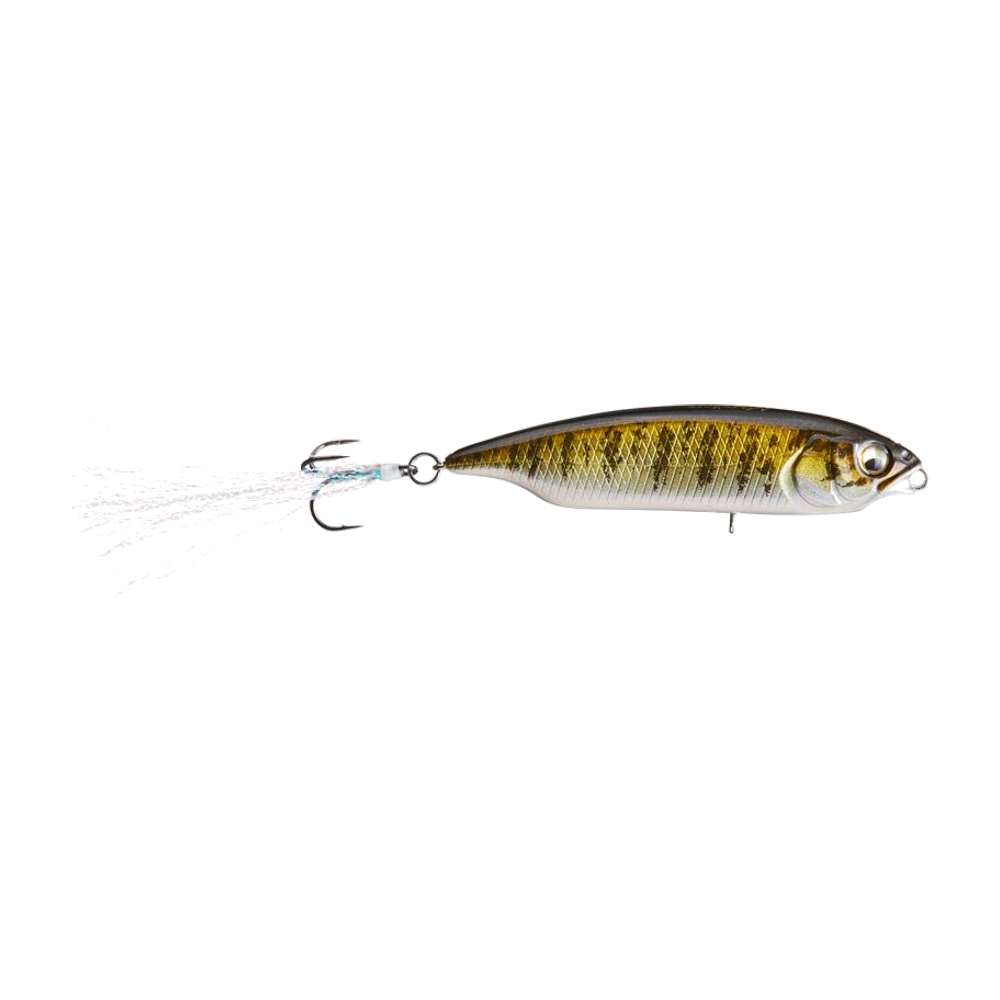
The body carries no lip at all. The line tie sits in the nose, and that is the only grip water has on the bait. Megabass describes a wide walk-the-dog action that darts left then right on every rod snap, a motion previously only available from topwater lures. The rest of the description covers the finish: raised 3D scale and lateral-line patterns, pronounced gill rakers, the brand's downward-facing eyes. Moulding detail, not swimming arguments — but on a fish that inspects a bait for a long time, they are not neutral.
Sink time is your only depth control
Understand this before the first cast. With no lip, nothing makes the bait dive during the retrieve: rod snaps send it sideways, never down. Depth is decided before the action, during the pause after the splashdown, and again on every pause you insert.
In practice you cast, leave slack line, and count. Three seconds and you're working the top foot. Eight seconds and you're under a metre. Because the bait barely climbs during the zigzag and drops again on every stop, a long retrieve finishes well below where it started: an advantage along a breakline, a liability over submerged weed.
Megabass publishes no sink rate. Test it at the start of the session along a bank where you can see bottom — at 5.3 g, line diameter and current shift that figure noticeably.
Two retrieves with nothing in common
Twitching, the main use
Rod tip low, almost in the water. Two or three short, sharp snaps from the wrist alone, the rod returning instantly to feed slack back. That slack is the whole trick: a lipless bait can only break sideways if the line isn't holding it. Then a one-to-three-second stop during which the bait sinks flat. String together bursts of two to five snaps separated by those stops, and raise the rod gradually so you don't finish the zigzag at your feet.
The bite almost always lands on the stop, rarely during the burst. It shows up as line moving off sideways rather than a thump in the rod, because the fish is taking a motionless, sinking bait.
The slow straight retrieve nobody tries
Megabass lists a second register, the opposite of the first: a steady straight retrieve with no rod action at all, which it compares to a spybait presentation for lethargic fish. The comparison is about register, not mechanism — the Karashi has no blades, so there's no rotation and no spinning flash. Very slow, very straight, very quiet: it's the mode to try when twitching only produces follows.
Line, leader and hardware
A 5.3 g lipless bait casts badly on heavy gear. A short, crisp rod, thin line, and a knot that leaves the nose free: a loop knot or a small clip, never a tight knot cinched against the eye. Fine braid with a metre of 20-25/100 fluorocarbon gives you the sensitivity to feel a take on a motionless bait while staying discreet in clear water.
On hardware the maker stays vague: it mentions premium components without giving hook size or count, so there's no telling what comes out of the package. The sample photographed here carries a single treble at the rear, dressed with white fibres and a few strands of blue flash, with a belly hook hanger clearly present but left empty. That's an observation from a product photo, not a specification.
The classic mistake
Twitching hard. The reflex comes from lipped jerkbaits, which need power to make the lip bite into the water. Here it's the reverse: too wide a pull on a body this light makes it break the surface or roll over instead of darting sideways. Halve the amplitude and check that you're feeding slack between snaps — nine times out of ten, that's the problem.
Second mistake: fishing it in weed. A bare treble on a bait that ends its run near the bottom collects everything. This is a clean-edge bait.
Not sure what to tie on?
Photograph your spot: CarnaFish reads the scene, cross-checks the conditions and gives you the zone, the lure and the retrieve. Free on iOS and Android.
Colour by water clarity
Megabass rotates its colour range quickly and names change between runs, so think in tones rather than references.
- Clear water: a natural gold-and-olive with a dark back and white belly, the finish photographed here. It mimics a river baitfish without excess flash.
- Bright sun: pearl chrome, throwing a short glint on every change of direction. The zigzag becomes a flicker, visible from further away.
- Dirty water or low light: matte black. It isn't the colour the fish sees, it's the silhouette that reads from below.
Where it sits in a box
The Karashi doesn't replace a lipped jerkbait like the Megabass Vision 110, which holds a fixed depth where the Karashi keeps sinking. It doesn't replace a surface pencil like the Megabass Dog-X either, whose visible spray remains a huge argument. Its closest neighbour is the Megabass X-80 Trick Darter, which also darts in mid-water — except that it has a small lip and therefore a predictable depth, while the Karashi depends entirely on the time you give it. You pull it out between the two: after the surface has been refused, before you drop to a bottom rig.
The size also suits perch in Europe, along pond margins and reservoir riprap, provided you shorten the pauses: perch will follow a long-sinking bait but commit more readily to a sustained rhythm. Picking the right water layer is the real question, and that's what CarnaFish does: a photo of the spot, and the app tells you which zone and depth to attack first. For spot and tackle fundamentals, our beginner's guide to bass fishing covers the ground.
Key takeaways
- The maker's table gives 5.8 cm / 2.3 in, about 5.3 g / 3/16 oz and a Slow Sink class: this is a slow-sinking bait, not a topwater.
- With no lip, depth is set purely by sink time, before and between bursts of action.
- The zigzag comes from the slack you feed back, not from the force of the rod snap.
- Hardware isn't documented by the maker; the photographed sample carries only the rear treble, dressed with white fibres.
FAQ
Is the Karashi Twitch Bait a topwater lure?
No. The maker's spec table rates it Slow Sink. It reproduces the zigzag of a surface bait, but it does so underwater and it starts dropping the moment you stop working it.
How deep does it run?
As deep as you decide. With no lip, nothing makes it dive during the retrieve: only sink time sets the water layer. Count in seconds and note what works, since the maker publishes no sink rate.
Why won't my Karashi zigzag?
Almost always because the rod snaps are too wide and the line stays tight. Halve the amplitude, keep the rod tip low and feed slack immediately after each snap — that slack is what lets the bait break sideways.
What line and leader should I use?
Fine braid with a metre of 20-25/100 fluorocarbon. The braid gives the sensitivity to feel a take on a motionless bait, the fluorocarbon the discretion for clear water. Loop knot or clip, never a tight knot on the eye.
How many hooks does it come with?
The maker only mentions quality hardware, with no size or count given. In the product photo a single treble is fitted at the rear, dressed with white fibres, with the belly hanger left empty. Check your own rather than assuming a range habit.
Will it catch perch?
Yes, 5.8 cm for 5.3 g matches what perch take in Europe along margins and riprap. Just shorten the pauses: they'll happily follow a sinking bait but commit more cleanly to a sustained rhythm.
The full bass lure guideSeason-by-season strategy: which family of lure, when, and why.Go from theory to fish
CarnaFish reads your spot from a photo and gives you the game plan: zone, lure, retrieve. Free on iOS and Android.