Lunkerhunt Furenzy Mouse: the flocked mouse that walks the surface
Not sure this lure fits YOUR spot today? CarnaFish tells you in 10 seconds, from a photo.
Rodents are not part of a bass's daily diet, and that is exactly what makes a surface mouse worth carrying. On water that has been worked all season with frogs, poppers and stickbaits, a profile the fish has never seen pulls honest blow-ups where the classics only draw a follow. The Lunkerhunt Furenzy Mouse is built for that, with a manufacturing detail you will not find elsewhere: a flocked skin.
Three sizes, and the gaps between them matter
The maker's table lists three versions, all classed topwater, so strictly surface. The smallest is 2 in, 5.1 cm, at 3/8 oz — about 11 g. The middle one moves to 2.5 in, 6.4 cm, at 1/2 oz, roughly 14 g. The largest reaches 3 in, 7.6 cm, at 3/4 oz, around 21 g.
Those numbers do not describe three flavours of one lure but three different jobs. The 11 g stays castable on an ordinary medium-heavy rod and suits waters holding average fish. The 21 g wants a heavy outfit and earns its place as soon as you have to punch through wind or clear thick cover. The middle size is the compromise most anglers will keep in the box.
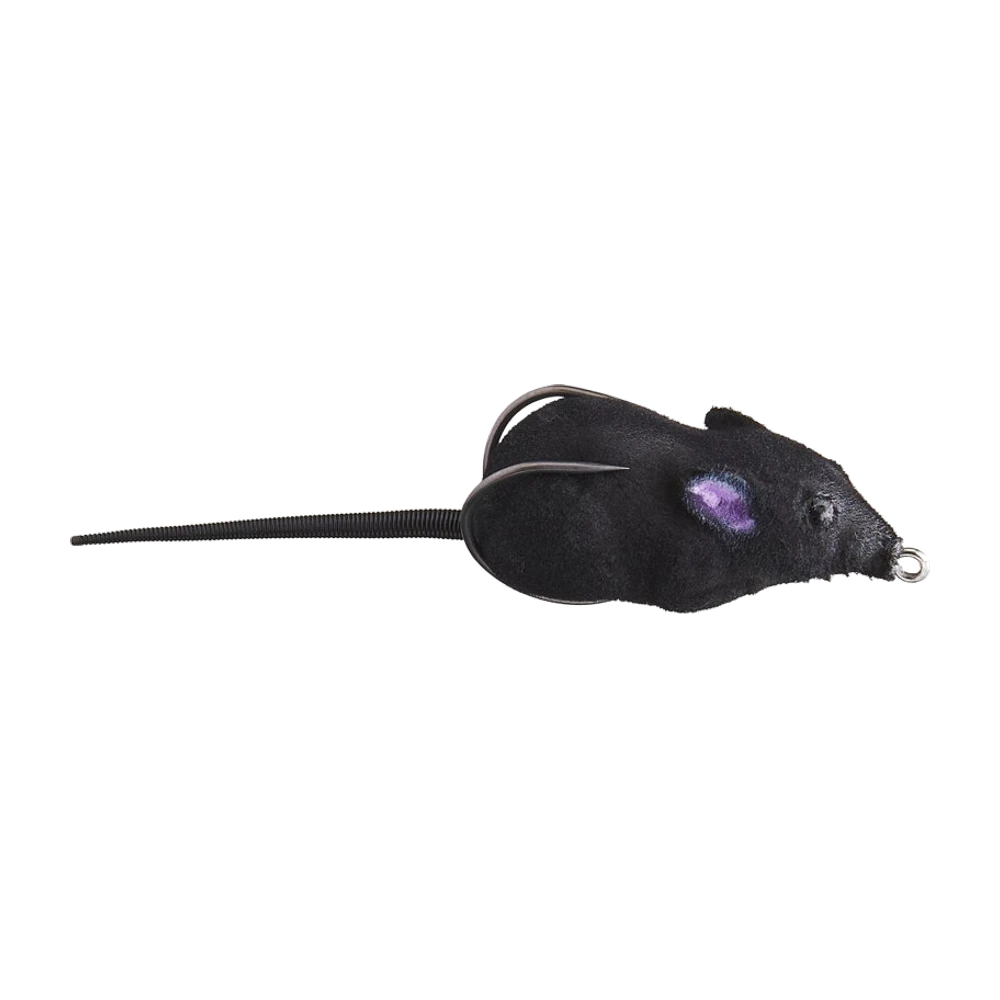
Worth noting: the quoted lengths are body lengths. The soft tail hanging off the back, clearly visible in the photo, adds to that figure and can easily double the lure's apparent footprint in the tray. Don't judge the total silhouette the fish will see from the table alone.
The flocked skin, and what it actually changes
Lunkerhunt describes a flocked rubber surface, textured to look like real fur. That is not a cosmetic argument without consequence: a matte, velvety coating reflects almost nothing. Under bright light, where a smooth plastic body acts as a mirror and can give a lure away to a wary fish, the Furenzy Mouse stays a dark, flat silhouette.
There is a trade-off worth knowing. Flocking holds water, and it holds debris too. After an hour over duckweed the skin loads up with green and the lure weighs more than it did out of the pack. A rinse in clean water at the end of a session and a flat dry stop the texture from eventually hardening.
A walking action the tail extends
The maker advertises a walk-the-dog action, produced the same way as on a standard frog: sharp rod tip taps and a deliberately slack line. The hollow body pivots one way then the other, and this is where the extra part comes in — the soft rubber tail, which the description presents as an element that increases topwater action. In practice it sweeps late behind the body on every change of direction, leaving a broken wake rather than a clean one.
That tail also forces a slower rhythm than a bare frog. Chain the rod taps too quickly and it never gets back in line, so it drags on the next pivot. Two taps, a one to two second pause, two taps: that is the cadence this lure rewards.
On a mouse, the long pause often beats the animation. Leave the lure dead still for five seconds beside a stump or a reed edge, hands off the rod. A rodent that falls in floats and waits, it does not sprint across the pond — and the biggest blow-ups almost always come on that dead time.
An ambiguity in the maker's own copy
Lunkerhunt's description states two things that do not quite sit together. It first presents the Furenzy Mouse as designed to fish over pads, grass and heavy vegetation, then writes a few lines later that it excels in open water. The two are not incompatible, but the nuance deserves saying: the build — hollow body, weedless slick-coated double hook folded against the body — is clearly that of a cover lure.
In open water it does work, but without trebles it converts strikes less reliably than a standard stickbait. Treat the open-water claim as a bonus, not as the lure's purpose. If you want to compare two takes on the same theme, the LiveTarget Hollow Body Field Mouse handles the rodent imitation with a painted rather than flocked finish, while the Savage Gear 3D Rad Rat steps up a size to target bigger fish.
Rigging and hookset
Same logic as a frog: 30 to 40 lb braid tied straight to the front ring, heavy fast-action rod, high-speed casting reel. The double hook carries the slick coating the maker advertises, which helps penetration but does not excuse skipping a sharpness check — the points of a surface double dull quickly against woody stems. For a smaller, more compact profile over the same cover, the Lunkerhunt Compact Frog is the obvious stablemate.
On the set, wait for the weight before you pull. On a mouse the strike is often even more spectacular than on a frog, and the urge to hit the noise scales accordingly. A full second late beats a lure torn out of an open mouth.
Not sure what to tie on?
Photograph your spot: CarnaFish reads the scene, cross-checks the conditions and gives you the zone, the lure and the retrieve. Free on iOS and Android.
Colours by water and light
- Night, dawn, dusk, dark water: solid black, like the one in the photo. Rodents move mostly at last light, and a black silhouette cuts out cleanly seen from below.
- Clear water, full light: a natural brown pattern, back darker than the flanks. That is the closest thing to a vole that has dropped off a bank.
- Stained water: a dark back over a pale belly. The fish attacks from underneath and the belly is its aiming point.
Lunkerhunt advertises several colours without naming them in its spec sheet: think in contrasts rather than catalogue references.
A surface mouse does not catch fish everywhere: it needs an undercut bank, a low branch, a reed edge — somewhere a rodent could genuinely fall in. That is exactly the kind of reading CarnaFish makes easier: a photo of the spot, and the AI suggests the zone to attack and the presentation that fits the day's conditions. For the rest of the fundamentals, our guide to getting started with bass fishing covers swims and tackle.
Key takeaways
- Three sizes in the catalogue, 5.1 cm at 11 g, 6.4 cm at 14 g and 7.6 cm at 21 g, all listed as topwater.
- The flocked skin kills reflections, but it loads with debris and needs rinsing after use.
- The soft tail extends the wake and forces a slower cadence than a bare frog.
- The maker's copy claims both heavy cover and open water: the build points clearly towards cover.
FAQ
Which Furenzy Mouse size should I pick?
The 6.4 cm at 14 g is the best entry point: castable on a medium-heavy outfit and bulky enough to interest a good fish. The 5.1 cm at 11 g suits small waters, the 7.6 cm at 21 g windy swims or larger specimens.
Will a mouse really catch bass?
Yes, but not just anywhere. It needs a believable context: an undercut bank, an overhanging branch, a reed edge. Over featureless open water a stickbait or a standard frog makes more sense and will out-fish it.
Can I fish it for pike?
In summer, over shallow weed beds, yes. The double hook is stout enough for a mid-sized pike, but add a heavy fluorocarbon or titanium leader without fail: braid cuts on pike teeth.
Does the rubber tail wear out?
It is the most exposed part, as on any lure with a soft appendage. It takes missed strikes well, repeated rubbing on rock edges less so. Check where it joins the body after every fish.
How do I look after the flocked surface?
Rinse in clean water at the end of a session to shed algae and silt, then dry flat, never in direct sun. A clogged flocking loses its matte texture and gains weight.
Does the hookset differ from a frog?
No, the rule is identical and even harder to hold to here, because the strike is often more violent: wait until you feel the weight of the fish in the rod, then set hard. Setting on the noise tears the lure out of a mouth that is still open.
The full bass lure guideSeason-by-season strategy: which family of lure, when, and why.Go from theory to fish
CarnaFish reads your spot from a photo and gives you the game plan: zone, lure, retrieve. Free on iOS and Android.