Manns Stretch 25+: deep trolling set by the line you let out
One lure, endless conditions. CarnaFish reads your spot from a photo so you are not just guessing.
Nobody loses fish on the troll because their lure was the wrong colour. You lose them because you do not know what depth it is running at.
That is the whole difficulty of this fishing: between the boat and the lure there are forty metres of line, a current, a variable speed, and no visual feedback at all. You can troll for two hours over a pack of catfish sitting at six metres without ever knowing it.
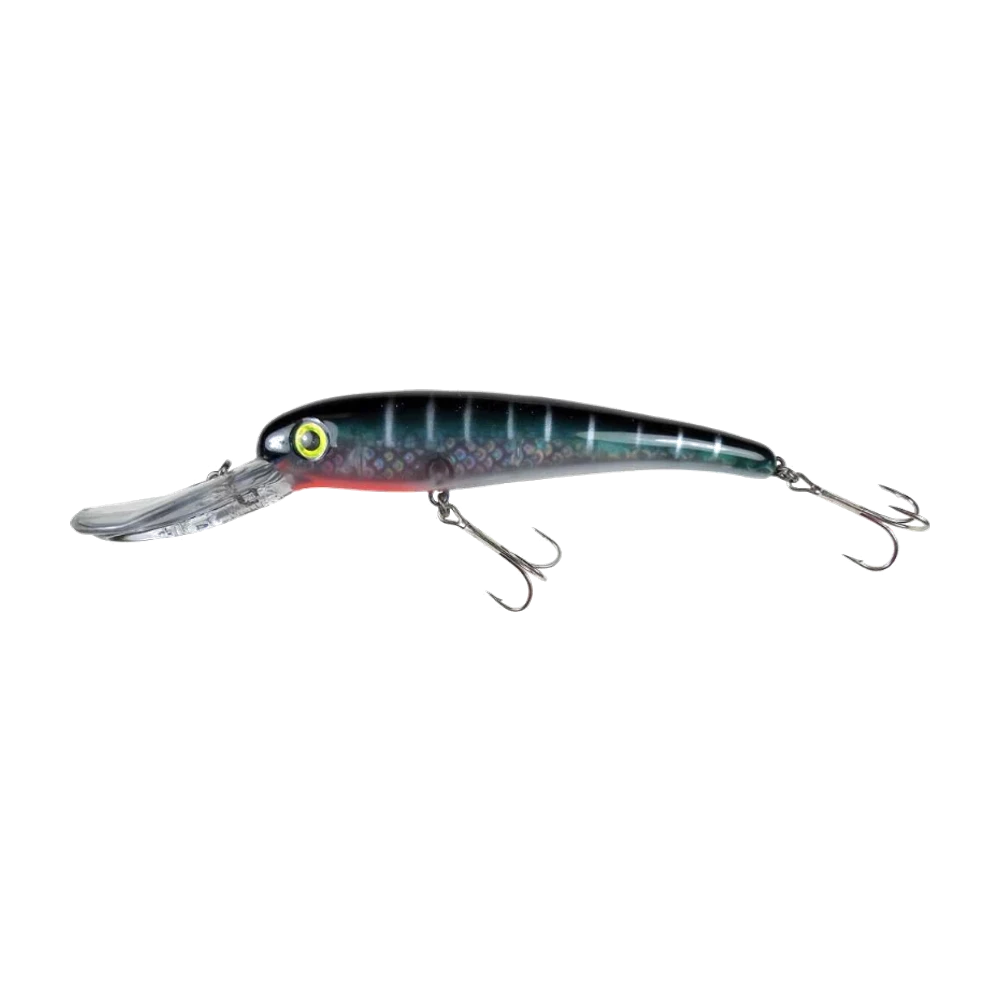
The Stretch 25+ exists to remove that uncertainty. Its oversized lip makes it a hard-pulling lure whose depth depends on a single controllable parameter: the length of line you let out. Once you have calibrated that relationship on your own tackle, you know where your lure is running, and the fishing becomes a matter of reading the sounder rather than luck.
A lip that pulls, and everything that follows
- Enormous pull. It is the first thing you notice. The rod bends hard the moment you engage the drive. Plan the right setup: a powerful trolling rod and a reel that can take a continuous load.
- A heavy, slow roll. No fine vibration: dull, widely spaced thumps, very easy to read in the rod tip. That signature is your working indicator — as long as you can see it beating, the lure is swimming.
- Clear bottom contact. When the lip touches, you feel it and you see it. That is intentional: clouds of silt and knocks on stones are a powerful call for catfish.
- Depth tied to line let out. At constant speed, doubling the length of line behind the boat takes the lure noticeably deeper — up to the plateau where it will go no deeper.
Calibrating your line length
This is a job you do once, and it beats every printed chart, because it depends on your line, your speed and your boat.
- Find a known, even bottom, for example a five-metre plateau marked on the sounder.
- Set your speed to 4 km/h on the GPS and do not change it for the rest of the test.
- Let out thirty metres of line, engage, troll for two minutes. Note whether you touch bottom.
- Add ten metres and start again.
- Keep going until the first clear bottom contact. You now know the length that puts you at five metres in these conditions.
- Write that reference down and work the rest out from it: less line, less depth.
| Line let out | Indicative depth | Use |
|---|---|---|
| 20 to 30 m | 3 to 4.5 m | Plateaus, channel edges |
| 40 to 50 m | 5 to 6.5 m | River holes, zander on a drop-off |
| 60 m and more | 6.5 to 7.5 m | Big catfish holes |
Braid is essential: over forty metres, mono stretches too much to transmit contact and makes the hookset useless. Add a heavy fluorocarbon leader of 1.5 to 2 m, especially for catfish, to handle abrasion against fin rays and sunken timber.
On the water: over a hole, do not troll along the deepest axis. Run the edge of the hole at an angle, so the lure touches bottom once every twenty or thirty seconds. It is those intermittent contacts that trigger, not a steady pass through open water.
Speed and reading the rod tip
The useful range sits between 3 and 5 km/h on the GPS. Any slower and the lure does not swim properly; any faster and it planes up and rises.
The rod tip is your only screen. It should beat steadily and widely. Three faults to recognise:
The tip stiffens and stops beating. The lure has picked up weed or a plastic bag. Reel in straight away, you are fishing for nothing.
The tip vibrates fast and irregularly. The speed is too high and the lure is blowing out. Drop 0.5 km/h.
The tip dips in repeated jolts. You are ploughing the bottom continuously. Take back five to ten metres of line, or you are about to snag.

Not sure what to tie on?
Photograph your spot: CarnaFish reads the scene, cross-checks the conditions and gives you the zone, the lure and the retrieve. Free on iOS and Android.
Catfish and zander: two different jobs
For catfish, the Stretch 25+ is a hole lure. You are looking for deep river sections, back eddies, bottoms cluttered with timber. The bottom contact and the big volume displaced work together. Bites are brutal and the hookset often happens on its own from the boat's pull: do not try to strike three times, just regain contact and let the rod do the work.
For zander, the use is finer. You target drop-offs and channel edges between four and six metres, at a fairly low speed of around 3 to 3.5 km/h, with much more spaced-out bottom contact. The Stretch is then a searching lure: it serves to locate an active band, which you then come back and fish on the cast with something lighter.
Stretch 25+, Catdiver or Clonk Teaser
These three lures live together in a catfish box, but they do not do the same job.
The MadCat Catdiver is also a big-lipped trolling lure, but it is designed above all for slow river trolling with a more settled swimming profile. The Stretch 25+ pulls harder and reaches depth faster, which makes it more interesting over very deep holes and on deep lakes.
The MadCat Clonk Teaser is not a rival at all: it is a vertical and clonking lure, used with the boat stationary or drifting, to work a fish you have already located. The Stretch finds, the Clonk Teaser converts.
For shallower, faster trolling, especially at sea or on a big lake, a Rapala X-Rap Magnum covers the intermediate band with a far livelier action.
Our guide to catfish fishing with lures explains how to read a hole before trolling it. And if you are unsure how much line to let out at the start, CarnaFish analyses a photo of the spot and answers.
Key takeaways
- Depth depends on the line let out, not on speed: calibrate it once.
- Braid is mandatory, with a heavy fluorocarbon leader for catfish.
- The rod tip is your only screen: learn to read its three faults.
- Aim for bottom contact every twenty to thirty seconds, not continuously.
- A searching lure: it locates, other techniques convert.
FAQ
How deep does the Manns Stretch 25+ run?
Roughly between 4 and 7.5 m depending on the line let out behind the boat and the trolling speed. The only reliable way to know is to calibrate the line-to-depth relationship yourself over a known bottom.
What trolling speed should I use?
Between 3 and 5 km/h on the GPS, held constant. Around 3 to 3.5 km/h for zander, more like 4 to 5 km/h for catfish. Below that the lure stops swimming; above it, it planes up and rises.
Should the lure touch bottom?
Intermittently, yes. A contact every twenty to thirty seconds lifts silt and produces knocks that are very attractive to catfish. Continuous ploughing, on the other hand, takes you straight to a snag.
Braid or mono for deep trolling?
Braid, in 0.30 to 0.40 mm. Over forty metres, mono stretches too much to transmit bottom contact and makes the hookset soft. Add a fluorocarbon leader of 0.60 to 0.80 mm over 1.5 to 2 m.
How does it differ from a clonking lure like the Clonk Teaser?
They do different jobs. The Stretch 25+ is trolled to cover ground and find fish; a clonking lure is fished with the boat almost stationary, straight down, on a fish already marked on the sounder.
Can it be cast from the bank?
No, not sensibly. Its mass and above all its enormous pull make it unfishable on the cast. It is a trolling lure, and its depth depends on a length of line behind a moving boat.
The full catfish lure guideSeason-by-season strategy: which family of lure, when, and why.Go from theory to fish
CarnaFish reads your spot from a photo and gives you the game plan: zone, lure, retrieve. Free on iOS and Android.