Megabass Big-M 2.0: 57 g of flat-sided crankbait for 1.8 m
This lure shines under specific conditions. CarnaFish tells you in 10 seconds if today is one of them.
A 12.7 cm crankbait that weighs 57 g and only runs at 1.8 m looks like a design error. It is not: on the Big-M 2.0 the mass is not there to dive, it is there to go a long way and to move a big volume of water in the most heavily fished layer of any lake. Once you grasp that, the bait becomes much easier to read.
Read the table before judging the bait
Megabass gives three columns and a single row: length, weight, depth. That reads 5 in, so 12.7 cm; 2 oz, so 56.7 g; 6 ft, so 1.83 m. Nothing else.
And one absence matters: there is no class column. Nowhere does the description say whether the Big-M 2.0 floats, suspends or sinks, and we are not going to guess on its behalf. If you intend to work this bait with pauses — which changes everything on a crankbait — the only way to know what it does at rest is to try it at the bank in a metre of clear water before you start fishing.
The maker's prose also introduces a small ambiguity: it mentions the 6-foot depth range, then fish lurking below the 6-foot mark. The table is unambiguous. Take 1.83 m as the running depth, and fish sitting just below it as a target you can pull up.
Why 57 g for 1.8 m
The answer is one word: distance. Megabass states a triple balancer system that shifts mass rearward on the cast and steadies the flight. That is what lets you throw a flat-sided body a long way when by nature it catches the wind like a sail and flies badly.
The second effect of the weight is volumetric. A 12.7 cm flat-sided bait displaces a great deal of water and pushes a far wider pressure wave than a conventional 7 cm crank. To keep that mass of water from spinning the bait, you need ballast, and it has to sit low: the maker specifically claims a low centre of gravity, used to push the roll to its maximum amplitude without the bait blowing out.
With this kind of bait, casting distance is not a catalogue argument. A crank that travels ten metres further spends ten metres more at the right depth, because it needs a few metres just to reach its running plane. Along a shallow edge, that is often the difference between reaching the fish on the bank and never getting to them at all.
Roll, flash and the scooped bill
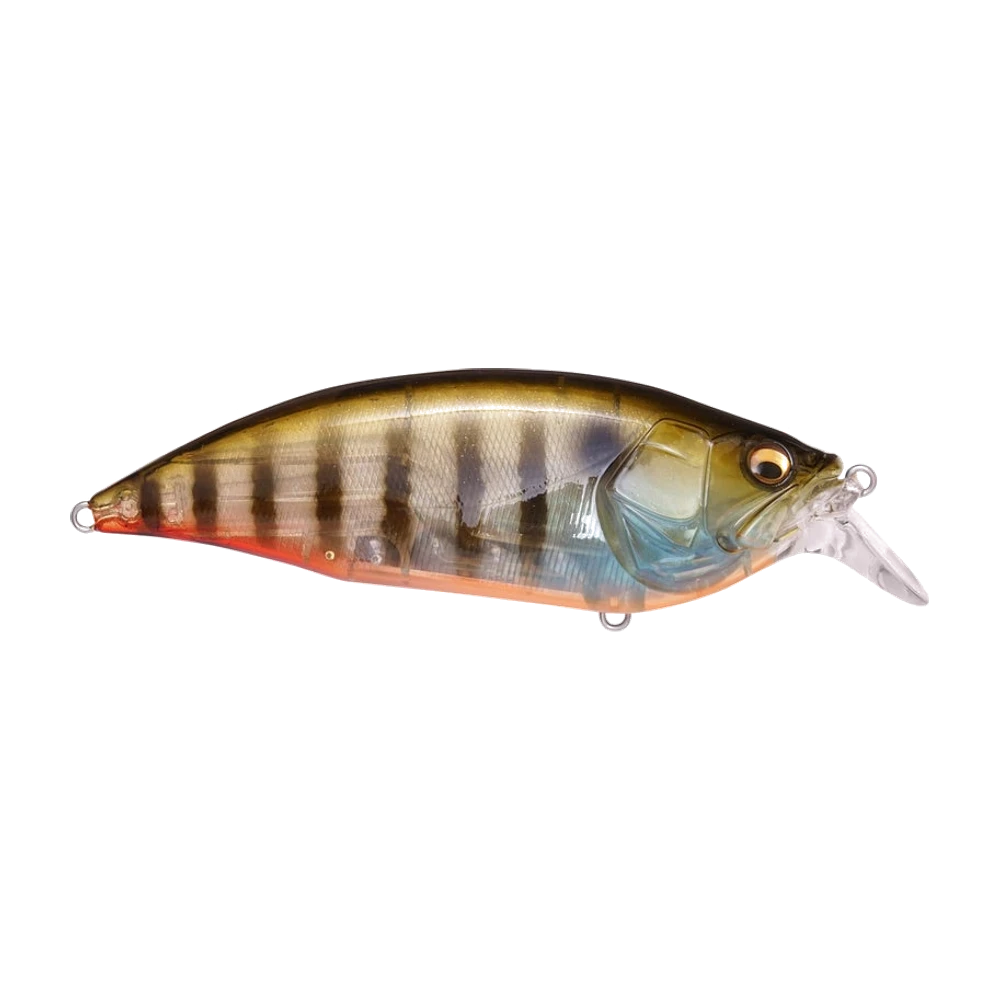
The Big-M 2.0's bill is not a flat plate: Megabass describes a scoop design that grabs water and throws it back, generating both the roll and a series of intense flashes. In the photo it looks wide, clear and distinctly dished, mounted below a line tie set on top of the nose.
What that gives in the water is a bait rotating on its long axis with strong amplitude, showing one flank then the other. Since the flanks are flat and broad, every rotation returns a large reflective surface — the opposite of a round-bodied crank, which vibrates more than it blinks. A Rapala Shad Rap plays on the same flat-sided register, but in a size and mass with no comparison.
A bait that pulls less than it looks
This is the other point Megabass highlights, and it deserves to be taken seriously: thanks to the hydrodynamic work on body and bill, the Big-M 2.0 offers surprisingly low pulling resistance for its size. In other words, you can retrieve it all day without ruining your forearms.
That has a slightly counter-intuitive practical consequence. A crank that pulls hard forces you to slow down to keep the cadence; a crank that pulls lightly lets you hold a constant speed through the whole retrieve. And on a bait whose action rests on roll, consistency of speed matters more than its absolute value.
Not sure what to tie on?
Photograph your spot: CarnaFish reads the scene, cross-checks the conditions and gives you the zone, the lure and the retrieve. Free on iOS and Android.
Where to work it
The 1.8 m layer is the busiest in any water: edges, flats, the tops of breaks, gravel bars, submerged treetops. That is where the Big-M 2.0 makes sense, and only there. If you have to fish at 4 m it is the wrong tool — a Megabass Deep-X 300 gets down there by design.
Contact remains the golden rule of crankbait fishing: aim to tick the bill off the bottom or off wood. The deflection that follows breaks the track for a fraction of a second, and that is very often when the bite comes. With 57 g on the line, go for a longish rod with a forgiving action that absorbs the weight on the cast and cushions head shakes without pulling hooks.
In Europe this format also interests pike along pond margins early in the season, with a suitable leader. For a more compact Megabass crank that fits an ordinary box, the Megabass Griffon remains the house reference.
Colours by water clarity
The description does not detail the colour range, but the example photographed says plenty: a translucent body in a bluegill-type pattern, dark bars over golden flanks and an orange throat.
- Clear water: this kind of translucent finish, which lets light through and gives the flash a softer, less metallic look.
- Stained water: a higher-contrast colour, dark back and pale flanks, so the roll stays readable as visibility drops.
- Overcast or brown water: a dark silhouette, relying on bulk and pressure wave rather than reflection.
Knowing which layer to fish before choosing between a shallow runner and a deep diver is the whole question. That is what CarnaFish simplifies: a photo of the spot, and the AI suggests the zone, the depth to aim at and the lure family that fits the day. For the basics of reading a swim, our guide to reading a fishing spot is a useful companion to this page.
What to remember
- One version in the table: 12.7 cm, 56.7 g, 1.83 m running depth.
- No class column in the description: buoyancy is not stated, so test the bait before working it with pauses.
- The weight is there for casting distance and displacement, not for depth: this crank stays a shallow-edge bait.
- Flat sides and a low centre of gravity give a wide roll and a broad flash, very different from the vibration of a round-bodied crank.
FAQ
How deep does the Big-M 2.0 actually run?
The maker's table states 6 ft, so 1.83 m. The prose also mentions fish holding below that mark, but that is the target, not the bait's depth. Take roughly 1.8 m as the running plane.
Does the Big-M 2.0 float or sink?
The description has no class column and never says. So it cannot be stated either way. If you want to work this bait with pauses, check its behaviour in a metre of water before you start your session.
Why such a heavy crankbait for so little depth?
Because here the mass does two things: it casts a flat-sided body that catches the wind, thanks to the triple balancer system, and it steadies a large volume whose roll is very wide. The ballast sits low, which increases rotation instead of forcing the bait down.
What rod does it take?
At 57 g you want a heavy-power casting rod, on the long side and with a relatively forgiving action. A very fast action copes badly with the weight on the cast and loses more fish on head shakes, because nothing cushions the pull on a bait this massive.
Is it tiring to retrieve?
Less than you would expect. Megabass highlights a surprisingly low pulling resistance for the bait's size, obtained through hydrodynamic work on body and bill. That is what lets you hold a constant speed through a long retrieve.
Does it suit pike?
Yes, along shallow margins and early in the season the bulk and flash interest pike. Use a wire or very thick fluorocarbon leader: a bait at this price is not one to lose to a bitten-off line.
The full bass lure guideSeason-by-season strategy: which family of lure, when, and why.Go from theory to fish
CarnaFish reads your spot from a photo and gives you the game plan: zone, lure, retrieve. Free on iOS and Android.