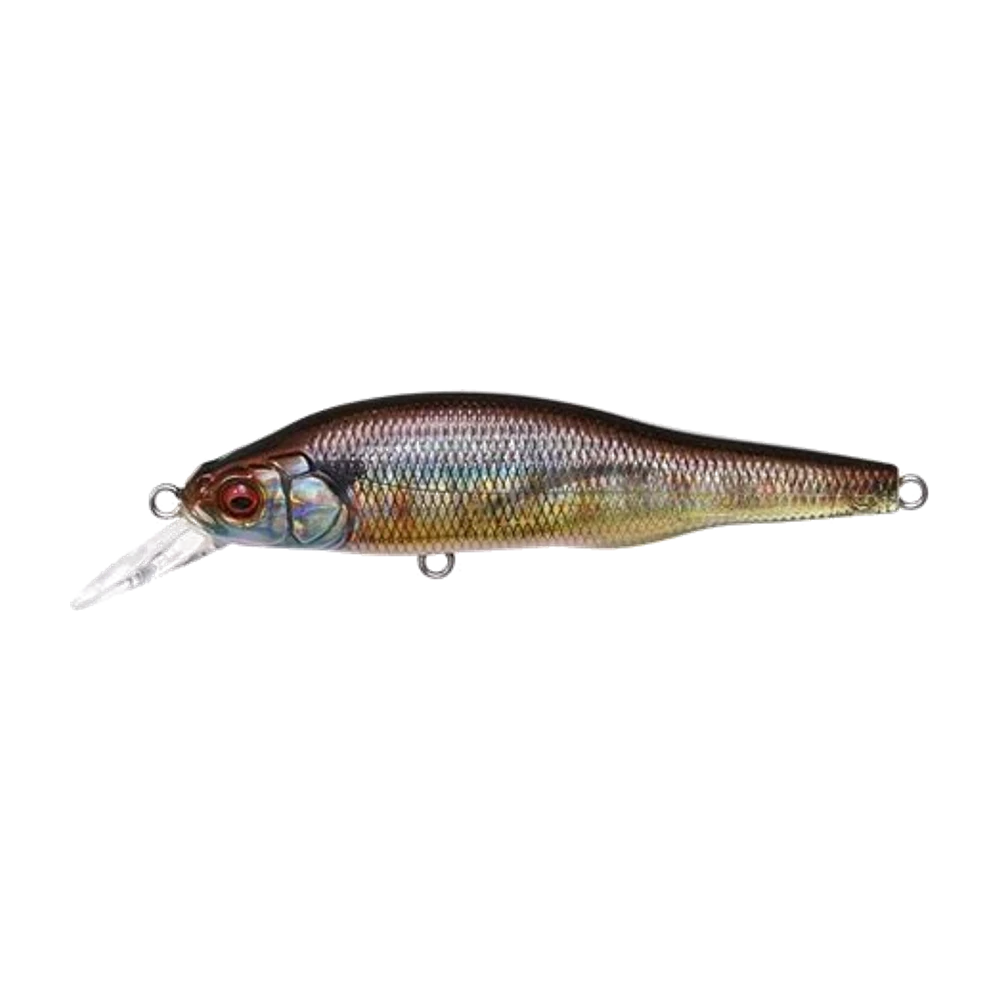
Megabass X-80 Trick Darter: the jerkbait that never darts the same way twice
The right lure in the wrong spot still catches nothing. CarnaFish spots the zone that works, from a single photo.
A well-tuned suspending jerkbait always does the same thing. You give it two sharp inputs, it goes left, then right, and it stops. Do it again and it repeats exactly the same figure. That is a quality when you want to control your lure to the centimetre. It becomes a handicap on a heavily visited water, where the fish have seen that figure dozens of times and the third pass produces nothing.
The other limit of the classic suspending shows up the moment there is wind or current. The lure keeps its neutral buoyancy, but your line catches the wind, it drifts, and you lose the contact that lets you work the lure cleanly. Your jerks arrive damped, your pauses stop being pauses.
The X-80 Trick Darter attacks both problems at once. It sinks slowly instead of suspending, which gives it working weight and an adjustable depth; and its geometry produces asymmetrical sideways darts that do not repeat from one sequence to the next. Two identical jerks give two different trajectories.
Darting: a dart, not a zigzag
You need to separate two families of movement. The zigzag of a classic jerkbait is regular and predictable: left, right, left, with comparable amplitudes. Darting is something else — a short, violent sideways break, in a direction the angler does not choose.
That behaviour comes from the body shape and the position of the lip: the lure is deliberately kept on the edge of stability. On the input, it breaks to one side or the other depending on how the water is flowing at that precise instant, and nothing guarantees symmetry.
For the fish, the difference is considerable. A regular zigzag looks like a fish fleeing under control. An unpredictable dart looks like a fish panicking, banging into things, one that has just realised it has been spotted. That is a trigger of a different order — and above all, it is a signal that the bass or perch of a heavily fished water does not yet associate with danger.
Using the slow sink: counting is fishing
The fact that it sinks slowly is not a compromise, it is a tuning tool. The working depth is controlled entirely by sink time.
| Sink time after the cast | Working depth | Typical situation |
|---|---|---|
| 0 to 2 seconds | 0.5 to 1 m | Visible surface activity, high fish, margins |
| 3 to 5 seconds | 1 to 1.5 m | The do-it-all setting, low weed |
| 6 to 10 seconds | 1.5 to 2 m | Cold water, fish glued to the drop-off |
| Sink to contact | The bottom | Depth mapping at the start of a session |
The method that works is mechanical: on the first cast, let it drop to the bottom while counting. You then know the depth of the spot. After that, take seconds off in steps of two until you find the layer holding the fish. You are no longer estimating anything, you are fishing a setting.
The retrieve in four steps
- Cast and let it sink for your chosen number of seconds, line semi-slack. Do not take up the slack by pulling: that would lift the lure.
- Two to three sharp, short jerks, rod tip pointed at the water, 20 to 30 cm of amplitude, recovering the slack between each input.
- Pause of two to four seconds. The lure sinks slowly, staying level. This is the bite phase: most strikes come during that descent.
- Repeat, varying the number of jerks. Two, then four, then just one. That deliberate irregularity, added to the lure's natural irregularity, is what breaks the routine.
On the water: on a slow sinking jerkbait, a bite during the pause almost never feels like a knock. It shows up as a line that stops sinking, or that moves slightly off to one side. Watch your line on every pause rather than trusting the rod — on a sinking lure, visual sensitivity beats tactile sensitivity.
Wind, current, and why it copes
This is a practical advantage that gets underrated. A lure that sinks stays below the waterline even when you have slack: it does not get pushed around at the surface by the chop and it maintains a minimum of tension. In practice, you can fish a windward bank or a current seam without your retrieve turning into nonsense.
Two adjustments help further:
- Switch to thin braid with a fluorocarbon leader of about a metre as soon as there is wind. Braid does not stretch, so your jerks arrive clean even with twenty-five metres of line out.
- Fish with the rod tip in the water, the first ten centimetres, when the wind is across. You remove the wind's grip on the line and get contact back.
On straight fluorocarbon, stay between 0.20 and 0.25 mm. Finer and you lack holding power near structure; heavier and you slow the sink and blunt the sideways darts.
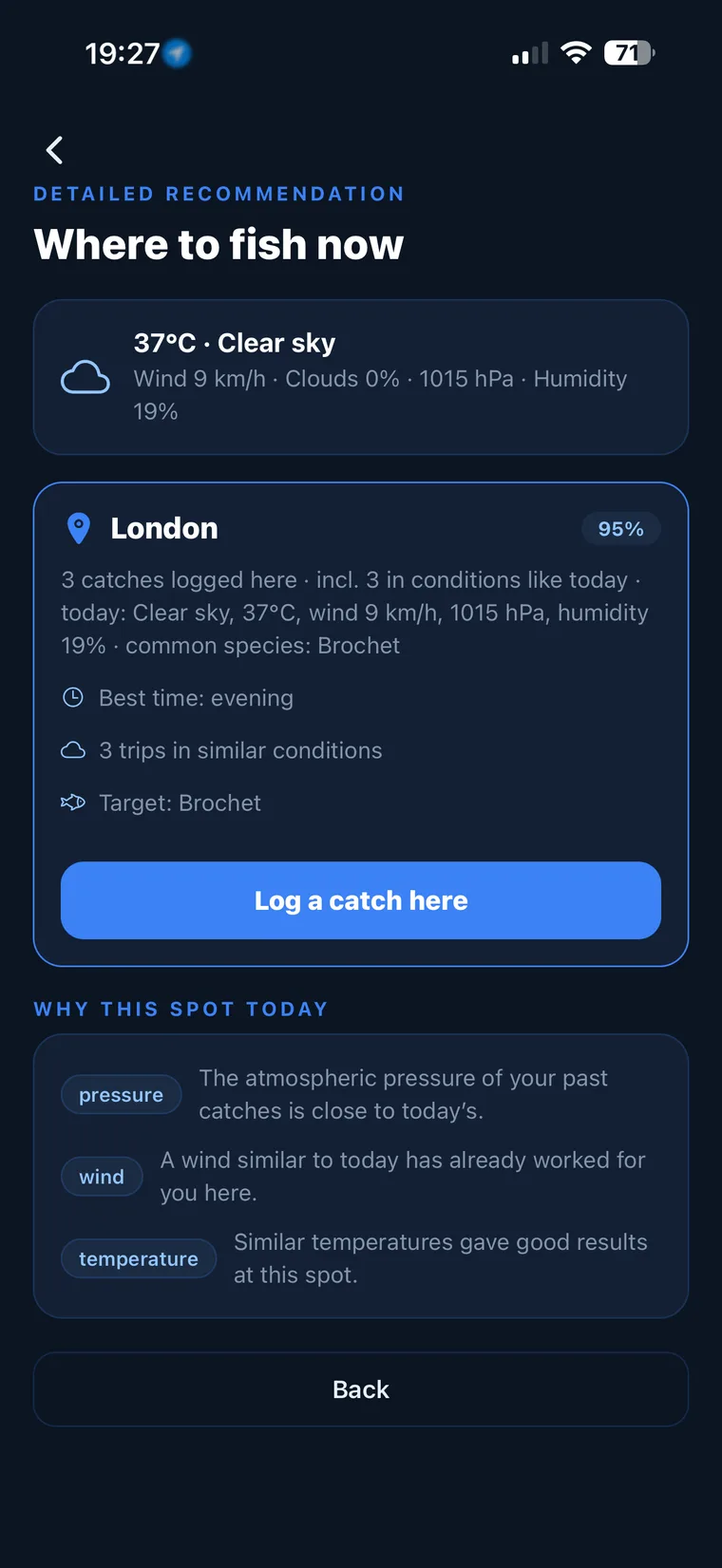
Not sure what to tie on?
Photograph your spot: CarnaFish reads the scene, cross-checks the conditions and gives you the zone, the lure and the retrieve. Free on iOS and Android.
Where it excels and where it is beside the point
It is at its best on active but wary fish, in water from clear to lightly stained, between half a metre and two metres down. Weed edges, jetty surrounds, shallow flats, feeding zones: anywhere perch or bass hunt in open water and have already seen a lot of lures go by.
It is poorly suited, on the other hand, to searching a big area fast: its retrieve demands time per cast, which is the opposite of a searching lure. The same goes for depths over three metres, where the sink time becomes too long to be productive. And in dense vegetation, its two trebles and its free descent turn it into a weed collector.
X-80 Trick Darter or a classic suspending jerkbait
A suspending like the Lucky Craft Pointer 100 stays exactly where you stop it, for as long as you want. That is irreplaceable in cold water, when the fish needs ten seconds of total stillness to make up its mind, and when you have to hold a lure right at the level of a submerged branch.
The X-80 Trick Darter does not do that — during your pause, it sinks. What it offers instead is a trajectory the fish does not anticipate, and a depth you choose by counting rather than by changing models. On an over-fished water, or the moment there is wind, it is often the one that unlocks the situation.
In a longer, slower format, an O.S.P Rudra covers big fish and cold water; at the other end, a DUO Realis Rozante 63 drops in size for difficult perch. Our beginner's guide to bass fishing places the jerkbait among the other approaches. And if you are unsure which layer to attack when you get to the bank, CarnaFish analyses a photo of the spot and answers.
Key takeaways
- Asymmetrical sideways darts: two identical sequences give two different trajectories.
- Slow sinking: depth is set by counting the seconds of descent.
- The bite comes during the pause — watch the line, not the rod.
- Handles wind and current far better than a suspending.
- A poor choice for searching fast, beyond three metres, or in vegetation.
FAQ
What depth should you fish the X-80 Trick Darter at?
Between 0.5 and 2 m, set by sink time. Count the seconds after the cast: two seconds for the top layer, five for about a metre fifty, more to hug the drop-off in cold water.
Sinking or suspending, which should you choose?
The suspending when the fish demands total stillness, typically in cold water or against a precise piece of cover. The slow sinker when there is wind or current, or when fish refuse the overly regular trajectories of a suspending.
How do you detect bites during the pause?
Visually. A line that abruptly stops sinking, or that moves off sideways, signals a take long before you feel it in the rod. Set the hook as soon as the descent stops for no reason.
How wide should the jerks be?
Twenty to thirty centimetres, from the wrist, rod tip pointed at the water, recovering the slack between each input. Jerks that are too wide pull the lure out of its layer and kill the sideways dart that makes it interesting.
Braid or fluorocarbon?
Fluorocarbon in 0.20 to 0.25 mm in calm conditions. As soon as there is wind or more than twenty-five metres of line out, switch to thin braid with a fluorocarbon leader of about a metre so the jerks arrive clean.
Does it catch perch as well as bass?
Yes. The 8 cm size matches good perch well, particularly fish hunting in open water. On average-sized perch, a shorter jerkbait or minnow will suit better.
The full perch lure guideSeason-by-season strategy: which family of lure, when, and why.Go from theory to fish
CarnaFish reads your spot from a photo and gives you the game plan: zone, lure, retrieve. Free on iOS and Android.