Megabass X-70 BFS: the 7 cm jerkbait that suspends in the top 2 ft
Before tying this one on, it helps to know if the spot actually calls for it. CarnaFish reads the scene from a photo.
Late September, a gravel margin, half a metre of water and fry snapping against the bank. You cast a 110 mm jerkbait, it dives to a metre, scrapes bottom on the second twitch and comes back with a dead leaf on the lip. The problem isn't your cadence: the bait is simply running three times deeper than the fish. The Megabass X-70 BFS is built for that exact case, and only for that one.
Seven centimetres, 4.7 grams: what the spec sheet actually says
The maker lists the X-70 BFS at 2-3/4 in, or 7 cm, for 1/6 oz. That fraction is worth a word, because it isn't neutral: the American lure trade thinks in eighths and sixteenths of an ounce, almost never in sixths. A listed sixth of an ounce is nearly always a rough conversion of a weight designed in grams to start with — around 4.7 g here. Take the order of magnitude rather than the decimal: you are between 4.5 and 5 g, and that is what decides your rod.
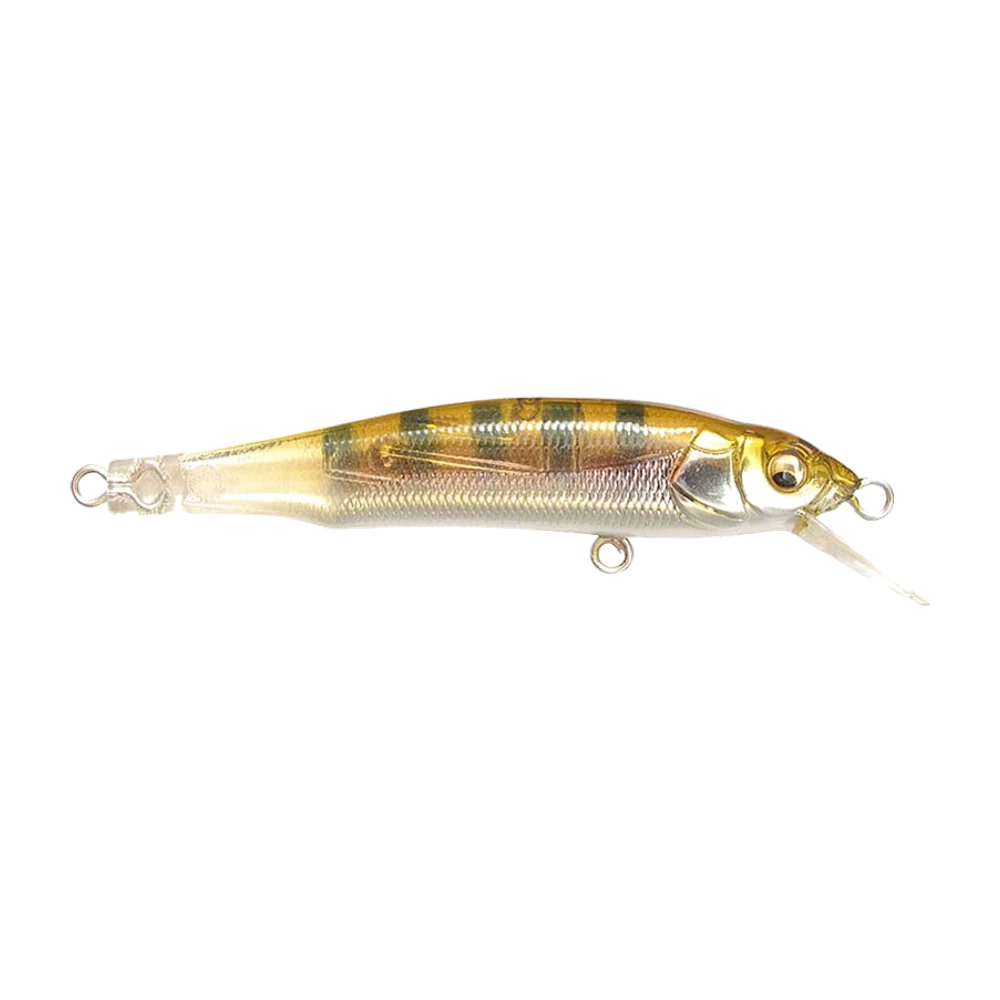
The other two columns are far more clear-cut. Listed running depth is 1-2 ft, or 30 to 60 cm, and the class is suspending: pause the retrieve and the bait neither rises nor sinks, it holds the depth it has reached. Listed hooks are #10 trebles, a fine wire gauge consistent with the body weight. In the catalog shot the lure appears bare, hanging on its three rings alone — that is a body photo, not an indication of what is in the package.
Flat sides, a wide dart
The X-70's body is flat-sided, not round like a conventional minnow. That choice has two direct consequences in the water. First, flash: on every twitch the bait rolls onto its side and throws a broad reflective surface, visible from a distance in clear water. Second, and less obvious but more useful: a flat flank settles into its running plane and resists rising. The maker talks about consistent depth-keeping even under a hard-hitting jerkbait cadence, and that is exactly what you see — you can hit the rod tip firmly without the bait blowing out at the surface.
The listed action is a wide side-to-side dart, meaning a broad lateral lurch rather than a pirouette on the spot. On a simple straight retrieve, with no rod input at all, the same body produces a flickering, understated swim. That dual register is rare at this size: most small minnows only do one of the two things well.
The pause on a suspending bait isn't counted in seconds, it's counted in patience. On an X-70, three seconds of dead stop is enough in summer; in October, once the water drops below 15 °C, go to eight or ten seconds without moving the tip. The bite almost always comes on the restart, and it shows up as line moving sideways, not as a thump in the rod.
Working a bait under five grams
Why BFS is in the name
BFS stands for Bait Finesse System: a baitcasting setup built around a lightened spool, designed to throw lures a standard casting outfit cannot move. At 4.7 g you are below the comfort threshold of a normal casting setup, which starts working properly around 7 g. Two honest options: a genuine BFS outfit, or a light 3-14 g spinning setup with thin braid. The second costs far less and even gains distance into a headwind.
Dead-drifting with twitches in current
The maker's own notes point to a presentation few anglers exploit: a dead drift broken up by twitches, in moving water. Cast across or slightly upstream, let the current carry the bait on a semi-slack line, and give one sharp twitch every two or three metres. Between twitches the X-70 does nothing: it drifts, exactly like a stunned baitfish that has lost control of its own line. This only works with a suspending bait — a floater would rise, a sinker would drop into the rocks.
Where to use it, and where not to
The listed water types are river systems, flats, shallow docks and skinny water. Add reed margins in late summer and gravel beaches in spring: anywhere you have between 40 cm and 1.20 m over a clean bottom, this bait belongs.
Be clear about its limits, though. At 4.7 g you will not cast far into a strong following wind, and you will never reach a fish sitting at three metres: that calls for a Megabass Vision 110. In stained water the loss of flash costs this size dearly. And a 7 cm bait on a pike spot means a wire trace, which ruins the discretion you came for.
Not sure what to tie on?
Photograph your spot: CarnaFish reads the scene, cross-checks the conditions and gives you the zone, the lure and the retrieve. Free on iOS and Android.
Rigging, hooks and leader
Tie it to a fine snap or a loop knot. A knot cinched straight against the nose ring chokes the lateral lurch and flattens the dart: that's the first thing to check if the bait feels dull. On a spinning setup, run 0.08-0.10 mm braid and a metre of 0.18-0.22 mm fluorocarbon leader — thin enough not to pull the nose up, strong enough to lever a bass out of branches.
The mistake that costs the most fish
Swapping the factory trebles for something bigger "to hook up better". The listed #10 gauge is not a manufacturer's saving: on a 4.7 g bait, two heavier trebles destroy the static balance and turn a suspending lure into a slow sinker. You lose the pause, which is the whole point. If you change hooks, change them for better #10s, not for #8s.
Colour by water clarity
- Clear water: a translucent amber finish with a silver flank, like the one in the photo, playing on reflection rather than colour. The flat side does the work on its own.
- Lightly stained water: a chartreuse back or a tiger pattern, which gives the fish a reference point again once visibility drops below a metre.
- Low light or shade under a dock: a dark silhouette, far easier to read against the light than a bright finish.
A size that earns its place beside the bigger brothers
The X-70 replaces neither a Megabass Vision 95 nor a Megabass X-80 Trick Darter: it works a layer those two pass straight through. In Europe, where a great many bass lies sit in a metre of water, this size earns its keep more often than a 110 mm pulled out by reflex.
Picking the right lure gets you nowhere if you are fishing the wrong seam. That's what CarnaFish makes easier: a photo of the spot, and the app suggests the zone, the depth and the presentation that suit the day's conditions. For the rest of the box, our guide to perch fishing with lures covers the complementary families.
Key takeaways
- A 7 cm suspending bait tuned to 30-60 cm: a layer most jerkbaits simply cannot hold.
- The listed 1/6 oz works out at roughly 4.7 g, an unusual fraction that betrays a design done in grams — think in orders of magnitude.
- Flat sides deliver broad flash and stable depth-keeping even under a hard twitching cadence.
- Keep the #10 trebles: heavier hooks kill the neutral buoyancy, and with it the pause.
FAQ
Do I really need a BFS outfit to cast the X-70?
No. A light 3-14 g spinning setup with 0.08 mm braid throws this bait easily, and often further into a headwind. BFS mainly buys you placement comfort at short range, under a dock or along a piece of cover.
Does the X-70 really run shallower than a metre?
The maker lists 1-2 ft, or 30 to 60 cm, on a normal retrieve with a thin leader. Heavy fluorocarbon or a chunky snap will shave a few more centimetres off that.
How long should the pause be?
Three seconds is enough in warm water, ten is not too much below 15 °C. Because the bait suspends, it holds its depth throughout: you can leave it hanging as long as your patience allows, and the fish has time to commit.
Can you catch perch on this lure?
Yes, it's one of its best uses. Seven centimetres matches the prey size margin perch hunt in late summer, and the flickering swim on a slow straight retrieve is often enough to draw the strike.
Should the factory hooks be replaced?
Only with the same #10 gauge. Going to #8 or #6 weighs the bait down and makes it sink slowly instead of suspending, which removes the pause that makes the model worth owning.
How does it differ from a Vision 110?
Size and water layer. The Megabass Vision 110 runs deeper and covers water, while the X-70 stays in the top half-metre and is there to work one precise shallow lie. The two complement each other rather than overlap.
The full bass lure guideSeason-by-season strategy: which family of lure, when, and why.Go from theory to fish
CarnaFish reads your spot from a photo and gives you the game plan: zone, lure, retrieve. Free on iOS and Android.