Norman Deep Tiny N: the micro crankbait that still reaches 1.8 m
Not sure this lure fits YOUR spot today? CarnaFish tells you in 10 seconds, from a photo.
A school of perch is circling under a jetty, visible to the naked eye, refusing everything that goes past. Soft plastics drop too fast, spinners twist the line, and the 6 cm crankbait that made the morning gets royally ignored. That's the classic situation where a lure the size of a pen cap turns a blank day into a decent one. The Norman Deep Tiny N belongs to exactly that category.
A misleading name, clear numbers
Let's clear up a misunderstanding first. "Deep" in the name suggests a serious diver. Norman's table says otherwise: 1.8 m / 6 ft, no more. That's a useful reminder — a model name is not a specification, and here "Deep" mainly separates this version from the original Tiny N, which runs shallower. Take it for what it is: a crankbait that works the layer just below the margins, not a deep diver.
The other three numbers in the table are just as clear: 1-1/2 in, that is 3.8 cm, and 1/8 oz, that is 3.5 g. A genuinely tiny bait, and above all a very light one, with two immediate consequences: it casts badly on standard tackle, and it gets swept away as soon as current goes past a few dozen centimetres per second.
Note one absence while you're at it: Norman's table carries no buoyancy column for this model, and the maker's copy says nothing about it. There's no way to state whether it floats or sinks on the pause — worth knowing before you build a presentation around long pauses. The only way to settle it is a visual test in a metre of clear water on your first cast of the day.
What that stubby body does
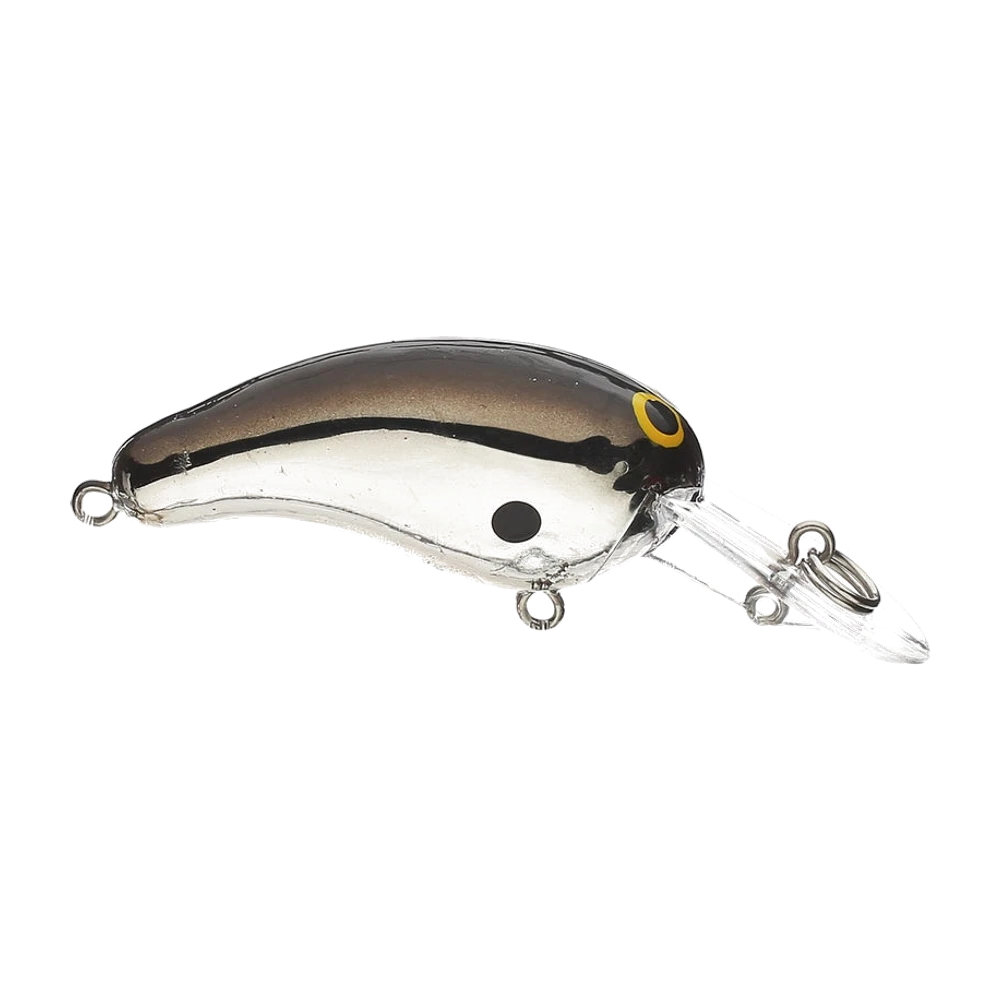
The product photo shows a very short, very deep body, humped over the back with a pronounced hollow just behind the head, and a bill nearly as long as the body itself. That squat geometry is the signature of the small "N" cranks: it shifts a disproportionate amount of water for its size, because vibration comes from frontal area, not from length.
Norman describes a medium-tight wobble, meaning a roll that is neither mushy nor frantic, starting from the first turns of the handle. The maker adds that the bait carries a combination of rattles producing an acoustic presence. On a 3.5 g lure that claim deserves measure: the sound output stays low, and it works mostly at close range, as a complement to the vibration rather than a long-distance call.
A 3.5 g lure tolerates no excess speed. Crank too fast and it blows out of its axis and rises to the surface, never reaching the stated depth. The right speed is the one where you feel a small steady tremble in the rod tip — not one turn of the handle faster.
Where this size makes the difference
The Deep Tiny N earns its place when fish refuse volume. Norman presents it as effective on fish eating small forage and on lightly feeding largemouth. Translated into real situations: late summer on low, clear water, a bright afternoon on a pond fished all season, or early spring when activity is barely waking up.
It's also an excellent perch bait. In Europe, the 3-4 cm size matches exactly the fry perch chase along riprap, jetties and lily edges. A Rapala Ultra Light Crank covers the same slot with a wider swim; the Deep Tiny N answers with a tighter vibration and a rounder volume, which makes it a genuine replacement once the first one starts getting refused.
The three passes that produce
The first is the slow straight retrieve along a vertical structure: sheet piling, jetty piles, quay wall. You track it thirty centimetres off, no rod action, letting the roll do the work on its own.
The second is bottom contact over rock at a metre and a half. As soon as the bill grinds, mark a very short stop. With a lure whose buoyancy isn't published, test first whether that pause makes it rise or hold — the right presentation follows directly from the answer.
The third, rarer but deadly, is the progressive slowdown at the end of the retrieve, as the lure climbs back toward the rod. A lot of perch bites happen within three metres of the angler, on that last stretch where the bait changes attitude.
The classic mistake: tackle that's far too heavy
This is by far the number one problem. At 3.5 g a medium 10-30 g rod never loads, the cast dies at fifteen metres, and the wobble no longer reaches your hand. You need a light rod, 5-15 g, a small reel with thin line, and fluorocarbon around 0.18-0.22 mm. Above that, diameter throttles the bait and costs it the little depth it has.
Second point: the line tie is drilled through the bill, as the photo shows. Tie a loop knot or use a micro snap. A tight knot straight onto a tie that small kills the amplitude of an already discreet bait.
Hooks: what the copy says, what the photo shows
Norman states two sticky-sharp trebles. The spec table, however, gives no hook size for this model — unlike the Norman DD22, whose row specifies a #2. And the photographed sample appears bare, with two empty hook hangers, with a split ring still hanging on the bill-mounted line tie. That's an observation from a product photo, not a specification: check what's in the pack.
If you have to fit the trebles yourself, stay very light. On 3.5 g, two oversized trebles wreck the attitude and turn a balanced crankbait into one that noses down.
Not sure what to tie on?
Photograph your spot: CarnaFish reads the scene, cross-checks the conditions and gives you the zone, the lure and the retrieve. Free on iOS and Android.
Colour by water clarity
- Clear water: the chrome finish with an olive-brown back on the photographed sample, with its black lateral line and flank spot. Chrome returns light like a roach scale and is plenty on clear, sunlit water.
- Stained water: firetiger, the orange and green that stay readable in sixty centimetres of visibility.
- Rock bottom, cold water: a dark craw, brown-red, playing the crayfish card rather than the fry card — a register this stubby profile handles very well.
A back-up bait that earns its box space
Nobody fishes a whole day on a Deep Tiny N. It's the bait you reach for when nothing else works, and that's precisely what makes it a good buy: it fills the slot most tackle boxes neglect, very small volume with real vibration. Alongside it, keep a Norman Deep Little N for the same swim in a mid-size format, and a Rapala DT6 for when you genuinely need to get down.
Knowing when to reach for a micro crankbait means reading the water properly: level, clarity, bottom type. That's what CarnaFish makes easier: a photo of the spot, and the app suggests the zone, the depth to target and the lure type that suits the moment. To go further on the species that benefits most from this size, our guide to perch fishing with lures covers the spots and the rigs.
Key takeaways
- 3.8 cm for 3.5 g and a stated 1.8 m: the "Deep" in the name shouldn't fool you, this is not a deep diver.
- Norman publishes no buoyancy data for this model: test it by eye before building a presentation around pauses.
- A very short, very deep body that shifts a lot of water for its size, with what the maker calls a medium-tight wobble.
- Light tackle is mandatory, 5-15 g and thin fluorocarbon: a rod that's too stiff cancels the whole point of the lure.
FAQ
How deep does the Norman Deep Tiny N run?
Norman states 6 feet, around 1.8 m. The word "Deep" in the name places it above the original Tiny N, not in the deep-diver class. In practice, with thin line and a slow retrieve you're working the 1.2 to 1.8 m band.
Does it float on the pause?
The manufacturer's table has no buoyancy column for this model and the copy doesn't mention it. Better to claim nothing: run a visual test in a metre of clear water before building your presentation on long pauses.
What rod handles a 3.5 g lure?
A light rod rated 5-15 g, with a sensitive tip. Anything above that won't load on the cast, you lose a good share of your distance, and you stop feeling the lure work in the water.
Is it a good perch bait?
Yes, that's its most natural ground in Europe. The 3-4 cm size matches the fry perch hunt along riprap and jetties, and the tight vibration stays perceptible even at slow speed.
How many trebles come fitted?
Norman states two sticky-sharp trebles, but the spec table gives no size for this model. The photographed sample appears bare, with two empty hangers: that's an observation from a product photo, not a specification.
Can it be fished in rivers?
In light current, yes, casting downstream or across. As soon as the flow picks up, 3.5 g isn't enough to hold a line and the bait blows to the surface: switch to something heavier or find an eddy.
The full perch lure guideSeason-by-season strategy: which family of lure, when, and why.Go from theory to fish
CarnaFish reads your spot from a photo and gives you the game plan: zone, lure, retrieve. Free on iOS and Android.