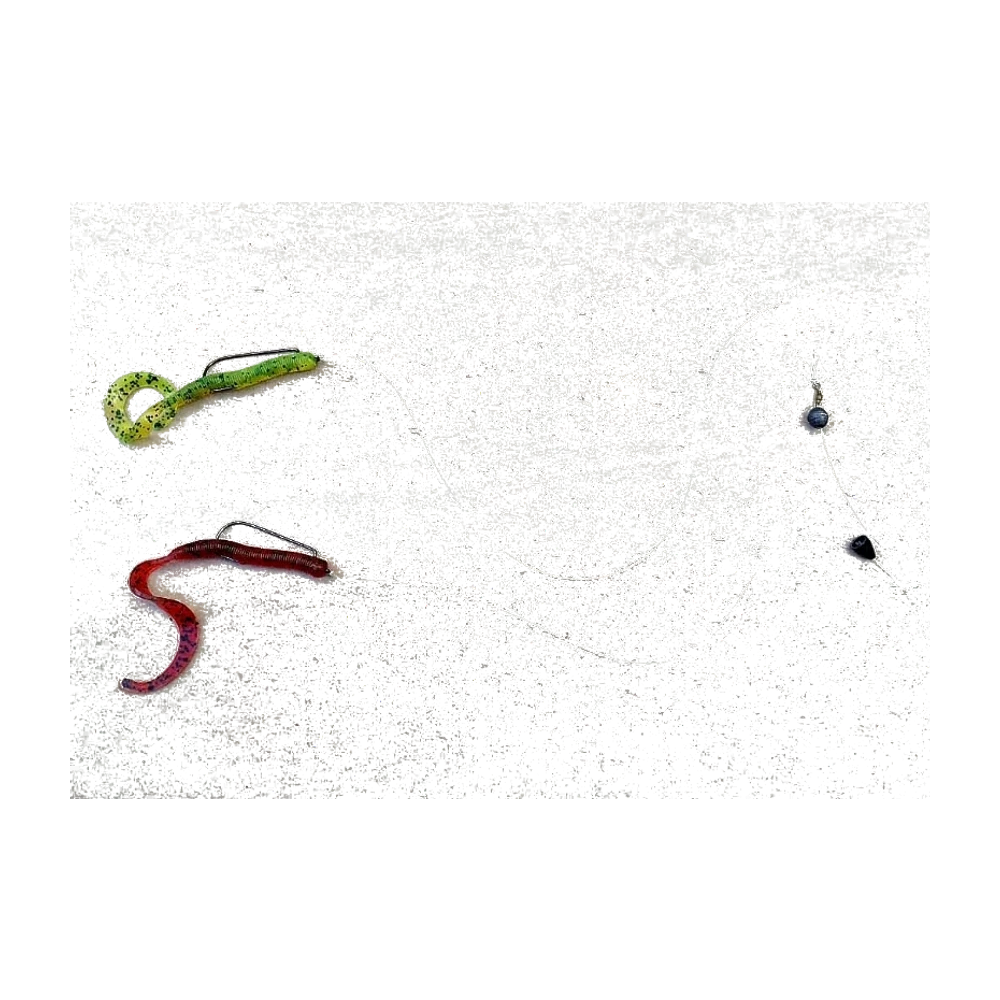
Split shot rig: one shot on the line and the bait swims free again
One lure, endless conditions. CarnaFish reads your spot from a photo so you are not just guessing.
A clear river in late summer, slow current, perch sitting behind the boulders and trout refusing anything that looks like a lure. You tie on a 3 g jig head: the bait noses down, crashes onto the gravel and behaves like a stone. You take the weight off: it never reaches the bottom and drifts along the surface.
Between the two lies a solution as old as coarse fishing and more or less forgotten by modern lure anglers: pinch a plain split shot onto the leader, about thirty centimetres ahead of the hook. The shot finds the bottom while the bait stays free behind it, with no mass inside its body at all.
The result is hard to achieve any other way. A soft plastic drifting naturally, at the speed of the current, five centimetres off the bottom, with nothing restricting its movement.
What moving the weight really changes
On a jig head, the mass sits in the nose of the bait. All its inertia is concentrated there, and it shows at three moments.
- On the drop, the bait noses down instead of gliding.
- On the pause, it rolls onto its side and goes dead.
- On the drift, it travels faster than the current because its own mass is pulling it along.
With a split shot, the weight is thirty centimetres in front. The bait sinks flat, glides through the pauses, and above all drifts at the speed of the water, exactly like a larva or a small fish carried by the current. On river fish used to seeing drifting prey go past, that difference is decisive.
The second effect is tactile. The shot ticks the bottom and keeps you informed: gravel, sand, weed. You are fishing blind, but you read the bottom like a map.
Setting it up, in two minutes
- Tie your leader in fluorocarbon, 0.14 to 0.22 mm depending on the species and the size of the bait.
- Hook the bait: a short-shank plain hook for a small bait, a light offset hook if the bottom snags.
- Pinch the shot onto the fluorocarbon, 25 to 60 cm from the hook, squeezing it with your fingers or flat pliers without crushing it.
- Check that it slips under heavy pull. That is deliberate: on a snag, the shot slides or comes off and you save the rest of the rig.
- Test the behaviour in the margins: the bait should sink flat, trailing behind the shot, without wrapping around it.
A shot squeezed too hard crushes the fluorocarbon and creates a breaking point. Too loose and it runs down to the hook on the first cast. The right setting sits between the two and you find it in three attempts.
Weight and distance: the double adjustment
Two parameters are set together, and this is where a rig that fishes parts company with one that just drags.
| Situation | Shot | Weight-to-hook distance |
|---|---|---|
| Slow river, under 1 m, wary fish | 0.5 to 1 g | 50 to 60 cm |
| Medium current, 1 to 2 m | 1 to 2 g | 35 to 50 cm |
| Strong current, 2 to 3 m | 2 to 3 g | 25 to 35 cm |
| Deep pool or headwind | 3 to 4 g | 25 to 30 cm |
The logic is simple: the stronger the current, the closer the shot goes, or the bait lifts towards the surface. The warier the fish, the further away it goes, so the bait works well clear of anything that might alert it.
On the water: when in doubt, lengthen the distance before you go heavier on the shot. An educated fish will refuse a bait trailing fifteen centimetres behind a lump of lead, however well presented. Going from 30 to 55 cm has rescued days that ten colour changes would never have saved.
Drift rather than retrieve
This is the least intuitive part of the rig: the more you work it, the worse it performs.
- Cast upstream, at forty-five degrees towards the far bank.
- Let the shot settle on the bottom while keeping just enough contact, rod tip low.
- Follow the drift by recovering slack only, never pulling. The current does all the work.
- Track it with the rod until the line is downstream of you.
- At the end of the drift, when the rig lifts and swings up in the current, be ready: a large share of the bites come at exactly that moment.
- If nothing comes, pause for five seconds, let the bait drop back, then fish it in with short ten-centimetre drags.
In still water or on a lake the principle reverses: there is no current to carry the bait, so you drag it very slowly along the bottom, in twenty-centimetre pulls broken up by five-second pauses.
The bite often shows up as nothing more than a feeling of resistance, as if the shot had caught. Strike at every doubt, without a big movement: a firm lift is enough with a sharp plain hook.
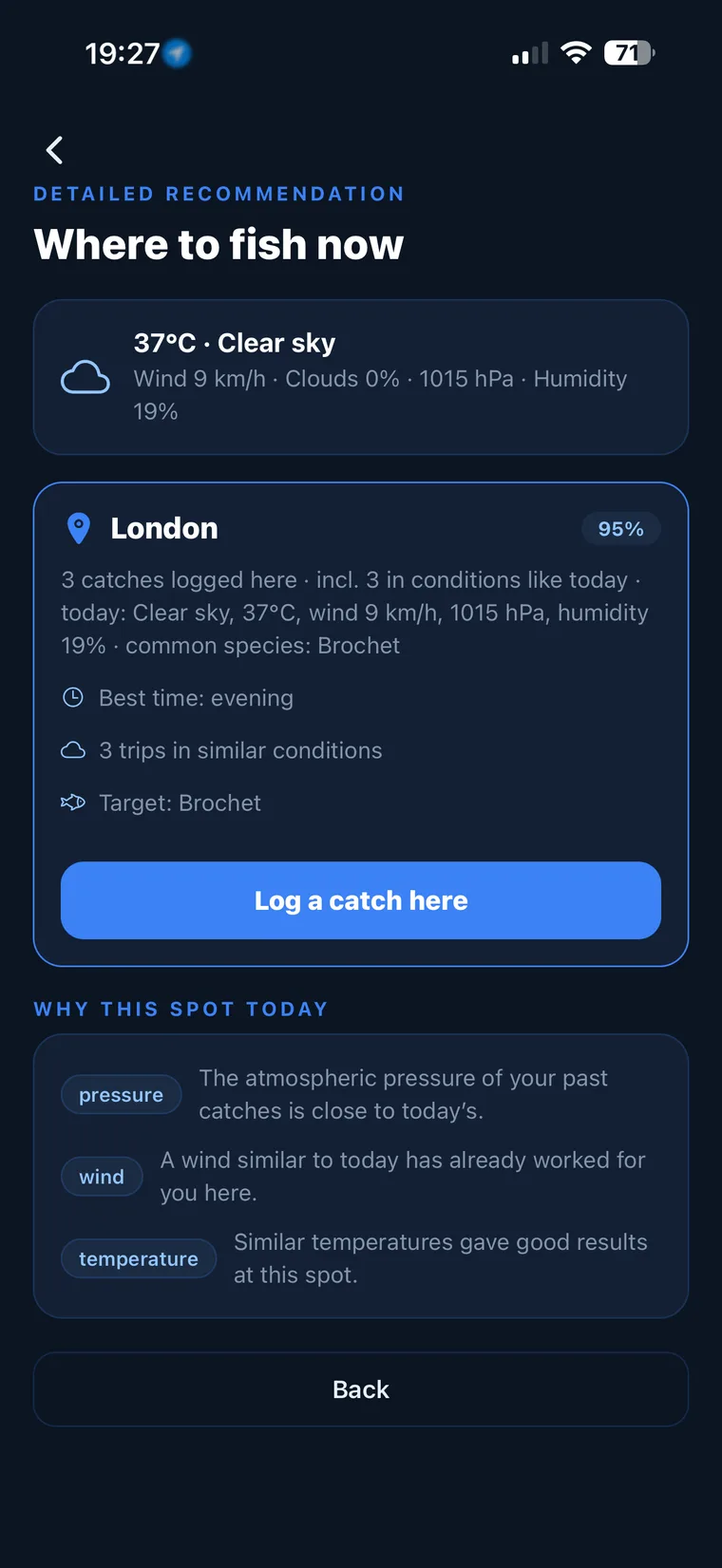
Not sure what to tie on?
Photograph your spot: CarnaFish reads the scene, cross-checks the conditions and gives you the zone, the lure and the retrieve. Free on iOS and Android.
The baits that suit it
This rig showcases baits that work without help: small slim worms, larvae, insect imitations, small soft shads with a responsive tail. A Zoom Finesse Worm cut short works very well, as does a Fox Rage Micro Fry on a plain hook.
Avoid stiff baits and models that need speed to vibrate: with no weight in the body and no traction, they stay silent.
Split shot, Carolina or drop shot
All three move the weight off the bait, but not for the same reason.
The Carolina rig is the split shot's big brother: heavy weight, long leader, and the aim is to cover ground over large deep areas. It is a searching rig, often fished from a boat.
The drop shot puts the weight below the bait and is there to hold it motionless at a fixed height, going nowhere. It is a static spot rig.
The split shot fills the remaining slot: minimal weight, a natural drift, and a bait travelling at the speed of the water. It is the most discreet of the three, the least bulky to carry, and the only one you can adjust by hand in ten seconds on the bank. In a clear river on educated fish, it has no real competitor.
Our guide to river trout fishing explains how to read the spots where this drift really comes into its own. And if you are unsure what shot to pinch on in front of a riffle, CarnaFish analyses a photo of the spot and answers.
Key takeaways
- A shot pinched 25-60 cm ahead of the hook is enough to transform the presentation of a soft plastic.
- The bait sinks flat, glides through the pauses and drifts at exactly the speed of the current.
- The stronger the current, the closer the shot; the warier the fish, the further away it goes.
- You follow the drift, you do not work the bait. The end of the drift is a key moment.
- A clear-river rig for educated fish, unsuited to searching deep water.
FAQ
What is a split shot rig?
It is a leader with a plain split shot pinched on 25 to 60 cm above the hook. The shot provides the depth while the bait, carrying no weight of its own, drifts freely behind it.
What distance between the shot and the hook?
Between 25 and 60 cm. You shorten it when the current is strong or the water deep, and lengthen it in slow, clear water and on wary fish that refuse a presentation too close to the weight.
What weight of shot should I choose?
0.5 to 1 g in a slow shallow river, 1 to 2 g in medium current, up to 3 or 4 g in a pool or into a headwind. The shot should tick the bottom without anchoring itself to it.
Should I work the bait?
As little as possible in a river: you follow the drift and recover slack only. In still water you drag it in twenty-centimetre pulls with five-second pauses.
Does the split shot work for perch?
Yes, very well, especially in rivers and canals on fish sitting on the bottom. It presents a small bait with no visible weight, which often triggers fish that have refused a jig head.
What is the difference with a Carolina rig?
The Carolina uses a heavy weight and a long leader to search large deep areas. The split shot stays a light, discreet rig, built for a natural drift in a small river on wary fish.
The full perch lure guideSeason-by-season strategy: which family of lure, when, and why.Go from theory to fish
CarnaFish reads your spot from a photo and gives you the game plan: zone, lure, retrieve. Free on iOS and Android.