NetBait STH BaitFuel Flat Sided Shad: a shad built for the drop shot
Before tying this one on, it helps to know if the spot actually calls for it. CarnaFish reads the scene from a photo.
The drop shot is unforgiving about bait choice. Because the bait barely travels, it has no speed with which to hide its flaws: everything rides on what it does while it hangs in one place. NetBait's Flat Sided Shad was drawn specifically for that case, and it shows in three shape details that only make sense for this technique.
Three shape details, three intentions
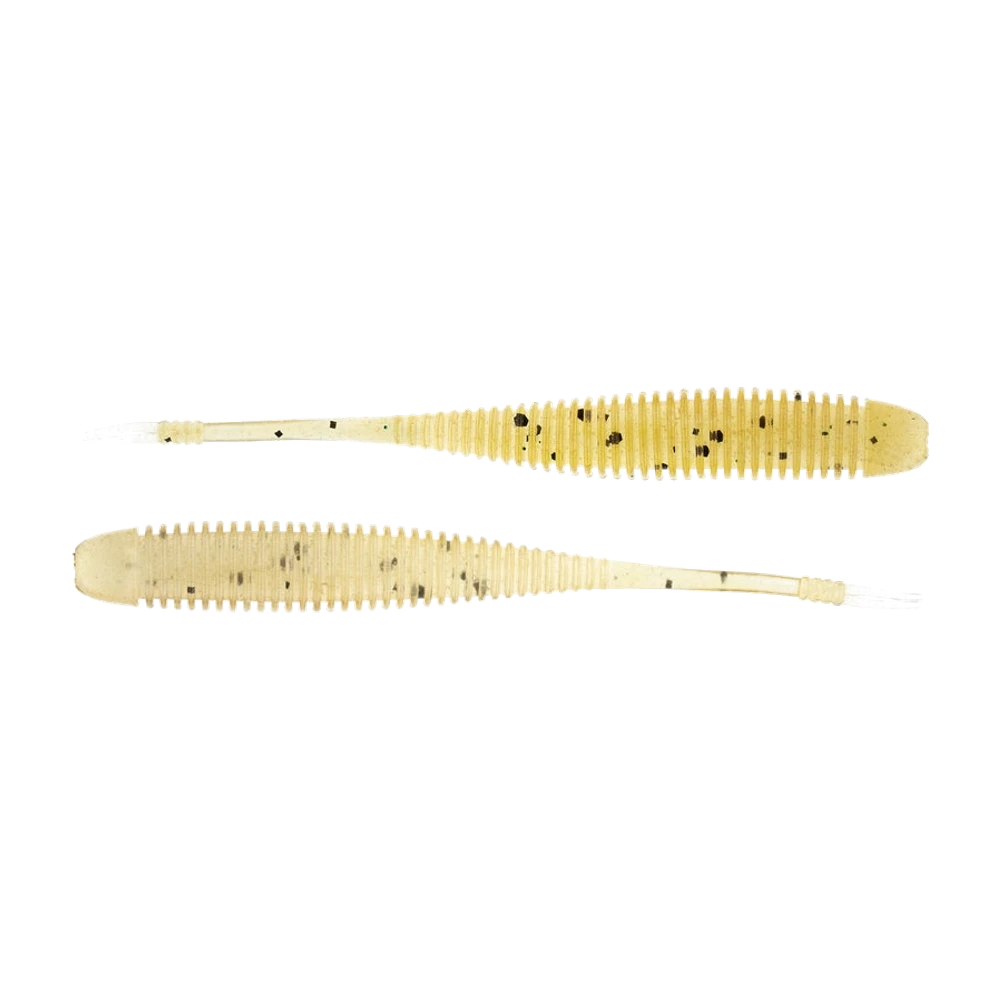
The first is the nose. It is deliberately bulky compared to the rest of the body, noticeably thicker than the section behind it. Two consequences follow. It offers enough material for a nose hooking that survives more than two fish — on a thin-nosed shad the hole widens and the bait ends up sliding down the shank after three casts. And it lets you bury the eye of a finesse hook inside the plastic itself, which removes the bright point that often stands out in clear water.
The second is the ribbing. It runs the full length of the body and does two separate jobs. Mechanically the ribs catch the water and return a short, quiet vibration, far closer to what a small baitfish holding station produces than any paddle tail swim. Chemically they increase surface area: more surface means more scent released per unit of time, so a wider scent footprint around the bait. NetBait loads its plastic with BaitFuel, built around what it calls F.A.S.T. — Fish Active Scent Technology.
The third is the tail. It is forked, carried on a very fine stem, and the two strands are so soft they tremble as soon as there is a little current, with no input from you at all. That is exactly what a drop shot asks for: a bait that keeps telling a story through the ten seconds when you are doing nothing whatsoever.
The trap with a drop shot is overworking it. Set the sinker, tighten just enough to feel it, and wait. If there is current or enough wind to drift the boat, the tail is already working on its own. Rod tip shakes are only there to re-trigger a fish you can see on the screen that will not commit.
What the manufacturer does not say
Let us be plain: NetBait's description for this item gives no length, no weight and no density. No spec table, no floating-or-sinking statement. That is unusual and it has a practical consequence — you cannot order this bait blind assuming it will match the size you use today. Check the figure on the retailer's exact item page before buying, especially if you are building a box around a specific forage size.
In the photo on this page the body looks laterally compressed, which lines up with the product name — but that is an observation from a product photo, not a specification. For fishing this fine, assume you will fit the hook to the first bag you receive rather than buying hooks in advance.
The rig, in detail
Standard drop shot
A palomar knot with a long tag end, hook point facing up, and a drop shot sinker — cylindrical over clean bottom, teardrop in cover. The bait is nose-hooked, passing through the thick head for only a millimetre or two. Tag length sets the swimming height: 20 to 30 cm when fish are pinned to the bottom, 60 to 100 cm when they suspend above structure. The full build is covered on our drop shot rig page.
Through-hooking for fish that tear baits
If you are losing baits on the bite, run the hook down through the head from top to bottom rather than front to back. You give up a little freedom of movement and gain a lot of durability.
The classic mistake
Rigging too heavy a sinker because "it gets down faster". On a drop shot the sinker has one job: hold bottom. Too heavy and it turns every micro-movement into a displacement of the bait, and you lose the one quality that makes the rig worth using — a bait that moves without going anywhere. Take the lightest sinker that holds in the current and wind you actually have, and change it as soon as conditions shift.
Where and when it takes over
Three typical situations. Fish visible on sonar suspended above structure: no other rig lets you stay at the right height that long. Very clear, heavily fished water, where line discretion counts as much as the bait. And the post-frontal period, when bass refuse everything fast and only respond to an object that is not fleeing.
Conversely, forget it for searching: a drop shot covers a few square metres at a time. If you are still looking for fish, a paddle tail shad on a straight retrieve or a reaction bait will cover ten times the ground. The Flat Sided Shad comes afterwards, once you know where they are.
Not sure what to tie on?
Photograph your spot: CarnaFish reads the scene, cross-checks the conditions and gives you the zone, the lure and the retrieve. Free on iOS and Android.
Colors by water clarity
- Clear water, bright light : a translucent flecked with black, Morning Dawn style, as in the photo on this page. Transparency avoids the hard silhouette that makes a wary fish back off on finesse presentations.
- Lightly stained water : Green Pumpkin, the fallback that works almost everywhere and never startles anything.
- Dark water or low light : Black Blue, to get a readable silhouette once transparency no longer buys you anything.
A precision rig, so a scouting rig
A drop shot is only worth as much as your knowledge of where to drop the sinker. That is the limit, and it is exactly what CarnaFish helps you narrow down: one photo of the spot and the AI suggests the zone, the depth and the kind of presentation that fit what it sees, before you even tie the leader. To go further into reading a spot and understanding why fish hold there rather than elsewhere, our guide to reading a fishing spot digs deeper.
Key takeaways
- The bulky nose does two things: it keeps a nose hooking alive over several fish, and it hides the hook eye.
- The forked tail quivers on its own in the slightest current: this is the bait that works while you do nothing.
- The manufacturer publishes neither length, weight nor density for this item — check the figure before buying.
- Use the lightest sinker you can: too heavy, and it drags the bait instead of letting it vibrate in place.
FAQ
What size is the Flat Sided Shad?
NetBait does not state it in the description for this item, and we would rather say so than put a wrong number on the page. Check the length printed on the bag or the retailer's listing before ordering, especially if you build your box around a specific forage size.
Why is the nose so thick?
To hold a nose hooking over several fish without the hole widening, and to let you bury the eye of a finesse hook in the plastic. It is a detail designed for the drop shot, not a moulding convenience.
Can it be rigged any other way?
The manufacturer presents it first and foremost as a drop shot bait. Nothing stops you putting it on a light jighead or a split shot, but the forked tail needs very little speed to come alive: the faster you retrieve, the less it does for you.
What drop shot sinker weight should I use?
The lightest that holds bottom in the conditions you have, typically 3.5 to 10.5 g. Too heavy and every rod tip shake becomes a displacement of the bait, which cancels the point of the rig.
Does it catch perch?
A finesse shad on a drop shot is a rig that works well for perch in Europe, but without a published length there is no way to say whether this particular model is the right size. Look at the figure on the bag before treating it as a perch bait.
Does the scent really make a difference?
It will not bring in a fish that is not there. On a presentation where the fish inspects the bait at length before deciding, though, it lengthens the time it holds on — and that extra delay is what turns a bite felt too late into a hooked fish.
The full bass lure guideSeason-by-season strategy: which family of lure, when, and why.Go from theory to fish
CarnaFish reads your spot from a photo and gives you the game plan: zone, lure, retrieve. Free on iOS and Android.