Northland Smeltinator Elite: the jighead shaped like a slender baitfish
Not sure this lure fits YOUR spot today? CarnaFish tells you in 10 seconds, from a photo.
A jighead looks like nothing much. A lump of lead, a hook, next question. And yet, between two heads of identical weight, the difference on the water can be bigger than between two different soft baits. Northland's Smeltinator Elite is a good case study: everything about its shape pushes the soft bait to behave like a small slender baitfish rather than a weighted lump of plastic.
A head that isn't a ball
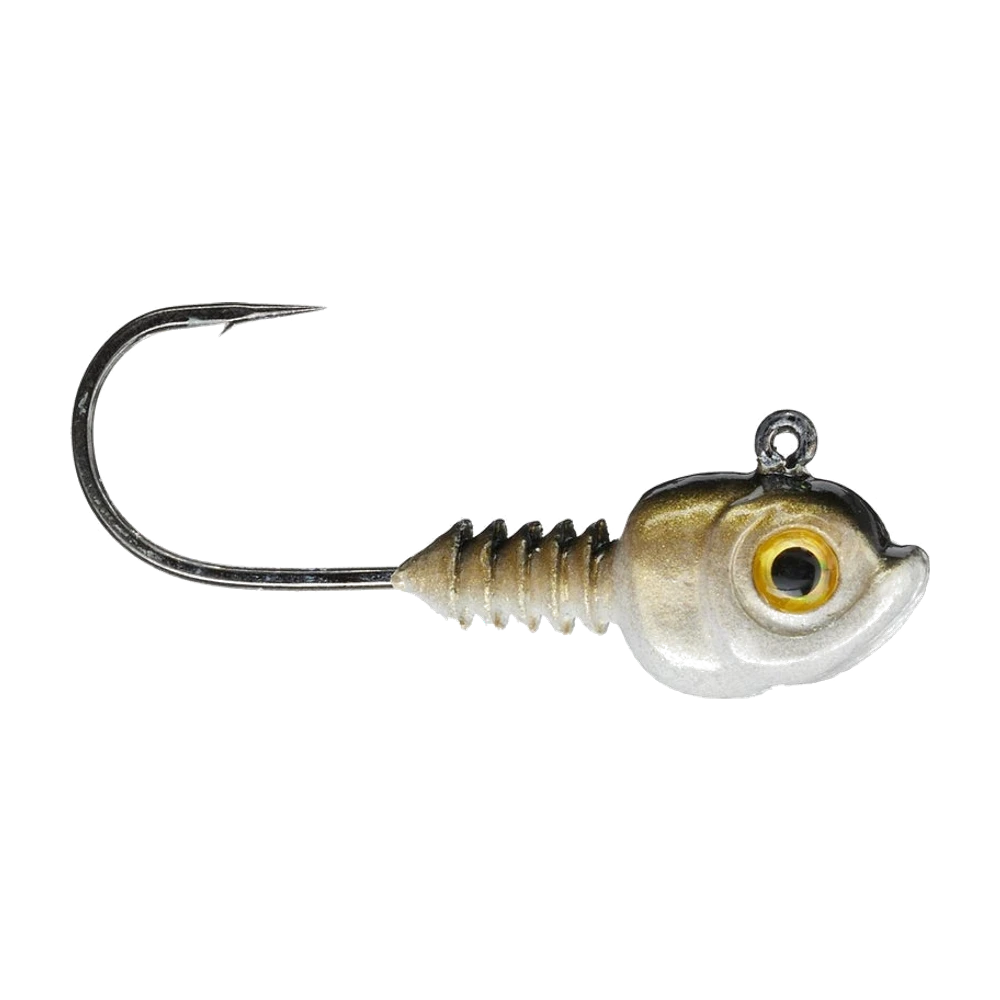
Looking at the photo, the first thing to note is what it isn't: not a round ball, not a football head. It's a fish-shaped moulded head, flattened side to side, with a pointed snout, a sculpted gill plate in relief and a large holographic eye set in a hollowed socket. Northland presents those elements as built to imitate a slender baitfish.
The most important detail, though, isn't cosmetic: the line tie comes out on top of the skull, not at the front of the nose. That position changes everything. A head pulled from above sits horizontal in the water, nose slightly up, instead of diving. It sways less from side to side on the drop, and above all it stays settled when you work it very slowly, or almost static under the boat. That's exactly what you want from a head meant to carry a slender shad.
The less pleasant consequence is that this flat profile slips through rock less easily than a conical head. Over very cluttered bottom, a classic round head like the one on a simple jighead rig is still easier to free.
The six weights, and what the table actually says
Northland publishes a table worth reading in full, because it has two columns: Size and Quantity. The first figure is the weight, the second is the pack count, not a hook size and not a length.
Converted, that gives six references: 3.5 g / 1/8 oz (3 per pack), 7.1 g / 1/4 oz (3), 10.6 g / 3/8 oz (3), 14.2 g / 1/2 oz (2), 21.3 g / 3/4 oz (1) and 28.3 g / 1 oz (1). The piece count drops as the weight climbs, which is standard practice on this kind of range.
Note carefully what the table doesn't say: no hook size appears anywhere, even though the maker's copy advertises hook sizes suited to a wide range of soft plastics. So there's no way to tell you here which gauge matches which weight — check the packaging, and do check it, because a hook that's too short on a 10 cm shad loses you every other fish.
The hook and the keeper, the two parts that work
Northland states a Gamakatsu hook. On the photo it's a single with a straight shank, round bend and wide gap, with a long tapered point and a tiny barb. That kind of point penetrates under very little pressure, which matters in finesse fishing, where you set the hook by leaning rather than ripping.
The keeper is worth a pause. It isn't a barb driven into the lead but a series of five moulded conical rings in the body, forming a stepped cone just behind the head. Northland claims a universal ribbed bait keeper that holds soft plastics without tearing them. The mechanical logic is sound: rounded ridges spread pressure across several points instead of concentrating everything on one barb that eventually splits the nose of the bait.
Always thread the soft bait all the way to the last ring, twisting it a quarter turn as you push. A shad stopped halfway down the keeper slides back on the first fish and goes crooked, and once crooked it no longer swims straight. Two extra seconds on the rig saves you one bite in three.
How to fish it
Vertical, under the boat
This is where the geometry pays off most. The whole thing hangs horizontal, the bait's eye at the height of a fish marked on the sonar, and it takes very little amplitude — five to ten centimetre lifts, slow, with long dead times — to bring the shad to life. A 7 to 14 g head is enough down to ten metres with no wind.
Straight retrieve near the bottom
Fit the lightest weight that still lets you feel the bottom, and reel at a constant speed just brushing the substrate. The flat head grips water well and transmits the bait's vibration all the way to the rod tip. With a narrow-tailed shad like the Northland Eye Candy Paddle Shad, which Northland pairs explicitly with this head, you can drop very low in speed without killing the swim.
Jigging a ledge
The heavy weights, 21 and 28 g, are not for bank-edge bass or perch. They're there to hold bottom in strong wind, on a drift, or in ten metres of water with current. If you're never in that situation, the first three weights in the range cover 90% of what you'll do.
The classic mistake: too heavy a head
It's the number one reflex and the most expensive. An oversized head sinks fast, but it crushes the soft bait's action on the fall, shortens the time it spends working, and raises your drop-off rate because the weight hanging off the fish's jaw acts as a lever. On a finesse shad, go down a notch before you go up.
Not sure what to tie on?
Photograph your spot: CarnaFish reads the scene, cross-checks the conditions and gives you the zone, the lure and the retrieve. Free on iOS and Android.
Colour by water clarity
- Clear water: the smelt finish of the photographed sample, dark back, glittered gold flanks and pearl white belly, with a yellow holographic eye and black pupil. It visually extends a translucent shad without creating a colour break.
- Silver forage: plain pearl white, which lets the soft bait carry the message alone and creates no dark spot at the head.
- Stained water: chartreuse, giving a clear aiming point at the front, where the fish needs to bite.
An accessory worth choosing rather than accepting
Northland happily tells this jig's story: born of a collaboration between Bryan Gustafson, Bassmaster Elite pro Jeff Gustafson and brand founder John Peterson, and tied to Jeff Gustafson's win at the 2023 Bassmaster Classic. That's a manufacturer's claim and carries no weight as a technical specification — but it does say which register the head was designed for: slow, precise fishing of a located fish, not high-speed searching.
For comparison with a more general-purpose approach, a Japanese round head like the Owner Cultiva Jig Head stays more versatile and cheaper, at the cost of a less decisive horizontal attitude. And whatever the model, weight choice matters more than brand: it's what sets fall speed, and therefore how long the fish has to make up its mind.
That still leaves the question of which depth to work and over which structure. That's the job of CarnaFish: a photo of the spot, and the app suggests the zone, the likely depth and the rig type suited to conditions. To build the basics of weight selection and spot choice, our beginner's guide to zander fishing with lures covers the rigs to master first.
Key takeaways
- Six weights from 3.5 to 28.3 g; in Northland's table the second figure is a pack count, not a measurement.
- Line tie on top of the skull: the head sits horizontal, ideal for very slow or vertical presentations.
- A five-ring cone keeper instead of a single barb, to hold the soft bait without splitting its nose.
- No hook size is published in the table: check the packaging before you buy.
FAQ
What weights does the Smeltinator Elite range cover?
Six: 1/8, 1/4, 3/8, 1/2, 3/4 and 1 oz, that is 3.5 / 7.1 / 10.6 / 14.2 / 21.3 and 28.3 g. The figures that follow in the maker's table are the number of pieces per pack, dropping from three on the light weights to one on the two heaviest.
Which hook size goes with which weight?
Northland's table gives no hook size at all, even though the copy advertises sizes suited to different soft plastics. So it's information to verify directly on the packaging, and it matters: a hook that's too short on a big shad multiplies drop-offs.
Why is the line tie on top of the head?
Because it makes the whole thing sit horizontal in the water, nose slightly up, instead of diving. That's exactly what you want for a very slow presentation or a vertical one under the boat.
Does the keeper damage soft plastics?
Northland claims a ribbed keeper that holds the bait without tearing it, and the shape visible on the photo supports that: five conical rings spread the pressure instead of concentrating it on one barb. Thread the bait all the way to the last ring for it to work.
Which weight should I start with?
The 7.1 and 10.6 g cover the vast majority of freshwater situations down to six or seven metres. The 21.3 and 28.3 g only earn their place in strong wind, on a drift, or in marked current.
Is it suitable for perch?
Yes, Northland explicitly cites a use range running from small perch to giant bass. In practice the 3.5 g weight paired with a small 5-7 cm shad is the one that matches perch best.
The full bass lure guideSeason-by-season strategy: which family of lure, when, and why.Go from theory to fish
CarnaFish reads your spot from a photo and gives you the game plan: zone, lure, retrieve. Free on iOS and Android.