O.S.P DoLive Beaver: flat claws that beat up and down
One lure, endless conditions. CarnaFish reads your spot from a photo so you are not just guessing.
A fleeing crawfish doesn't back away in a straight line. It beats the water with its tail, veers off, bumps into things, goes again. Reproducing that with a nine-centimetre piece of plastic is the problem O.S.P's engineers set out to solve with the DoLive Beaver. Their answer sits in a moulding detail you only see when you look closely.
Claws lying flat, not on edge
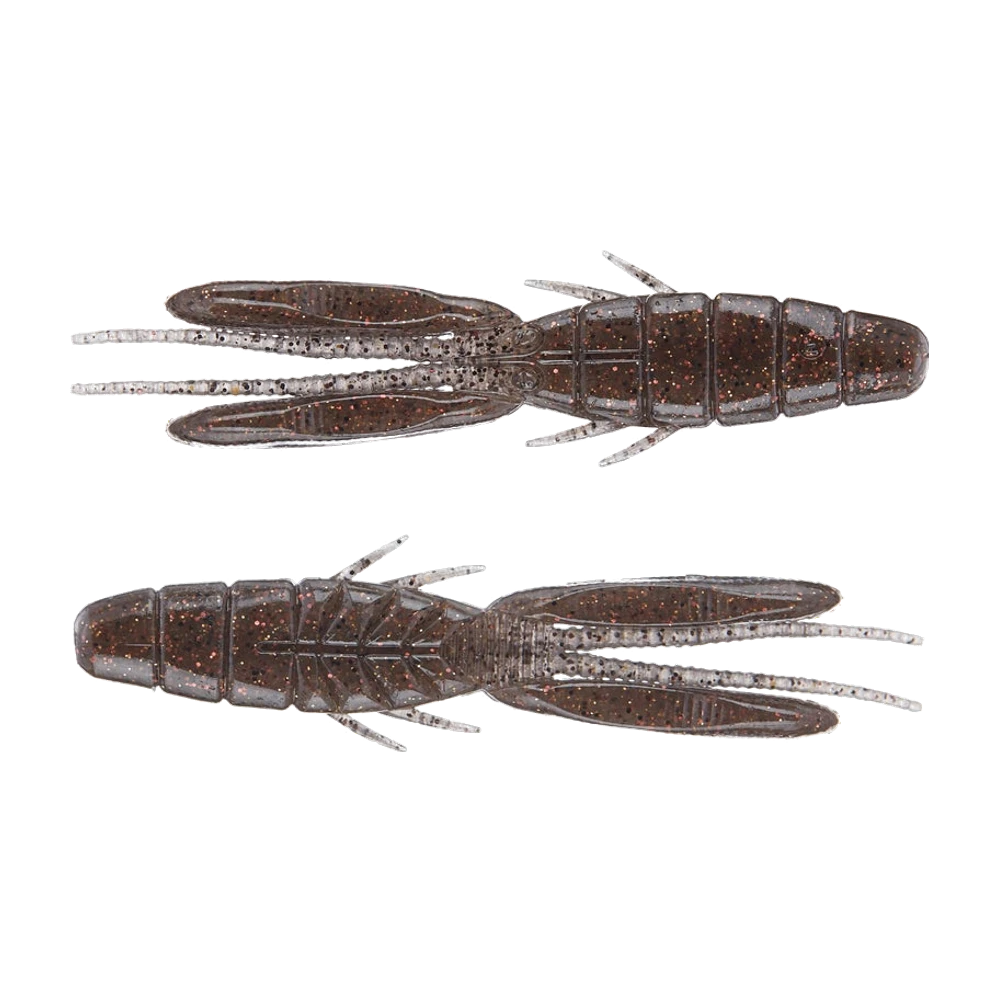
On the product photo, the two claws are large flat lance-shaped paddles, ribbed down the middle and thinned at the edges. The decisive point is their orientation: they're moulded with the broad face turned upward, in the horizontal plane of the body.
A paddle set that way can't beat sideways like a shad's tail. As the bait moves forward or falls, water pushes on the wide face from below, and the claw rises and drops. O.S.P describes exactly that behaviour: vertical paddle-shaped claws that move up and down as they travel through water, forcing the whole body to produce a waving motion, like an escaping crawfish.
That's an important distinction when you're choosing. A creature bait with claws on edge, like a Strike King Rage Craw, produces a nervous flap and a strong vibration signal. The DoLive Beaver instead waves its entire silhouette in a vertical plane: quieter, slower, and far more like an animal moving than a lure vibrating.
The antennae and the legs: the second stage of the action
Two long thin antennae, round in section with a ringed texture, extend well past the front of the bait. The body also carries several pairs of short, tapered side legs in a pale translucent material that contrasts with the brown of the body.
O.S.P presents these appendages as generating micro-movements that complete the main action. The mechanics are credible: those thin parts have negligible mass, so they quiver continuously under the slightest current, including when the bait is sitting dead still on the bottom. That is precisely when most flipping bites arrive.
Never trim an antenna to "tidy it up" or make the bait more subtle. On this kind of lure the body and claws attract the fish, while the fine appendages close the deal during the two seconds it spends inspecting the thing on the bottom. A trimmed Beaver loses exactly the part that turns a follow into a bite.
A grooved back, so a genuine weedless
The Beaver's back carries a central groove running the length of the segmented section. O.S.P states that this concave back lets you keep the hook point recessed, for a truly weedless Texas rig.
In practice that means you can bury the point in the plastic without creating a bump, so the rig doesn't catch on a branch as it passes. And on the hookset, the point exits the groove with minimal resistance, which matters on a thick bait: a bulky creature bait with a badly buried point is the classic fish lost halfway through the fight.
The rigs the maker claims
O.S.P cites five uses for this bait: Texas, flipping, punching, Carolina and shaky head. That isn't catalogue filler, it describes one consistent employment profile — a bait with real bulk, fished slowly, in contact with cover.
- On a light Texas rig with a 3.5 to 7 g bullet weight along a weed edge: the bait sinks slowly and the claws work by themselves on the fall.
- Flipping with 10 to 14 g, dropped at the foot of a stump or a dock, leaving two to five seconds of stillness before you lift.
- Punching with 18 g and up, to break through a floating vegetation mat. Here the bait's bulk works against you: take the heaviest weight the rod will handle, or you don't get through.
- Carolina, to sweep hard bottom on a long drag, where the bait works well behind the weight.
- Shaky head, as a finesse version, on a wary fish you've already located.
The attractant: a claim worth qualifying
O.S.P states that the DoLive Beaver is infused with genuine shrimp and squid powder, meant to add both scent and taste so fish hold on longer.
That's a manufacturer's claim, not a measurable figure. What can be said honestly: on a slow rig with long pauses, anything that delays the spit-out works in your favour, because you often set the hook half a second after the bite. But an attractant doesn't replace reading the spot properly, and it doesn't make up for a badly chosen sinker.
Not sure what to tie on?
Photograph your spot: CarnaFish reads the scene, cross-checks the conditions and gives you the zone, the lure and the retrieve. Free on iOS and Android.
What the maker doesn't say
Let's be precise: the O.S.P description gives neither the bait's weight nor the pack count. There's no spec table at all. The only published measurement is 3.5 in, around 8.9 cm, repeated through the text as the model designation. If you want to match a specific Texas hook, check the packaging: on a thick creature bait it's the hook gap, not the shank length, that decides your hook-up rate.
Colour by water clarity
- Clear water: the copper-brown flake over a smoky translucent base of the photographed sample, with its pale legs and antennae. Copper flake stands in for the glints off a shell without creating an aggressive flash.
- Lightly stained water: green pumpkin, the safe bet of the creature bait aisle, neutral enough to go anywhere.
- Dark water or heavy weed: black-blue, a clean silhouette that reads when the fish looks up at the bait against the light.
A Japanese bait in a very American family
The creature bait is a format born in the United States, and the aisle's references are largely American: Reaction Innovations Sweet Beaver, Zoom Brush Hog. The DoLive Beaver slots in with a different approach, closer to what O.S.P does on its other baits such as the O.S.P Dolive Craw: less raw signal, more refinement of movement.
That makes it a good second choice rather than an opening bait. On a spot already worked with a Brush Hog without result, coming back with the Beaver on a lighter weight and longer pauses often changes the outcome.
That still leaves the question of where to drop it, and that's decided before the first cast. It's the job of CarnaFish: a photo of the spot, and the app suggests the zone, the likely depth and the presentation type suited to the moment. For tackle and bass spot fundamentals, our beginner's guide to bass fishing remains a solid starting point.
Key takeaways
- Flat paddle claws lying horizontally: they beat up and down and make the whole body wave, instead of vibrating sideways.
- A back hollowed by a central groove, built to bury a Texas hook point without creating a bump.
- Antennae and small legs that quiver even with the bait dead on the bottom: that's where flipping bites are won.
- The only published measurement is 3.5 in, around 8.9 cm. No weight and no pack count in the maker's description.
FAQ
What size is the DoLive Beaver?
O.S.P states 3.5 in, around 8.9 cm, and that's the only published measurement. The description gives neither the bait's weight, nor the pack count, nor any spec table.
Which way do the claws beat?
Up and down. The paddles are moulded flat, broad face turned upward, so water pushes them vertically and makes the whole body wave. That's what O.S.P describes, and the product photo confirms it.
What hook and weight should I use?
A wide-gap Texas hook, with the point buried in the groove along the back. For weights, reckon 3.5 to 7 g on a light Texas rig, 10 to 14 g for flipping, and 18 g or more to punch a vegetation mat. The maker publishes no figures of its own.
Does the attractant actually change anything?
O.S.P states an infusion of genuine shrimp and squid powder, meant to add scent and taste. That's a manufacturer's claim, not measured data. On a slow rig with long pauses, anything delaying the spit-out helps, but it won't replace a well-chosen spot.
Does it really come through weed?
Yes, provided you use the dorsal groove as intended: point tucked into the plastic, no bump. That's exactly what the concave back is for, and what makes it suitable for punching and flipping under cover.
Is it better than the classic American creature baits?
It does something different. A Zoom Brush Hog or a Reaction Innovations Sweet Beaver put out more raw signal; the DoLive Beaver plays a slower vertical wave with fine appendages. It's a good second pass on a spot already worked without result.
The full bass lure guideSeason-by-season strategy: which family of lure, when, and why.Go from theory to fish
CarnaFish reads your spot from a photo and gives you the game plan: zone, lure, retrieve. Free on iOS and Android.