Rapala Crush City Cleanup Craw: the craw with a tight kick
Not sure this lure fits YOUR spot today? CarnaFish tells you in 10 seconds, from a photo.
Flipping into flooded timber is precision work: you drop the bait into a hole the size of a dinner plate, let it sink, and you have two seconds for something to happen before you lift it out and aim at the next hole. Everything in those two seconds depends on what the bait does while it falls. The Cleanup Craw is built for that very short window, and its claws are the reason.
Two wide claws, one tight kick
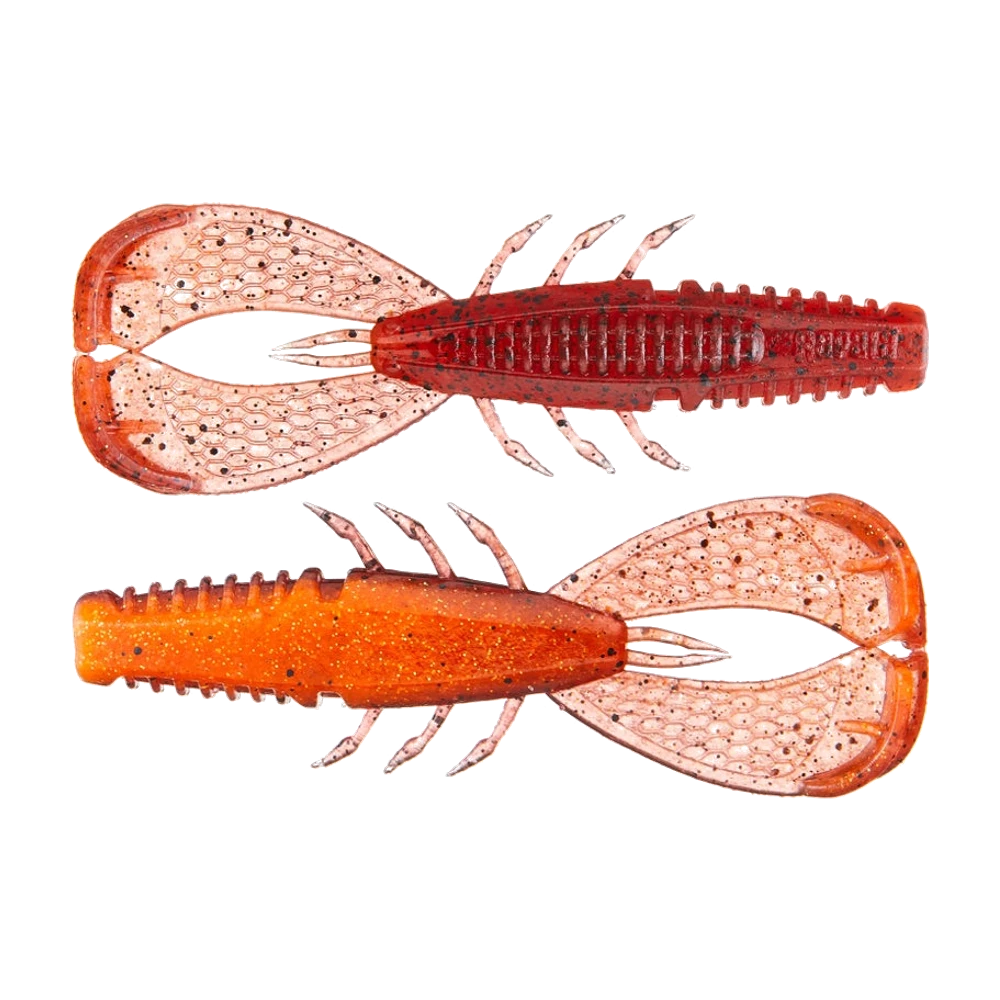
The claws on the Cleanup Craw are flat, wide, veined surfaces with a raised rim running around their outline — Rapala stresses that flange and describes it as aggressive. It is a design choice with a direct consequence on the action.
A soft claw with a thin edge folds under water pressure and sweeps wide, kicking slowly. A claw with a reinforced edge resists deformation: it does not fold, it vibrates. Rapala accordingly advertises a tight kicking action rather than a wide sweep. That is exactly what you need during a short vertical fall: a high-frequency vibration that starts immediately, without having to give the bait any speed.
The body itself is heavily ribbed along its whole length, clearly visible in the photo. Rapala gives it two roles: moving a lot of water, and hiding the hook point for easy weedless rigging. Between the claws, two thin antennae extend the outline, and three pairs of small legs complete the package.
What the table gives, and the question it leaves open
The maker's spec table is a single line, and its header reads Length Quantity: length and pack count.
| Published length | Equivalent | Pack |
|---|---|---|
| 3-1/2 in | 8.9 cm | pack of 7 |
Three remarks, in order of importance.
There is only one size. No small finesse format, no XL version for heavy punching. That is a real constraint: if you want to downsize on wary fish, you will have to change baits, not sizes.
Rapala publishes neither a weight nor a buoyancy class. No Class column in this table, and no sentence in the description says the claws float, that the body is neutral, or that it sinks fast. That matters, because a lot of soft craws on the market make a selling point of floating claws that hold the bait in a defensive posture on the bottom. Nothing here supports that claim. The description mentions salt dosed into the plastic, which usually makes it heavier, but an ingredient is not a class. If the resting posture matters to you, test it yourself in a bucket before building a strategy on it.
The published length does not say what it covers. On a craw ending in two wide claws and two antennae, the gap between the body alone and the claw tips is significant. The table does not settle it. Treat 8.9 cm as a size marker, and measure the body before choosing your hook.
Four uses, and what changes between them
Rapala lists four applications, and they call for neither the same tackle nor the same animation.
Flipping. Texas rig with a 7 to 14 g bullet pegged against the head, short accurate drops under the branches, fall watched on a semi-slack line. The bite almost always comes on the way down, and you see it on the line before you feel it.
Punching. Same logic, but through a mat of floating vegetation, with a 20 to 35 g weight that has to break through. The Cleanup Craw goes through well thanks to its compact body and the point buried in the back channel. A heavy-wire hook is mandatory.
Dragging. Pulled slowly across hard bottom, on a Carolina rig or a light Texas rig, rod low and reel only. The claws vibrate continuously as soon as the bait moves, even very slowly: that is where the reinforced rim earns its keep.
Trailer. Rigged behind a jig or a chatterbait, it adds volume and a high-frequency vibration layered over the blade's own. On a flipping jig it is the most classic and the most effective pairing.
The classic mistake
Fishing the Cleanup Craw as a search bait. This is not a bait you cast long to cover water: its action is short and its value is concentrated in the fall and in bottom contact. If you reel it back across twenty metres of open water you lose almost everything that sets it apart from any other soft plastic. Drop it, let it work, lift it, start again a metre further on.
One detail that changes results when flipping: do not lift the bait the moment it reaches the bottom. Leave it sitting three seconds longer than feels reasonable, then give a single small tip twitch without moving it. The claws restart vibrating on the spot, and it is often that stationary restart that triggers a fish which had been watching without committing.
Not sure what to tie on?
Photograph your spot: CarnaFish reads the scene, cross-checks the conditions and gives you the zone, the lure and the retrieve. Free on iOS and Android.
Colours by water and season
- Spring, warming water, active crawfish: the dark craw red with black flecks from the photo. It matches what the fish is actually eating at that time of year.
- Stained water or silt bottom: the flaked orange, also visible in the image. It stays readable under poor light penetration, and the flake catches what little light there is.
- Gravel bottom, clear water, wary fish: green pumpkin. It is the universal soft-craw shade, the one that never lies over natural substrate.
Against the other soft craws
The Strike King Rage Craw plays exactly the opposite card: claws designed for a wide, aggressive sweep that need movement to express themselves. On a bait dragged fast or trailed behind a quick chatterbait, the Rage Craw puts out more. On a two-second vertical fall, the tight kick of the Cleanup Craw starts earlier.
The Zoom Z Craw sits between the two, with more thread-like appendages and a longer outline. It often goes down better in very clear water, where the bulk of the Cleanup Craw's claws can look excessive.
And within the same range, the Rapala Crush City Bronco Bug answers a different need: its two large paddles generate real thrust and make the whole body undulate, where the Cleanup Craw vibrates on the spot without travelling on its own.
Knowing where to drop a flipping bait counts for more than picking the model: CarnaFish reads a photo of the swim and points out the zones to target first. And to learn how to decode a cluttered bank before you even tie a bait on, our guide to reading a fishing spot lays out the method.
Key points
- The reinforced rim on the claws prevents folding and produces a tight vibration that starts on the fall, with no need for speed.
- One size only, 8.9 cm, in packs of seven. No weight and no buoyancy class published.
- Nothing in the description says the claws float: do not build your presentation on that assumption without checking it.
- This is a contact and fall bait, not a search bait: drop it, let it work, move a metre.
FAQ
Do the Cleanup Craw's claws float?
Rapala never claims so, and the table has no class column. Floating claws are a feature other soft craws advertise, not this one. If the resting posture matters to your fishing, test the rigged bait in a bucket before relying on it.
What hook size do you need?
A wide-gap Texas hook in 3/0 or 4/0 depending on wire, and a heavy-wire model as soon as you fish cover. The body is thick and heavily ribbed, so too closed a hook will not clear its point on the set.
Does the Cleanup Craw come in several sizes?
No, Rapala publishes only one: 3-1/2 in, that is 8.9 cm, in packs of seven. To downsize you have to change models.
Can it be used as a chatterbait trailer?
Yes, and it is a very good use. The tight vibration of the claws layers over the blade's oscillation without fighting it, unlike wide-sweeping claws that can unbalance a fast chatterbait.
How should you work it when flipping?
Drop it into the hole, watch the fall on a semi-slack line, then three seconds of stillness on the bottom. One small tip twitch without moving the bait, two more seconds, then lift and aim at the next target.
Does the 3-1/2 in length include the claws?
The table does not say: it publishes a length column without stating what it measures. On a wide-clawed craw the gap is not trivial, so measure the body yourself if your hook choice is tight.
The full bass lure guideSeason-by-season strategy: which family of lure, when, and why.Go from theory to fish
CarnaFish reads your spot from a photo and gives you the game plan: zone, lure, retrieve. Free on iOS and Android.