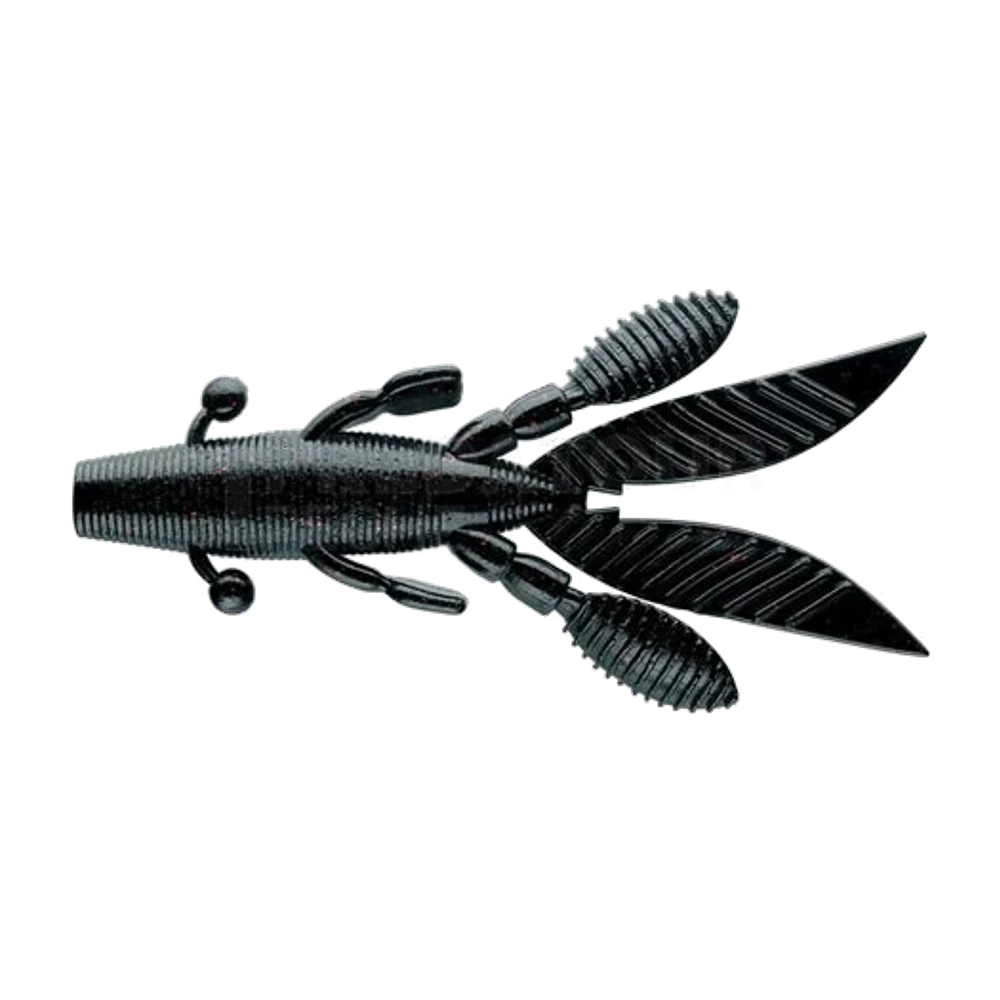
Gary Yamamoto Flappin Hog: the dense creature that punches through cover
This lure shines under specific conditions. CarnaFish tells you in 10 seconds if today is one of them.
A mat of lily pads in high summer, three metres of water underneath, and you know the bass are down there in the shade, pinned to the inverted surface. You drop your soft plastic in with a 7 g weight: it stops on the leaves. You slide it along, it finds a hole, sinks thirty centimetres and jams in the stems. You never reached the fish.
That isn't an animation problem, it's a penetration problem. You need a compact, dense, streamlined package that goes through in one go, and a bait that doesn't slow the descent. The Flappin Hog is built for exactly that: a short body, heavy plastic, and appendages that work without acting like a parachute.
The plastic does half the work
Everyone talks about the claws on this bait. The real argument is elsewhere: the material.
Yamamoto plastic is heavily salt-loaded, which has three direct consequences.
It's dense. For the same volume, it weighs more than standard plastic. Which means it goes straight down instead of drifting, and it helps your weight get through instead of holding it back. When you're punching, that's the difference between reaching the fish and sitting on the leaf.
It's soft and heavy at once. A bass taking it in feels a weight and a give consistent with a crayfish, and holds on a second or two longer than with hard plastic. In a style of fishing where the hookset is delayed by a metre of stems, those two seconds are exactly what you need.
It tears fast. That's the trade-off and you have to accept it: one or two fish per bait in heavy cover. Count it as a consumable, not a defect.
Shape-wise, the two big flat claws flap hard during the fall — that's the main signal — then settle at rest, where only the small side appendages keep quivering.
The retrieve: the fall, then almost nothing
The rig itself is covered in our Texas rig guide, and there's nothing specific to reinvent here. What changes is the rhythm.
- Drop the bait vertically, flipping or pitching, into a hole in the cover. No long casts: you want the most vertical trajectory possible.
- Let it sink while following the line, without tightening it or letting it go completely. The claws flap through the whole descent. One bite in two comes here, and shows up only as a line that stops.
- On the bottom, do nothing for five seconds. Really nothing. The appendages quiver on their own.
- Two small 15 cm lifts, without moving the bait horizontally, then another five-second pause.
- After three cycles, pull out and drop it somewhere else. A hole in the cover gets fished in thirty seconds or not at all.
On the water: flipping under cover, don't try to feel the bite through the rod. Watch your line where it enters the water. If it shifts sideways by a centimetre, or if it stops sinking when you know there's water left below, that's a fish. Drop the rod towards it, take up the slack, then set the hook with one firm vertical strike. Anglers who wait for a sensation in the blank miss half the fish of the day.
Choosing the weight and the context
| Context | Rig | Weight | Goal |
|---|---|---|---|
| Open margin, 1 to 3 m | Standard Texas | 5 to 7 g | slow fall, claws very visible |
| Dead timber, stumps | Texas with pegged weight | 10 to 14 g | controlled descent, easy to free |
| Lily pads, algae mats | Punching, pegged weight | 18 to 21 g | punch through in one go and reach bottom |
| 10 to 21 g jig | Trailer | to suit the jig | extra bulk and signal |
Two practical points. Always peg the weight when fishing heavy, with a stop or a peg: a sliding weight arrives on the bottom by itself and leaves the bait hung up two metres higher. Use a heavy-wire hook, 3/0 or 4/0 with a wide gap: on 0.30 mm fluorocarbon or 0.40 mm braid, a fine hook opens at the first tug of war in the stems.
The jig trailer use deserves highlighting. Rigged behind a brush jig, the Flappin Hog adds bulk, claws that flap on the fall, and above all density — the jig falls faster and straighter, which is precisely what you want in cover. Plenty of anglers trim a centimetre off the bait to tighten the whole package up.
Not sure what to tie on?
Photograph your spot: CarnaFish reads the scene, cross-checks the conditions and gives you the zone, the lure and the retrieve. Free on iOS and Android.
Where it's at its best, and where it has no place
Its window: dense cover in warm water, from late spring to autumn. Lily pad mats, floating weed, log jams, laydowns, reed edges. Every situation where you're fishing above the fish rather than in front of them.
It's also very good post-spawn, when bass take refuge in the shade and refuse to chase anything: a bait that lands beside them and stays still is often the only thing they'll accept.
It's a poor searching tool: too slow, too localised, you cover a few square metres at a time. It's also a bad choice on big open flats, where a rig that glides for a long time works far better — that's Carolina rig territory. And in very cold water below 10 °C, an aggressive creature with big flapping claws provokes less than a near-motionless finesse bait.
Flappin Hog or Lizard
Against the Zoom Lizard, the contrast is structural and worth the detour. The Lizard is slim, light, with four legs that act as a parachute: it's made to glide behind a Carolina weight over an open flat, and its best window is spring on spawning ground. The Flappin Hog is short, dense and compact: it's made to drop fast and straight into a hole in the cover, and its best window is summer.
They don't replace each other — they answer two opposite kinds of water. If you can only take one in high summer on a weed-choked pond, it's the Flappin Hog without hesitation.
Against a Yamamoto Senko 5, same house but opposite logic: the Senko relies on a horizontal shimmying fall and a total absence of appendages, so a minimal signal for wary fish. The Flappin Hog commits to a strong signal and a fast descent.
Our beginner's guide to bass fishing covers how to approach a water choked with vegetation. And if you're unsure which weight to fit in front of a lily pad mat, CarnaFish reads a photo of the spot and answers for you.
Key takeaways
- Dense, salted plastic: the bait helps the weight punch through instead of holding it back.
- The claws flap on the fall, the small appendages quiver at rest. Two signals, two phases.
- Vertical drop, guided fall, five seconds of stillness. Three cycles per hole, no more.
- Pegged weight and a heavy-wire 3/0 or 4/0 hook: without them you lose the fish in the stems.
- A bad choice for searching and on big open flats.
FAQ
What weight do I need to punch through lily pads?
18 to 21 g with a bullet weight pegged against the bait. Below 14 g, the whole package bounces off the leaves instead of going through. On an open margin, drop back to 5 or 7 g for a slow, visible fall.
Why peg the weight?
A sliding weight goes down through the stems on its own and leaves the bait hung up higher: you're no longer fishing and you no longer detect bites. A stop or a peg keeps the package together and lets it punch through in one movement.
Can the Flappin Hog be used as a jig trailer?
Yes, it's one of its best uses. It adds bulk and flapping claws, and its density makes the jig fall faster and straighter. Plenty of anglers shorten it by a centimetre to tighten up the package.
How many fish per bait?
One or two in heavy cover. The salted plastic that gives the bait its density and softness is also what tears quickly. Treat it as a consumable and stock up accordingly.
What hook size should I choose?
A heavy-wire Texas hook in 3/0 for the 9 cm version, 4/0 for the 10 cm, with a wide gap. Fishing under cover with braid, a fine hook opens as soon as the fish wraps itself in the vegetation.
What's the difference with the Zoom Lizard?
The Lizard is slim and glides, built for the Carolina rig over open bottom and most effective in spring. The Flappin Hog is compact and dense, made to drop fast into cover, with summer as its best season.
The full bass lure guideSeason-by-season strategy: which family of lure, when, and why.Go from theory to fish
CarnaFish reads your spot from a photo and gives you the game plan: zone, lure, retrieve. Free on iOS and Android.