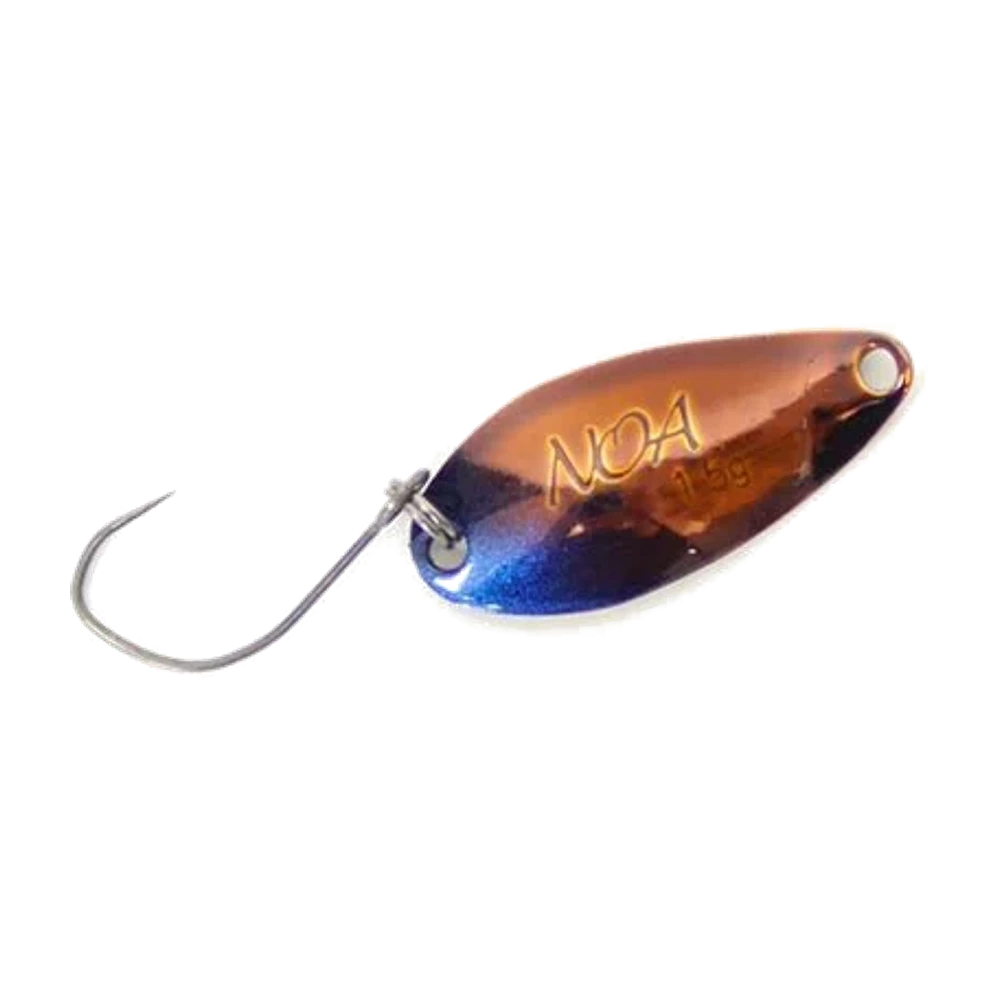
Rodio Craft Noa: tuning your spoon to the tenth of a gram
One lure, endless conditions. CarnaFish reads your spot from a photo so you are not just guessing.
Open a well-stocked area fishing box and you will often find forty colours and three weights. It should be the other way round. The first reflex of an angler who has stopped catching is to change colour — and he can spend a full hour cycling through shades without ever touching the one parameter that actually governs his lure's path.
A 2 g spoon and a 2.4 g spoon, in the same shape and the same colour, do not fish the same water. They do not sink at the same speed, they do not settle at the same depth for a given retrieve speed, and they do not run at the same angle. Four tenths of a gram are enough to move a lure from "thirty centimetres above the fish" to "right in among them".
The general principle of area fishing is covered on the Forest Miu page. What makes the Noa distinctive is that it comes in deliberately very closely spaced weight steps, and that this is the dial it invites you to use.
Weight is a setting, not a constraint
On an area spoon, weight determines three things at once.
Sink speed. Obvious, but rarely quantified. Between 1.5 g and 2.5 g, the time to reach a metre can vary by a factor of two. That is your main depth dial.
The settling depth at a given speed. This is the point almost nobody exploits. At a constant retrieve speed, every spoon settles on a precise running plane. The heavier it is, the lower that plane. If you want to fish fifty centimetres deeper without slowing down — because the current speed is working — the only clean solution is to go up one weight step.
Casting distance. Into a headwind, going from 1.8 g to 2.5 g buys you five to eight metres. On a lake where fish patrol offshore, those metres decide the session.
| Step | Typical use | Retrieve speed |
|---|---|---|
| 1.5 to 1.8 g | Top layer, calm water, visible fish | Very slow |
| 2 to 2.2 g | All-round, 50 cm to 1.2 m | Slow |
| 2.5 to 2.8 g | Middle layer, light wind | Slow to medium |
| 3 to 3.5 g | Bottom layer, headwind, long range | Medium |
The method: vary weight before colour
- Settle on a retrieve speed you are comfortable with and hold it. That is your constant for the next ten minutes.
- Start from the middle step, around 2.2 g, and count the sink for three seconds.
- If nothing responds after ten casts, go up one step without changing anything else. Same colour, same speed, same count.
- Keep going up until you touch bottom, then come back down one step.
- Only then change colour. You have swept the whole water column at constant speed, and you know the problem is not depth.
That discipline has a hidden benefit: it teaches you which step the fish are holding at on the day, and that information stays valid for every other lure in your box.
On the water: when you change step, change nothing else at the same time. It is the classic area fishing trap — you alter weight, colour and speed together, it starts producing, and you have no idea why. One variable at a time, ten casts minimum before drawing a conclusion.
Matt finishes, a real card to play in clear water
The second useful feature of this family is its muted, matt, non-reflective finishes.
On a very clear lake, in bright sun, with trout that have seen thirty spoons go past during the day, a metallic flash becomes counterproductive. It attracts from a distance, but it makes fish peel off in the last metre — the ones that follow then refuse.
A matt finish does the opposite. It produces no flash, it produces a silhouette. The fish reads a shape and a movement, not a reflection. On educated fish in clear water, it is often the only register that keeps working in the afternoon.
The three families to carry with this logic in mind:
- Dark matts (black, brown, olive) for clear water and full sun.
- Pastel matts (off-white, pinkish grey, beige) on wary fish and in diffuse light.
- Classic brights (silver, gold) kept for slightly stained water, overcast skies and the first minutes after a stocking.
Not sure what to tie on?
Photograph your spot: CarnaFish reads the scene, cross-checks the conditions and gives you the zone, the lure and the retrieve. Free on iOS and Android.
Where it takes the lead, and where it adds nothing
- Very clear lakes, where the matt finish makes the difference on followers.
- Long sessions, several hours, where the step-by-step method lets you track fish dropping deeper as the day goes on.
- Waters of varying depth, where you change spot and therefore water column often.
- Competitions and busy catch-and-release fisheries, on trout that have seen everything.
It brings nothing specific on a tiny, shallow pond where a single step covers everything. And the closely spaced step logic loses all meaning if you only have one or two versions in the box: it is a method that assumes you own at least four.
Noa or a specialist spoon
The trade-off comes down to how you build your box.
A box of specialists lines up one tool per situation: a slow-falling spoon such as the Forest Pal for the top layer, a wide-wobbling spoon such as the Nories Masukuroto Weeper for the bottom, a fast spoon such as the Valkein Highburst for active spells. You change lure when the situation changes.
A box built around the Noa works differently: one model, one action, but a fine weight dial that lets you cover the whole water column without changing swimming behaviour. It is clearer, quicker to adjust and far simpler to learn — at the cost of a less varied range of signal.
In practice the two approaches combine: the Noa serves as a reference and a probe to find the layer, the specialist spoons exploit the layer once found. Our guide to river trout fishing covers the running-water side of this fishing. And if you do not know which step to start with on a lake you have never fished, CarnaFish analyses a photo of the spot and answers.
Key takeaways
- Weight governs three things: sink speed, settling depth at a given speed, and casting distance.
- To fish deeper without slowing down, go up one weight step rather than change speed.
- Sweep the water column step by step before touching colour.
- One variable at a time, ten casts minimum before drawing a conclusion.
- Matt finishes create a silhouette instead of a flash: often the last register that works in clear water.
FAQ
Why so many different weights on the same spoon?
Because weight is the main depth control. A few tenths of a gram change the sink speed and the running plane at constant speed, which is enough to move the lure down to the fish rather than above them.
Should I change weight or colour when the bites stop?
Weight first. Until you have swept the water column step by step at constant speed, you do not know whether the problem is depth or presentation. Colour is only worth changing after that sweep.
How do I fish deeper without slowing down?
By going up one weight step. Slowing down does get the lure deeper but it also changes the vibration and the running attitude; changing weight moves the settling plane while preserving the behaviour that was working.
What are matt finishes for?
To present a silhouette rather than a flash. In very clear water and on educated trout, a metallic glint attracts from a distance but makes fish peel off in the last metre. A muted finish keeps followers committed all the way to the take.
How many steps do I need to own?
At least four, otherwise the method loses its point. A typical set covers around 1.6 g, 2.2 g, 2.8 g and 3.5 g, which lets you sweep from subsurface to the bottom of a two to three metre lake.
Is this spoon suitable for beginners?
Yes, and it is one of the simplest ways into area fishing: one model, one action to understand, and a single setting to work with. The variety of shapes and wobble widths can come later.
The full trout lure guideSeason-by-season strategy: which family of lure, when, and why.Go from theory to fish
CarnaFish reads your spot from a photo and gives you the game plan: zone, lure, retrieve. Free on iOS and Android.