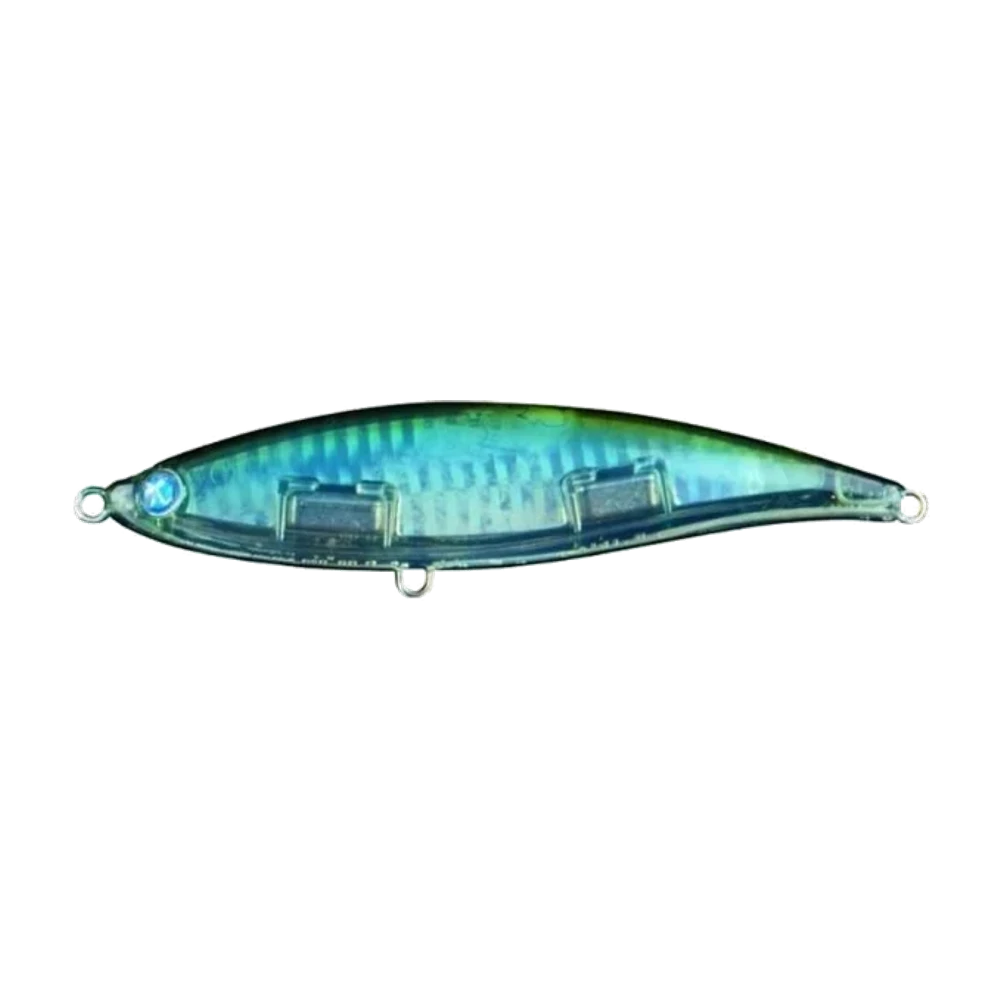
SeaSpin Janas: the stickbait you let the current work for you
Before tying this one on, it helps to know if the spot actually calls for it. CarnaFish reads the scene from a photo.
There is one situation nearly every bass lure handles badly: a hard seam of current, in a tidal race, an estuary channel, or between two breakwaters. You cast across, the current grabs your line, the lure is immediately dragged sideways, its action turns into a permanent buzz, and it crosses the seam in ten seconds without ever staying in the zone that matters.
The problem comes down to one thing: most saltwater lures have a lip, so their action is imposed on them. As soon as the pull of the current adds to the pull of your line, that action goes into overdrive and the lure no longer looks like anything edible.
The Janas has no lip. It is a sinking stickbait: left to itself, it does not swim. It sinks, it glides, it lets itself be carried. And that is exactly what you want on a current seam, because a bass sitting behind a point or an obstruction is not looking for a fish rowing against the flow — it is looking for prey coming down with it.
A lure with no action of its own, and why that helps
Having no lip changes three things compared with a standard minnow.
- Nothing runs away with it. However hard the current pushes, the lure never starts vibrating like a caricature of itself. It keeps a believable silhouette even sideways across a fast seam.
- The movement comes from you. A short pull makes it pivot and dart to the side, walk-the-dog style but below the surface. Two pulls back to back give you two opposite darts.
- The stop produces a glide. At the end of a dart, the lure carries on with its momentum while slowly losing height, staying flat. That is where most bites happen.
The trade-off is plain: this is not a straight-retrieve lure. Crank it back without doing anything else and it simply travels, with nothing to show for it. It needs an active hand, or a current doing that job for you.
Working it in current, step by step
This is where it gives its best.
- Find the seam and its edge. Bass sit in the shear zone, between fast water and slack water, not in the middle of the flow. Our guide on how to read a fishing spot covers reading those lines.
- Cast upstream, at 45 degrees up-current, never across and never down.
- Let it sink on a controlled line for two to five seconds. The lure drops while drifting, exactly like an injured fish carried by the flow.
- Follow the drift with the rod tip, keeping just enough tension to feel, never pulling. At this stage you are not fishing: you are letting the current present the lure.
- When the lure reaches the shear zone, give two or three short sharp pulls. It darts sideways across the seam.
- Stop dead and let it glide and sink for three seconds, still drifting.
- Start again until the line is downstream, then bring it back on the surface and recast.
On the water: in a race or a channel, do not try to retrieve the lure — try to keep it in the seam as long as you can. One cast that lasts forty seconds in the right line beats five casts that cross it in ten. If your lure is out of the current after fifteen seconds, you cast too far downstream.
In calm sea, with no current
The Janas still has a job with no current, but the fishing changes completely: it becomes a provocation lure.
| Situation | Sink count | Retrieve |
|---|---|---|
| Bass busting on the surface | 0 to 1 second | Fast darts in rhythm, no stopping |
| Fish located but passive | 4 to 8 seconds | Two darts, 3 second stop, repeat |
| Breakwater edge at night | 2 to 3 seconds | Slow, spaced pulls, long glides |
| Shallow rocky plateau | 1 to 2 seconds | Short darts, rod tip high to stay above it |
The setting that matters is how much slack you leave between pulls. Short, tight line and the darts are tight and nervy. A little slack and they get wide, with the lure gliding further. On wary fish, the wide version almost always produces more.
The tackle that goes with it
- Fine braid, 0.10 to 0.14 mm. Transmission is everything on a lure with no action of its own: your hand has to reach the lure undamped.
- A 0.28-0.35 mm fluorocarbon leader, about a metre. Enough for abrasion on mussels and rock, not long enough to soak up your pulls.
- A rod with a lively tip, not a stiff one. The pulls must be short and sharp, and it is the tip that makes them.
- A light round snap. It frees up movement at the nose. A flat or heavy snap kills the darts.
Not sure what to tie on?
Photograph your spot: CarnaFish reads the scene, cross-checks the conditions and gives you the zone, the lure and the retrieve. Free on iOS and Android.
Where it shines, where it is useless
Its windows:
- Current seams: races, narrows, estuary channels, lagoon outflows on the ebb.
- Breakwater and jetty edges, where the current runs along the structure and bass sit in the eddies.
- Actively feeding bass, when you need an erratic lure rather than a steady swim.
- Night fishing in calm water, on slow pulls and long glides.
Where it has no business:
- Fast searching over big areas. It needs constant input: you cover very little ground per hour.
- Big seas. The lure comes out of the water on every wave and the retrieve becomes unreadable.
- Strong headwind. Its moderate weight limits distance, and a line taking the wind kills the transmission of your pulls.
- Deep ground. Beyond two or three metres, the sink time is no longer worth it.
Janas, Pro-Q or Mommotti
The three SeaSpin models split by sea state and by how you work them, not by species.
The SeaSpin Pro-Q is a straight-retrieve minnow: you turn the handle and it works on its own. It is the lure for the calm beach and the weed flat, on patrolling fish. Where the Janas demands your hand, the Pro-Q asks for nothing.
The SeaSpin Mommotti is the lure for rough rocky coast: dense, it casts into the wind and holds its swim in the wash. It is the answer when the sea gets up, exactly where the Janas becomes impossible to work cleanly.
The Janas takes the slot left over: current, or bass refusing a steady swim. It replaces neither of the other two, which is why plenty of shore anglers carry all three.
And if you are torn between a straight swim and an erratic retrieve when you reach a spot, CarnaFish reads a photo of it and answers.
Key takeaways
- No lip, so no action of its own: the movement comes from your hand or from the current.
- In current, cast 45 degrees upstream and try to stay in the seam as long as possible.
- The stop after a dart produces a sinking glide: that is where most bites come.
- Fine braid, short leader, lively rod tip and a light round snap.
- Pointless for fast searching, in a big sea, or into a strong headwind.
FAQ
How do you work a sinking stickbait in salt water?
With short sharp wrist pulls, rod tip down, taking up the slack between each one. The lure darts alternately left and right below the surface, and the stop that follows produces a sinking glide that draws most of the bites.
Where should you cast in a current seam?
Upstream, at about 45 degrees, never across and never down. The aim is to let the lure drift in the seam as long as possible, working it only as it crosses the shear zone between fast and slack water.
Can you fish it on a straight retrieve?
Technically yes, but there is little point: with no lip it has no action of its own and simply travels. If you want a lure that works by itself on the handle, take a lipped minnow instead.
What size should you pick?
The smallest version for lagoons, harbours and small bass; the biggest as soon as you need distance, strong current or bigger fish. The large size also holds a drift better in a fast flow.
Do you need a long leader?
No, about a metre is enough. It protects against abrasion on mussels and rock without damping your pulls. A two-metre leader absorbs part of your input and the darts turn mushy.
Does it work at night?
Yes, and that is one of its best windows in calm water. Slow right down: spaced pulls, long glides, a solid dark colour. Bass at night pick up silhouette and movement, not the detail of a finish.
The full sea bass lure guideSeason-by-season strategy: which family of lure, when, and why.Go from theory to fish
CarnaFish reads your spot from a photo and gives you the game plan: zone, lure, retrieve. Free on iOS and Android.