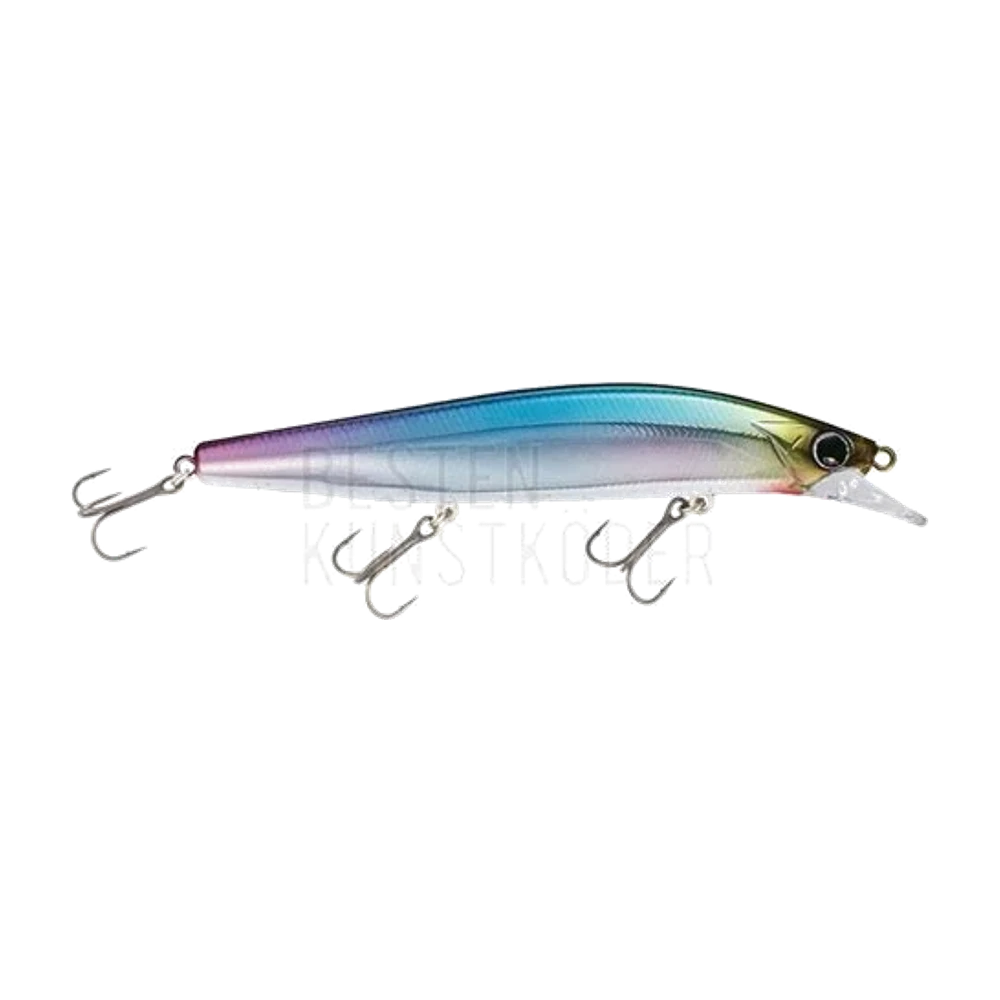
Shimano Bantam Rip Flash: a flash that survives the pause
Rather not fish it blind? Photograph your spot — CarnaFish cross-checks the conditions and points you the right way.
A suspending jerkbait sitting still is a motionless piece of plastic. Everything that was meant to seduce — the sideways break, the flash off the flanks, the vibration — happened during the jerk, and stops dead the moment the lure settles. Yet that stillness is precisely when a cold-water fish makes up its mind, sometimes after ten seconds.
So there is a hole in the retrieve: the most productive phase is also the most silent one. The Bantam Rip Flash attacks that hole directly. Inside the body, a reflective blade mounted on a spring keeps oscillating after the lure has stopped. While the shell is frozen, the inside is still moving and throwing short flashes through the translucent flank.
The principle is simple. What it means for how you fish is less so, and that is the whole point of this lure.
A flash that outlives the stillness
What a fish perceives from a jerkbait in clear water is first and foremost a run of flashes. The flank throws light when the lure pivots; the moment it stops pivoting, there is nothing left to see but a silhouette.
The internal blade changes that on three counts:
- It extends the signal by two to four seconds after the last jerk. The fish that turned at the noise still finds something moving when it arrives.
- It produces flashes out of sync with the body. It is no longer one flash per pivot, but an irregular shimmer, closer to the scales of a trembling injured fish than to a metronomic lure.
- It works on a straight retrieve too, which makes the lure usable beyond pure jerking: cranked slowly, it keeps an extra signal its rivals do not have.
Add to that flat sides. A flattened section reflects light over a large surface all at once, unlike a round body that scatters it. It is the same principle as a flat-sided crankbait: more flash, less vibration.
The retrieve: lengthen the pauses, shorten the jerks
This is where the lure asks you to break your habits. With a standard jerkbait, you compensate for the silent pause with long, frequent jerks. Here it is the opposite.
- Cast, then two or three fast turns to bring the lure down to its depth.
- Two short, sharp jerks, ten to fifteen centimetres each, wrist only, rod tip pointed at the water. No need for big amplitude: you are trying to launch the blade, not move the lure.
- A long pause, keeping the line slightly slack. This is the working phase: the body is frozen, the inside shimmers.
- Take up the slack slowly before the next jerk, staying alert — a good share of bites show up as simple weight as you tighten.
- Repeat to the bank, never shortening the pauses to go faster.
| Water temperature | Number of jerks | Pause length |
|---|---|---|
| Above 16 °C | 3 to 4 | 1 to 2 s |
| 11 to 16 °C | 2 to 3 | 3 to 6 s |
| 7 to 11 °C | 2 | 6 to 10 s |
| Below 7 °C | 1 to 2 | 10 to 20 s |
On the water: with this model, do not pick the rhythm up when nothing is biting — lengthen the pause by another third. The internal blade takes about a second to get going and carries on for several more. A two-second pause cuts the signal before it has given its best, and you lose exactly what you bought this lure for.
Tuning: what throws the suspension off
Like any suspending lure, it is tuned to a knife edge and the usual three parameters unbalance it.
The line. Fluorocarbon of 0.28 to 0.30 mm keeps it in its layer. At 0.35 mm, it sinks slightly during long pauses — sometimes useful in winter to drop another thirty centimetres, but do it knowingly. Floating monofilament lifts it.
The hooks. Stay with trebles of the same wire diameter as stock. A heavy-duty treble for pike weighs down the front and changes the attitude at rest: compensate by fitting a lighter model at the back.
The pike leader. Twenty centimetres of fine wire goes through without spoiling the action. Heavy titanium, or a leader that is too long, restricts the sideways break. On pike that is a compromise to accept: better a slightly restricted lure than a lure bitten off.
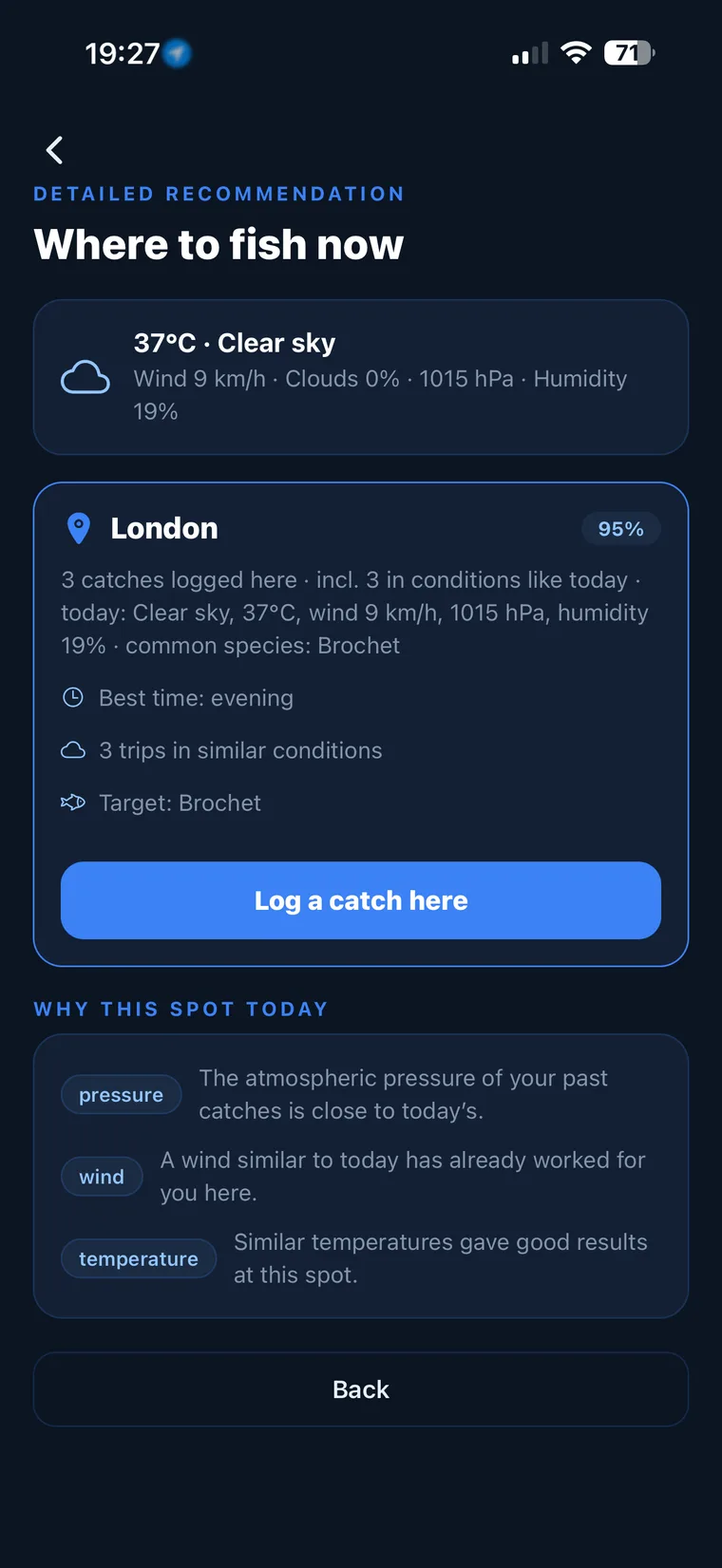
Not sure what to tie on?
Photograph your spot: CarnaFish reads the scene, cross-checks the conditions and gives you the zone, the lure and the retrieve. Free on iOS and Android.
Its windows, and its blind spots
It is at its best in clear to lightly stained water, from 8 to 16 °C. In other words autumn, a mild winter, and the very start of spring. Typical spots: rocky edges, gentle drop-offs, dead weed beds, points and backs of bays where fish are sitting shallow but inactive.
Its limits are sharp:
- In very murky water or at night, the flash has nothing to work with: with no light, the blade is useless. A lure with a strong vibration will do better.
- On very active feeding fish, the long pause is wasted time. A fast searching lure covers far more ground.
- Deep, beyond two metres, it will not get there. This is not a diving jerkbait.
- In strong wind, holding a half-slack line for ten seconds becomes impossible and you lose control of the pause.
Rip Flash against the benchmark jerkbaits
The Lucky Craft Pointer 100 remains the benchmark for perfect stillness: it holds its layer as long as you like, with a very clean sideways break. That is the choice if you are playing purely on the stop and the frozen silhouette, and it is more compact, so easier to get accepted in very clear water.
The Megabass Vision 110 bets on a more rolling swim and a long glide after the jerk: the lure keeps travelling for a while, which is excellent on following fish.
The Rip Flash sits between the two with an argument neither has: an active signal during the stop. In practice, you prefer it when you are seeing follows without takes in clear, cold water, and when lengthening the pauses with a standard jerkbait has stopped producing. Its flat sides also make it more visible at distance on grey days.
Our guide to choosing a pike lure puts the suspending jerkbait back in its place in the season. And if you are unsure how long to hold the pause as you arrive in front of a dead weed bed, CarnaFish reads a photo of the spot and answers.
Key takeaways
- An internal reflective blade extends the flash two to four seconds after the lure stops.
- Short jerks of ten to fifteen centimetres: you are launching the blade, not moving the lure.
- When nothing bites, lengthen the pause by a third rather than speeding up.
- 0.28-0.30 mm fluorocarbon to hold the suspension, 0.35 mm if you want it to sink deliberately.
- Clear, cold water between 8 and 16 °C. Pointless at night, in murky water, or on actively feeding fish.
FAQ
How does the Bantam Rip Flash keep flashing at a standstill?
A reflective blade mounted on a spring inside the body carries on oscillating after the jerk. The lure can be perfectly motionless while the inside is still moving and throwing light through the flank for a few seconds.
How long should the pause be?
One to two seconds above 16 °C, three to six seconds between 11 and 16 °C, and up to ten or twenty seconds below 7 °C. With this model in particular, the right correction when nothing bites is to lengthen further, not to speed up.
Is it suitable for pike?
Yes, with about twenty centimetres of fine wire leader. A thick or overlong leader restricts the sideways break, but it is a necessary compromise: without it, you lose the lure on the first solid take.
Should you change the stock hooks?
Only if you move on to bigger fish, and staying close to the original wire diameter. A heavy-duty treble at the front changes the attitude at rest: if you fit one, lighten the rear to compensate and keep the suspension.
What depth does it run at?
Roughly one to two metres depending on line and approach speed. It is not a diving jerkbait: to reach fish below that, you need a model with a longer lip.
Is it effective in stained water?
Hardly. Its whole point rests on reflecting light, and without visibility the internal blade produces no useful signal. In murky water, a strong-vibration lure or a lipless covers the ground far better.
The full bass lure guideSeason-by-season strategy: which family of lure, when, and why.Go from theory to fish
CarnaFish reads your spot from a photo and gives you the game plan: zone, lure, retrieve. Free on iOS and Android.