Snag Proof Zoo Wake: a buzzbait wake without the exposed hook
The right lure in the wrong spot still catches nothing. CarnaFish spots the zone that works, from a single photo.
In the last quarter of an hour before dark, along a weed edge, a wake crossing the surface draws more strikes than a discreet lure. The problem is always the same: the buzzbait that produces that wake fouls on its first pass over the vegetation. The Zoo Wake is an attempt to answer that — the same kind of disturbance, but on a soft hollow body with an integrated hook, so it can be cast where a buzzbait is out of the question.
A paddle tail instead of a blade
Where a buzzbait spins a metal blade on a shaft, the Zoo Wake has no mechanical part at all: the tail itself does the work. Snag Proof describes a paddle tail that aggressively churns water at the surface, and claims an action comparable to a buzzbait's obtained with a soft plastic frog body.
The practical difference matters. A spinning blade produces a steady metallic noise and a squeaking shaft; a soft tail produces a duller, more irregular slap. Both work, but not on the same fish or the same days. When the metallic noise has been seen over and over on a pressured water, the Zoo Wake's flatter register becomes a novelty again.
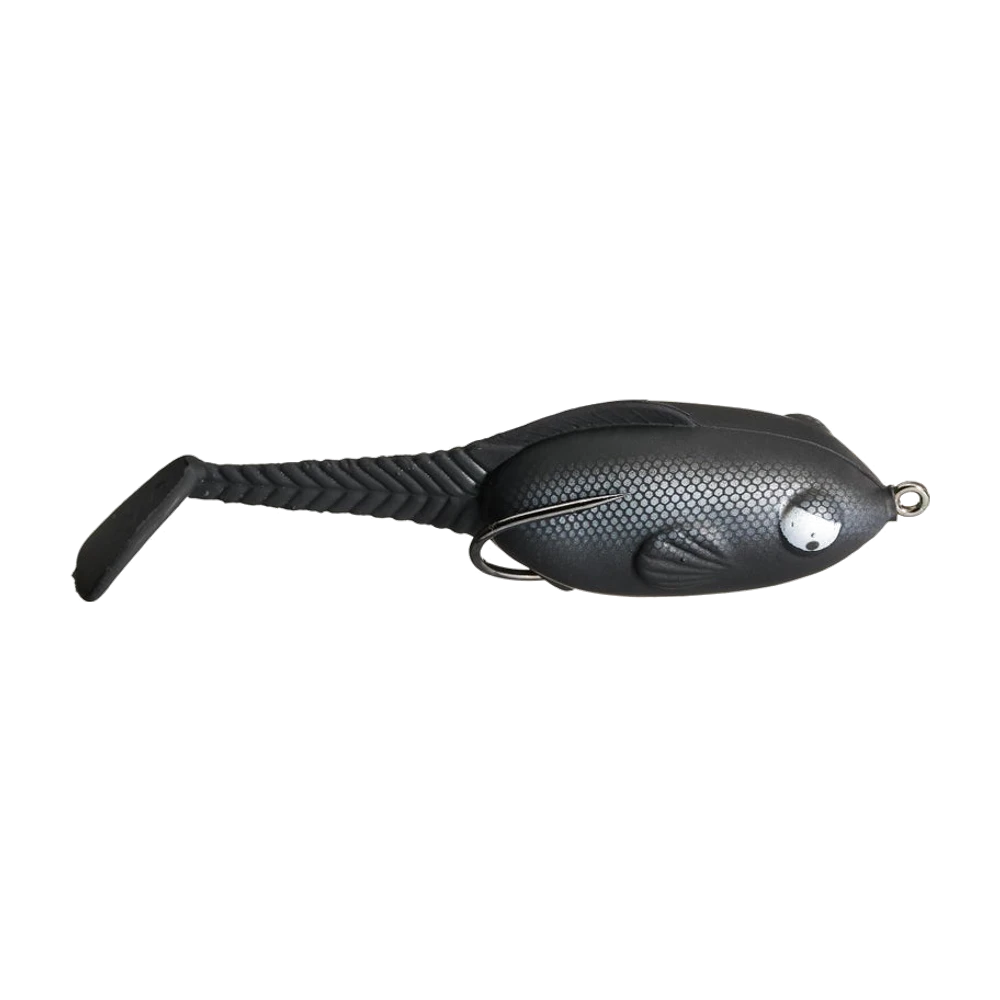
The product photo shows a broad hollow body with printed scales, a moulded pectoral fin and a white eye, a nose ring, a double hook lying against the flank, and a long ribbed tail ending in a flat upturned paddle. The example photographed is solid black. These are observations from a product photo, not specifications.
11.4 cm for 10.6 g: lightness with a purpose
The stated figures are 4.5 in and 3/8 oz, so 11.4 cm for 10.6 g. That is little for the length — for comparison, the Snag Proof Zoo Kick weighs 17.7 g for only 8.9 cm.
That low density is not a flaw, it is the condition for staying on top at low speed. A heavy bait needs speed to hold the surface; a light one stays up almost from the first turn of the handle. In exchange, the cast is more sensitive to wind and carries less far, so you have to accept fishing closer or finding shelter from the wind to keep your accuracy.
The wake is judged by eye, not through the rod. Retrieve slowly enough that the tail leaves a crisp continuous ripple behind the bait, not a spray. The moment it starts splashing you are above the useful speed: the fish then hears a lure fleeing, not a lure travelling.
Working it: one speed, and few pauses
Finding the minimum
As with most kicking-tail baits, the right pace is the slowest at which the tail keeps moving. Deliberately start too slow, then step up a notch until the wake sets in. That point is your cruising speed for the whole pass.
Crossing cover
The manufacturer states a hook fully integrated into the body, which lets the bait slide over vegetation without fouling. In practice you have to anticipate: when you see a dense patch coming, give one extra half-turn of the handle to lift the bait onto the obstacle, then return to your slow pace once past it.
Pauses
The manufacturer's spec table carries a Class column reading Topwater for this model. Watch the meaning: that is a use category, not a buoyancy measurement. Nowhere does the description say the Zoo Wake floats at rest. So treat pauses with caution and keep them short until you have checked how your own example behaves in the water.
Where and when to use it
A wakebait is fished horizontally, parallel to a structure, not across it. Run it along the weed edge a metre off the vegetation, along a line of pilings, along the line where the pads stop: the fish sits under the cover and comes out sideways to intercept. A perpendicular cast gives it a window of one second.
As for timing, this is a low-light bait. The first two hours of the morning, the last hour of the evening, and all day when the sky is low or the water lightly stained. In full sun on clear water the wake stays visible but so does the silhouette, and the refusal rate climbs sharply — better to go below the surface then.
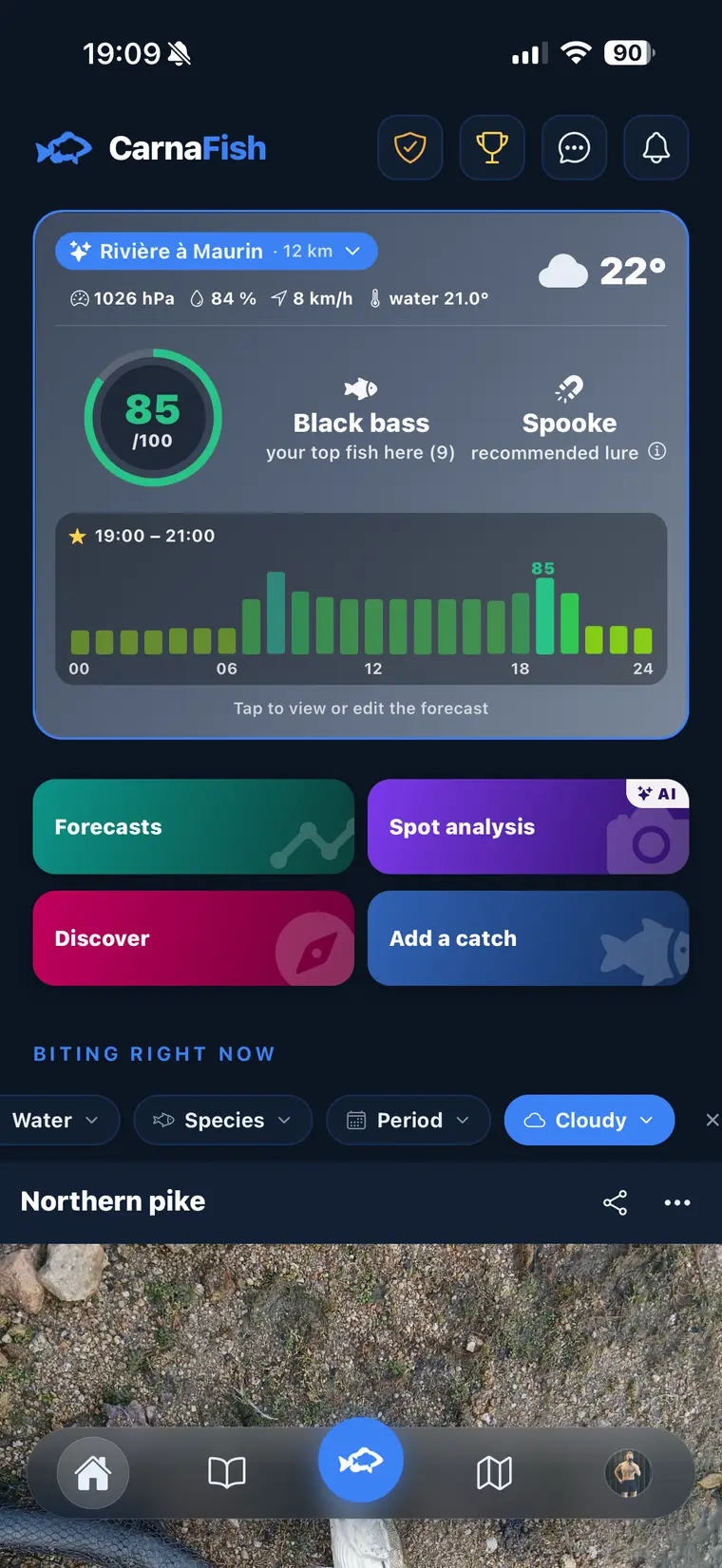
Not sure what to tie on?
Photograph your spot: CarnaFish reads the scene, cross-checks the conditions and gives you the zone, the lure and the retrieve. Free on iOS and Android.
The body that collapses, and what to do about it
Snag Proof stresses a very soft plastic body that compresses easily to expose the hooks on the set. That is the central argument of this family of baits, and it has a direct consequence on how you strike.
The classic mistake
Setting the hook at the first sign. On a wakebait you see the attack coming — the wake blurs, a mass rises, the water lifts — and the urge to pull is enormous. But until the fish has closed its jaws on the body, the points stay flat. Wait for the weight, then set wide and long. Second mistake: retrieving faster after a miss, out of excitement. Slow down instead, and come back over the same spot.
Colours by light and water
On this model the manufacturer explicitly advertises frog and bluegill-inspired patterns, which gives a solid base.
- Weed edges, vegetated water: a frog pattern, consistent with what actually moves around in those zones.
- Clear water, fish on forage: a bluegill pattern, which matches a broad, deep-bodied prey item rather than a slim fish.
- Backlight, dusk, falling night: solid black, like the one in the product photo. At that time of day it is the cut of the silhouette against the sky that counts, not the shade.
That still leaves which edge to work and at what hour, which often weighs more than the colour. That is exactly what CarnaFish makes easier: a photo of the spot, and the AI suggests the zone, the depth and the lure family that fit the day's conditions. If pike is the target along those same edges, our guide to choosing a pike lure helps frame the sizes and the rigs.
Key takeaways
- A paddle tail replaces the buzzbait's blade: the same wake logic, but with no mechanical part and no exposed hook.
- Confirmed figures: 11.4 cm / 4.5 in for 10.6 g / 3/8 oz, a low density that allows it to stay up at slow speed.
- The manufacturer's Class column reads Topwater, which names a use rather than a measured buoyancy at rest.
- Set the hook on the weight, never on the sight: the soft body has to collapse first for the double to come clear.
FAQ
Does the Zoo Wake float at rest?
The manufacturer does not say so. Its table lists a Topwater class, which describes a use category rather than a measured buoyancy. The body of the description does not mention behaviour at rest either. So it cannot be asserted, unlike the Snag Proof Zoo Kick, whose table explicitly reads Floating.
What is the difference with a buzzbait?
A buzzbait produces its disturbance with a metal blade on a shaft, and its single hook stays exposed. The Zoo Wake gets a comparable wake from a soft tail, on a hollow body whose hook is integrated. It therefore goes through vegetation, but it does not make the same noise.
Why is this bait so light for its size?
Because a topwater bait that has to work slowly needs low density to stay up. The stated 10.6 g over 11.4 cm go in that direction. The downside is a cast more affected by wind than with a compact heavy bait.
Is it suitable for pike?
Along weed edges in Europe, yes, provided you add a heavy fluorocarbon leader. The broad 11.4 cm profile suits pike better than the smaller models in the range, but a double held flat against a soft body remains less effective on a bony jaw.
What retrieve speed?
The slowest at which the tail keeps moving and leaves a crisp ripple behind the bait. If it splashes you are too fast; if the wake disappears you are too slow. It is a visual adjustment, made over the first few metres of every cast.
Can it be used on a solid mat?
It slides over cover thanks to its integrated hook, but its long soft tail picks up strands more readily than a compact body does. On a genuinely dense mat a conventional frog such as the SPRO Bronzeye Frog remains easier to work through.
The full bass lure guideSeason-by-season strategy: which family of lure, when, and why.Go from theory to fish
CarnaFish reads your spot from a photo and gives you the game plan: zone, lure, retrieve. Free on iOS and Android.