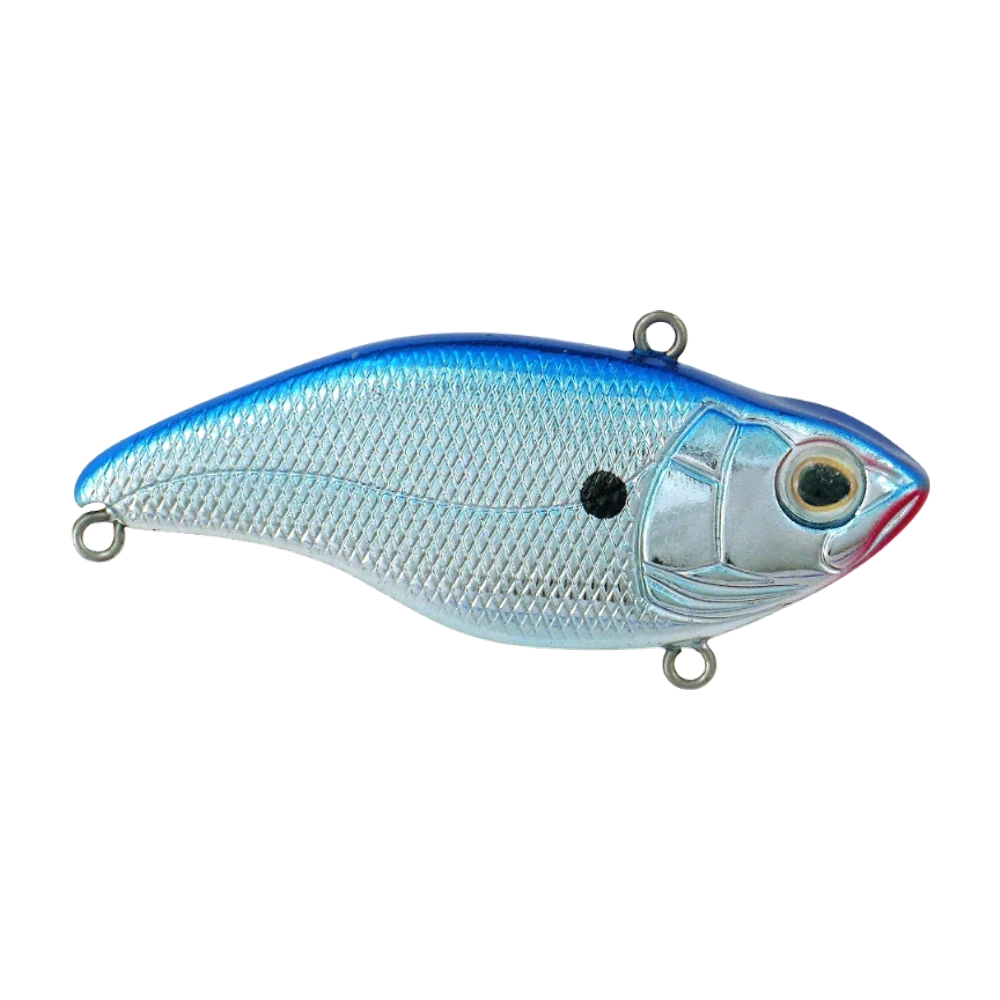
SPRO Aruku Shad: the lipless with a deep knock instead of a rattle
The right lure in the wrong spot still catches nothing. CarnaFish spots the zone that works, from a single photo.
On heavily fished water there comes a moment when the lipless stops catching. Not because the fish have left, but because they have heard the same high-pitched rattle forty times in a month. You change colour, you change size, you change speed — and nothing changes, because you have not touched the parameter that matters.
The sound of a lipless is not background detail. It is the lure's main signal, the thing that gets it noticed from ten metres away in water with thirty centimetres of visibility. And on the vast majority of models, that signal comes from a cloud of small beads producing a high, bright, very recognisable frequency.
The Aruku Shad plays in another register. Its rattle system produces a deep, muffled knock with more space between the hits — closer to a crayfish clicking off a rock than to a maraca. That is its main asset, and it shapes the whole way you fish it.
Why the frequency of the sound changes the result
A low sound and a high sound do not travel through water the same way, and they are not perceived the same way by the fish.
- Low frequencies carry further and cut through vegetation and dirty water better. In stained water or over dying winter weed, that is a direct detection advantage.
- They are read by the lateral line as much as by the inner ear, which makes them effective on a fish that can see nothing.
- They are less "filed away" in the repertoire of an educated fish. The high rattle is associated with danger on busy waters; the dull knock, far less so.
The trade-off is that on an active fish in clear open water, the high-frequency signal of a classic lipless calls faster and from further. So the Aruku Shad is not a universal replacement: it is the tool you pull out when the standard lipless saturates.
A slim profile, so the fall matters
The model's second technical trait is its silhouette: slimmer and less bellied than most lipless baits. Two concrete consequences.
First, the vibration on the retrieve is tight rather than wide. You feel it in the rod tip without it shaking the rod, and the lure does not blow out when you speed up — the classic flaw of very flat lipless baits.
Second, and this is the key point, it falls flat. On a slack line it does not nose-dive: it tips horizontal and wobbles sideways as it loses height, like a fish coming unstuck. On a zander or a bass sitting on the bottom, that phase produces almost every bite.
Reckon on roughly one second per 30 to 40 cm of fall depending on the size of the model. That is not a universal constant but a reference to recalibrate by counting over a known depth at the start of the session.
The yo-yo retrieve, step by step
The yo-yo is this lure's signature retrieve. It is not complicated, but it is easy to get wrong.
- Cast long and let the lure fall to the bottom on a semi-tight line, counting. Note the number.
- Lift the rod firmly by 60 cm to 1 m, briskly enough for the vibration to kick in clearly.
- Follow the lure back down with the rod tip, without dumping all the slack. You need just enough contact to feel a bite, without preventing the flat fall. That is the key move.
- Wait to feel the bottom or count down to your target depth.
- Repeat, picking up one or two turns of the handle between cycles.
- Over dying weed, force the passage: when the lure catches in the stems, give a sharp snap to rip it free. A lure tearing suddenly out of the vegetation triggers an immediate strike one time in three.
On the water: on a yo-yo fall, the bite is almost never felt. It is seen — the line moving off to one side, or going slack earlier than expected. Count under your breath on every fall: the day your fall stops at "four" instead of "six", set the hook without thinking.
The sizes and their windows
| Size | Indicative weight | Window |
|---|---|---|
| 6 cm | around 7 g | Perch and small bass, clear water, 1 to 3 m of depth, wary fish |
| 7 to 7.5 cm | around 14 g | The all-round format: zander in the margins, bass, 2 to 5 m |
| 8.5 cm | around 21 g | Long casts, wind, big flats, bigger fish, searching |
One adjustment that often gets overlooked: the stock trebles are fine-wire, which helps penetration but opens up on a big fish hooked in the vegetation. On a water holding big zander or passing pike, switch to heavy-wire trebles of the same size, and adjust your count since the lure will fall slightly faster.
For line, 0.26 to 0.35 mm fluorocarbon tied straight through does the job. A clip is acceptable here: the attachment point is on the back and the action does not depend on a fine pivot.

Not sure what to tie on?
Photograph your spot: CarnaFish reads the scene, cross-checks the conditions and gives you the zone, the lure and the retrieve. Free on iOS and Android.
Where it excels, where it falls behind
Its windows:
- Dying autumn and winter weed beds: this is its signature setting. The yo-yo above the flattened stems, with firm rips free.
- Stained or dirty water, where the deep knock carries and sight counts for nothing.
- Educated fish on busy waters, once the high-pitched rattling lipless has stopped producing.
- Zander in late autumn, on flats of 3 to 5 m, on a counted fall. Our beginner's guide to zander explains how to find those flats.
Its limits:
- Very snaggy ground: two exposed trebles do not forgive branches or rip-rap.
- Clear cold water on a completely inactive fish: the lipless is still a speed lure, even slowed down, and a soft plastic on a jig head will often out-fish it.
- Calling from very far on scattered active fish: there, a high-pitched rattling lipless remains superior.
Aruku Shad against the other lipless baits
The Cotton Cordell Super Spot is the classic representative of the rattle school: loud, high-pitched, carrying a long way, deadly on active fish and in churned-up water. It is the exact opposite of the Aruku, and the two complement each other in the box rather than replace each other.
The Savage Gear Fat Vibes plays on volume: thick body, wide vibration, a strong signature in the lateral line. It displaces more water and suits situations calling for a massive signal at low speed. The Aruku, being slimmer, keeps a stable action where the Fat Vibes turns unstable if you speed up.
The Jackall TN 70 is the Japanese school of finesse: very tight vibration, compact silhouette, excellent on wary fish in clear water. The difference is mostly sound — the TN bets on discretion, the Aruku on a deep signal that carries.
And if you are unsure which type of vibration bait to tie on when you reach the bank, CarnaFish analyses a photo of the spot and answers.
Key takeaways
- The deep knock replaces the high rattle: it carries better in stained water and wears educated fish out less.
- The slim profile gives a flat, wobbling fall, which produces most of the bites.
- The yo-yo is played on the guided fall, not on the lift.
- The bite is seen on the line, not felt: count every fall.
- Home ground: dying weed and stained water. Avoid branches and rip-rap.
FAQ
What sets the Aruku Shad apart from other lipless baits?
Its rattle produces a deep, spaced knock rather than the high-pitched shriek of a cloud of beads. That low-frequency signal carries better in stained water and through vegetation, and it is less associated with danger on heavily fished waters.
How do you fish a lipless on the yo-yo?
Fall to the bottom on a count, a firm lift of the rod over 60 cm to 1 m, then a guided fall without dumping all the slack. The bite almost always comes during that fall, and it is read on the line rather than felt.
Why can't I feel the bites on the fall?
Because a fish that inhales a sinking lure creates no tension at all. You have to watch the line: if it moves off to one side or stops going slack before the usual number of seconds, set the hook immediately.
What size should I choose for zander?
The middle format around 7 to 7.5 cm covers most situations. Move up to 8.5 cm when you need to cast a long way, in wind, or on deep flats, and drop to 6 cm on wary fish in clear water.
Should I change the stock hooks?
Only if you are fishing for thick-set fish or in dense vegetation: the fine stock trebles penetrate very well but can open up. Heavy-wire trebles of the same size solve that, at the cost of a slightly faster fall.
Can it be fished on a straight retrieve?
Yes, and it is effective on active fish, particularly along a break or over a flat. But it is on the yo-yo that this model shows what it does differently, because its flat fall is its real weapon.
The full zander lure guideSeason-by-season strategy: which family of lure, when, and why.Go from theory to fish
CarnaFish reads your spot from a photo and gives you the game plan: zone, lure, retrieve. Free on iOS and Android.