SPRO Essential Series E Pop: the rattling popper in two sizes
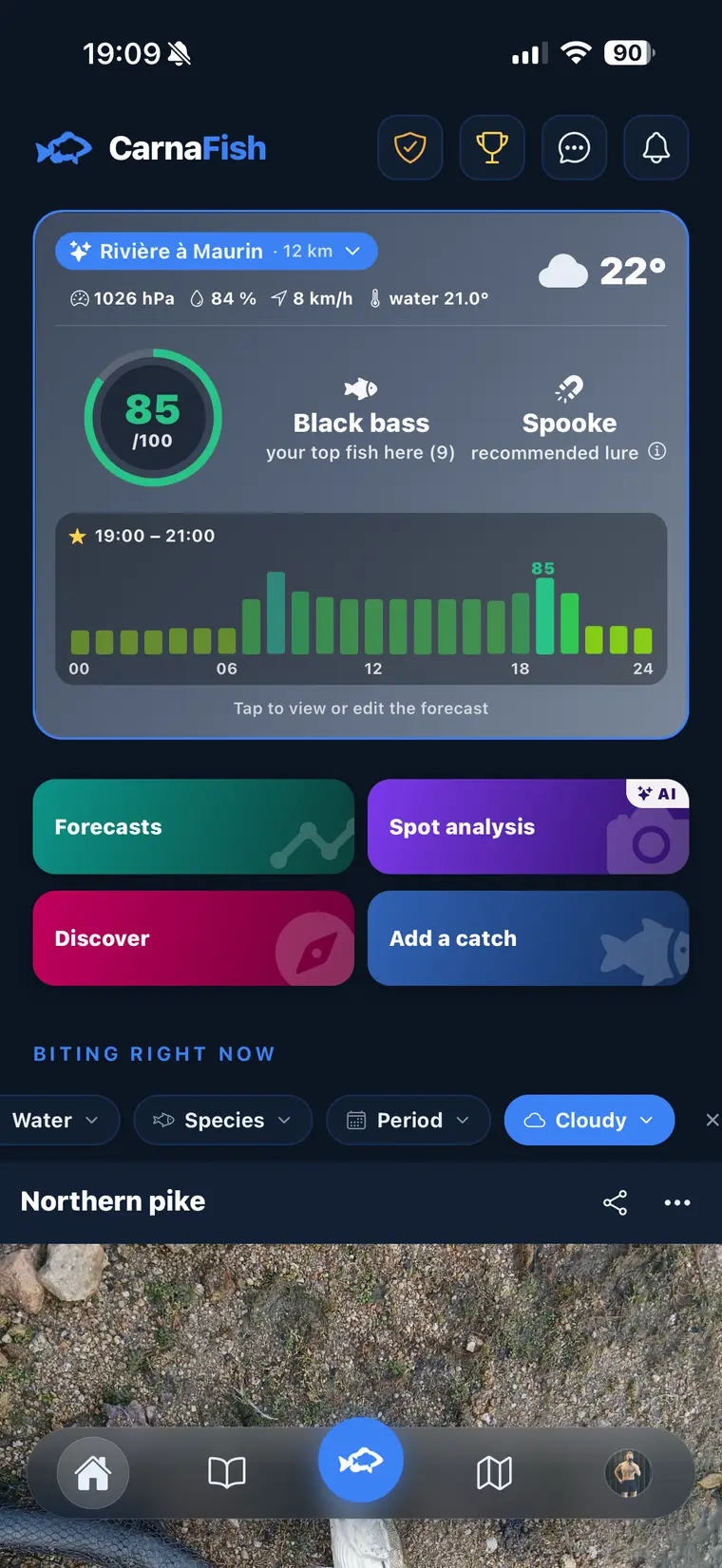
This lure shines under specific conditions. CarnaFish tells you in 10 seconds if today is one of them.
A popper is the easiest lure in the world to understand and the easiest to use badly. You cast to a weed edge, pull three times too fast, wind in, start again — and you catch nothing, when the same lure worked with twenty more seconds of patience would have produced two fish. SPRO's Essential Series E Pop does not change that rule, but it gives you two or three extra tools to respect it.
Two sizes, and specs worth reading properly
The retailer's table carries three columns, Length, Weight and Class, and two rows:
- E Pop 65 Popper: 2-1/2 in, 3/8 oz, Topwater. That is about 6.4 cm for 10.6 g.
- E Pop 80 Popper: 3 in, 7/16 oz, Topwater. That is about 7.6 cm for 12.4 g.
Two remarks. First, the model names suggest 65 and 80 millimetres while the converted figures give 63.5 and 76.2 mm: do not be surprised if the lure looks a touch shorter than its name. Second, the Class column reads Topwater for both: that is a usage category, not a measured buoyancy, and nowhere does SPRO state these poppers are rated floating.
The weight gap between the two versions is small — under two grams — for twelve millimetres of extra length. In practice, the 65 is the more versatile size, and the 80 shifts a little more water, so it pops deeper in tone and carries slightly further on the cast.
What the rattle changes
The description states a loud popping action and a powerful internal rattle, presented as an added auditory attraction. That is a manufacturer claim, but it has one clear practical consequence: a popper with a rattle stays noisy during the pause, because the lure keeps rocking in place for a second after the pull. A silent popper goes quiet the moment it stops.
That detail shapes the cadence: with a rattling model you can stretch the pauses without losing acoustic contact, which is valuable on flat water with a sluggish fish.
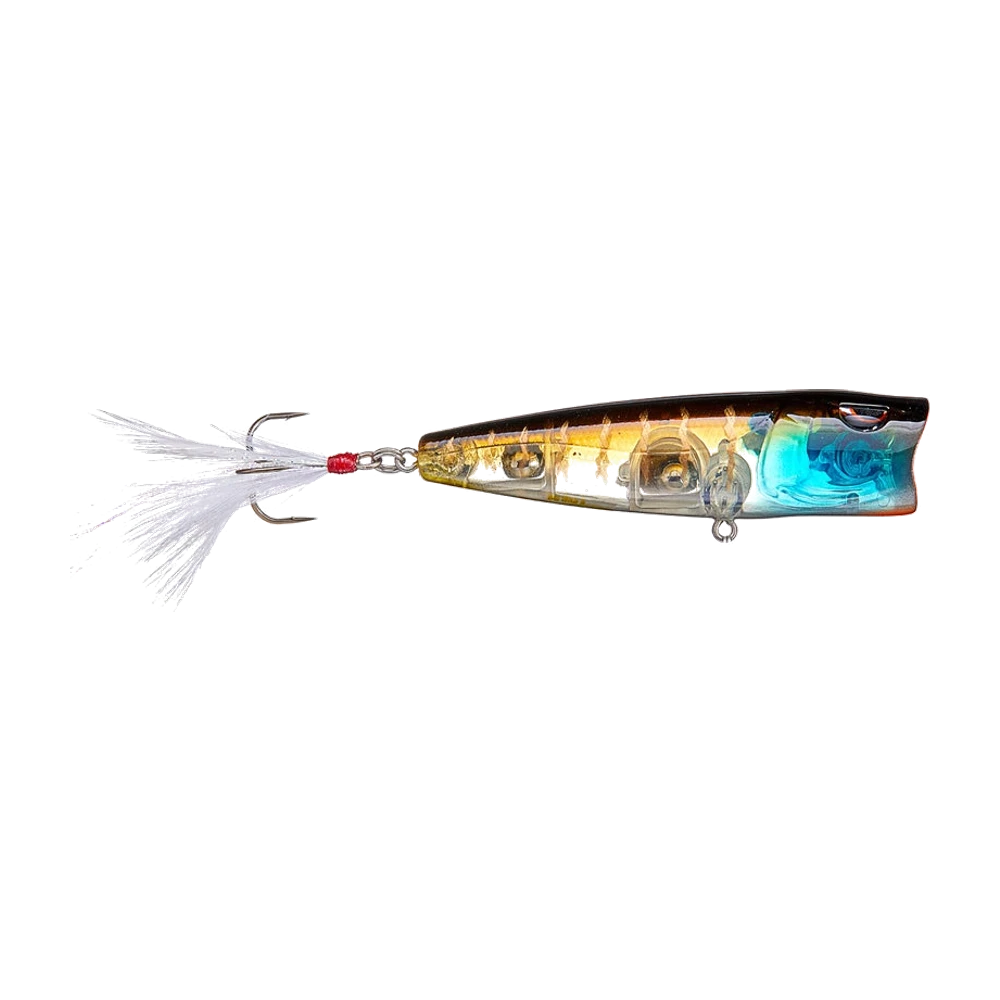
In the product photo the body is translucent and shows two internal chambers holding loose balls. That is an observation from a product photo, not a specification: from the image there is no telling whether those balls serve only as a rattle or also as weight transfer for casting. The description only mentions the rattle.
The retrieve: the pause does all the work
Cast, let the lure settle for two seconds, then drop the rod tip towards the water. Give one short sharp pull of about ten centimetres, wrist only, then take up the slack you created. Wait. Two to four seconds, sometimes more. Repeat.
The universal mistake is stringing pops together. A popper does not search water, it works a target. Three or four sequences per cast are enough if you picked your landing point well: a weed edge, the shade of a tree, a laydown, a reed line.
Two variations worth having
The double pop: two pulls half a second apart, then a long pause. It mimics a baitfish that thrashes twice and freezes, and it triggers more often than an isolated pop.
The glide pop: a longer, softer pull that sends the lure off to the side instead of throwing water. Alternating one true pop with two glide pops gives an irregular path that looks far more like a panicking fish than a straight line punctuated by identical cracks.
If a fish comes up behind the lure without taking it, do not pop harder: stop everything. A popper sitting dead still for three seconds, with only the feathers on the rear treble moving, triggers more often than an aggressive restart. That is why the feathered treble is more than a catalogue detail.
Hooks: what the source states, and what the photo shows
The description mentions razor-sharp Gamakatsu treble hooks including a feathered rear treble, and plays up their ability to convert short strikes. It gives neither size nor exact reference.
In the product photo a single hook is fitted: the feathered rear treble, with a bunch of white feathers and a small red collar, joined to the body by a split ring. The belly hanger is clearly there under the body as a wire loop, but it is empty on that sample. So check what is in your packaging and make it up if needed: a popper with no belly treble converts far fewer head-on strikes.
If you swap hooks, keep the total weight the same. A few tenths of a gram are enough to alter the trim of a topwater: a popper that lies over on its flank at rest throws water badly on the pull.
Tackle
A 1.95 to 2.30 m rod, medium power, with a fairly tip-biased action so the pull costs you no effort. A popper fishes very well on spinning gear with thin braid, which makes short clean pulls easier: 10 to 15 lb class, with a 10 to 14 lb fluorocarbon leader of 80 cm to a metre.
Tie a loop knot or run a small fine snap: a knot cinched straight to the nose ring restricts how the lure tips and kills the glide pop. Here it is the freedom of the nose to rotate that creates the irregularity.
For perch, drop to the 65 and lighten everything: 8 lb braid, 6 lb fluorocarbon, a light rod. Perch hit poppers in this size class through summer along the margins, and only one strike in three connects — that is normal, keep working the lure.
Not sure what to tie on?
Photograph your spot: CarnaFish reads the scene, cross-checks the conditions and gives you the zone, the lure and the retrieve. Free on iOS and Android.
Where and when to use it
The popper is a calm-water, margin lure. It needs a fairly flat surface for the crack to carry, and a precise target to work over. Its best windows are first light, late evening, and the heavy overcast August days when fish hug the shaded edges.
It loses a lot as soon as the wind puts a chop on: not only does the noise drown, you also stop seeing the lure, so you can no longer time your pauses.
The Essential range is positioned as affordable gear that does not sacrifice quality — that is SPRO's own commercial argument, and the observed prices, around twelve to thirteen dollars, back it up reasonably well. A popper is a lure you rarely lose, so it is a good way into topwater fishing without paying Japanese-import money.
Colors by water
- Clear water: the finish in the photo, dark brown back and translucent gold flanks barred in brown. The translucency breaks up the silhouette and the gold throws a discreet flash on every pop.
- Stained water: white and chartreuse. The hard contrast makes up for reduced visibility and also helps you track the lure so you can time your pauses.
- Dusk and falling light: black. As with every topwater, what gets seen is the outline against the sky, not the color.
Where it belongs in the box
The E Pop fills the slot of the mid-box all-round popper. For a historic reference with quite different behaviour, the Rebel Pop-R is still the baseline; for a finer and dearer Japanese popper, the Megabass Pop-X sits at the other end of the spectrum; and when you need to cover distance rather than work a target, a Rapala Skitter Pop does the job nicely.
A popper is useless if the spot does not fish on top that day. That is exactly the question CarnaFish answers: photograph the water and the AI suggests a zone, a depth and a lure family suited to current conditions. And to go further on the species that responds best to these small sizes, our guide to lure fishing for perch covers the spots and the rigs.
The short version
- Two sizes, 6.4 cm for 10.6 g and 7.6 cm for 12.4 g, under two grams apart: the 65 is the more versatile.
- The stated rattle lets you stretch pauses without losing acoustic contact, and the pause is what earns bites.
- On the photographed sample only the feathered rear treble is fitted; the belly hanger is empty.
- A loop knot or a fine snap is non-negotiable if you want the nose free to tip.
FAQ
Should I pick the 65 or the 80?
The 65, at 6.4 cm and 10.6 g, is the more versatile and suits bass and perch alike. The 80, at 7.6 cm and 12.4 g, shifts more water, pops deeper in tone and casts slightly further; keep it for bigger fish or windy water.
Do these poppers float?
The Class column reads Topwater for both sizes, which denotes surface use rather than measured buoyancy. SPRO does not state it explicitly. A popper has to sit on the surface to crack, but that is not a specification written in the source.
How long should I pause between pops?
Two to four seconds as a rule, stretching to six or eight on flat water with inactive fish. The stated internal rattle helps here: the lure keeps emitting while it settles, so a long pause does not break contact.
What hooks come fitted?
The description mentions Gamakatsu trebles including a feathered rear treble, without giving a size. In the product photo only that rear treble is in place, and the belly hanger is empty. Check what arrives and make it up if needed.
Does it need a particular knot?
Yes, a loop knot or a small fine snap. A knot cinched straight to the nose ring stops the nose tipping freely, which removes the glide pop and flattens the action. It is the cheapest and most effective tuning on this kind of lure.
The full bass lure guideSeason-by-season strategy: which family of lure, when, and why.Go from theory to fish
CarnaFish reads your spot from a photo and gives you the game plan: zone, lure, retrieve. Free on iOS and Android.