Strike King Homing Minnow: the small pre-rigged swimbait built for scoping
Before tying this one on, it helps to know if the spot actually calls for it. CarnaFish reads the scene from a photo.
You have the fish on the screen, seven metres ahead of the boat and three metres down. You cast, you watch your lure appear on the sonar, and you steer it to him. That way of fishing is less than ten years old, it divides opinion as much as it fascinates, and it has created an entirely new category of lure. Strike King's Homing Minnow belongs to it: it is not designed to be chucked around at random, it is designed to be driven.
Why a "sonar lure" is not an empty claim
Three details, and all three are in the manufacturer's own description.
The first is the flat sides. A flat body presents a wider reflective surface every time it rolls slightly, which makes it far more readable on a screen than a round body. You keep track of it without losing it, even when it crosses the fish's trace.
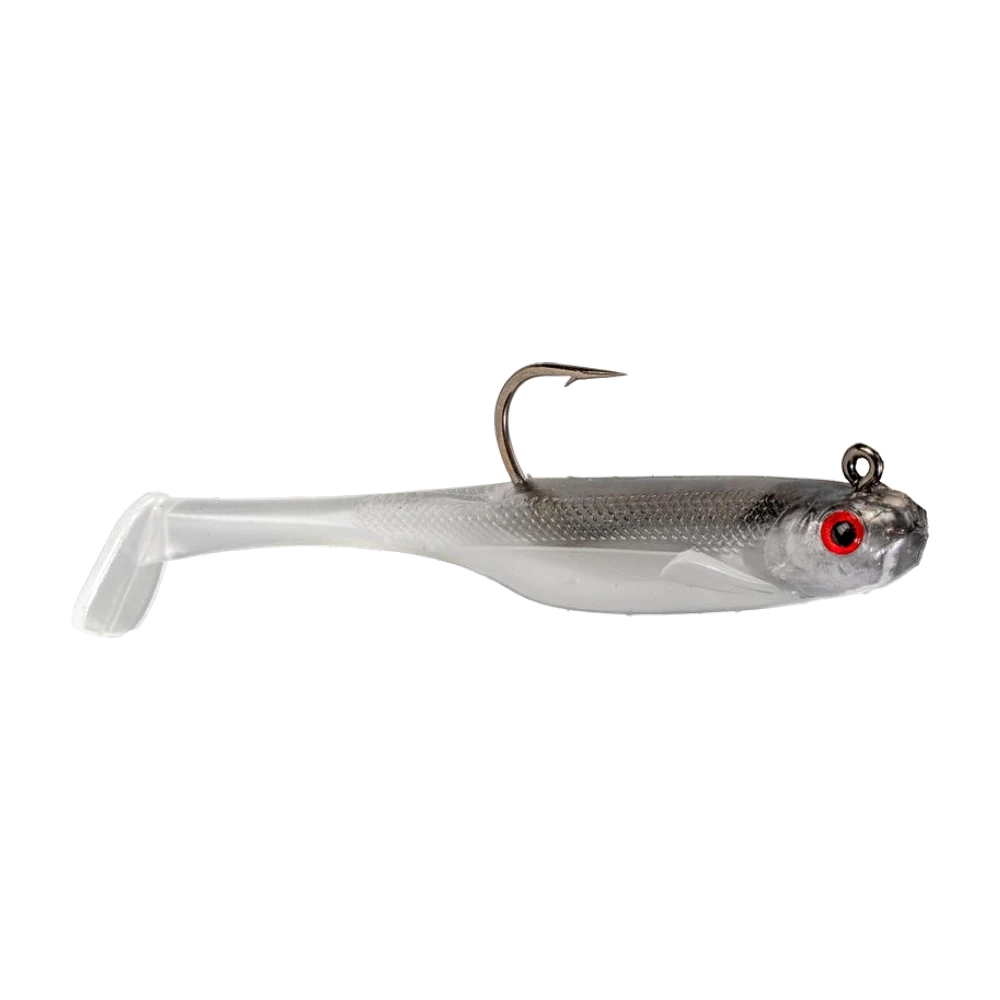
The second is the 90-degree line tie. On the product photo it stands vertically on top of the head, not in line with the body as on a conventional swimbait. That placement does two things: it holds the bait horizontal under the line, broadside, with maximum surface turned toward the sonar beam, and it makes the bait far more obedient when you want to slow it, lift it, or back it up half a metre.
The third is that it comes pre-rigged. No jighead to choose, no rigging to get right: tie it on and fish. The brand states the hook is a sharp medium-wire single, and it is clearly visible on the photo, point up, emerging from the back about a third of the way along the body.
What the manufacturer leaves out, and why it matters here
The description contains no length, no weight and no spec table. That is awkward on this kind of bait, because fall rate is the central variable of this fishing: it decides whether you can hold the lure level with a fish or whether it slides past under his nose. Nothing in the published sheet lets you anticipate it.
In practice, plan on a calibration drop as soon as you launch: let the bait sink alongside the boat while you count seconds, and note how long it takes to reach one metre, then two. You will have your real fall rate in two minutes, and you can use it all day. The manufacturer only states a compact, bite-size profile.
Before you look at the screen, look at your line. On a swimbait this light you will not feel a bite on the drop: the line stops, or it suddenly moves sideways. When you fish with your eyes glued to the sonar you miss exactly those bites, and they are often the best fish.
How to work it
Slow straight retrieve
The paddle tail starts kicking within the first few centimetres, which lets you go genuinely slow. That is the base retrieve: cast beyond the fish you have marked, let it sink as long as needed, and wind at a constant speed passing just above him. A fish holding on a spot will rise far more readily than it will drop.
Steering on the sonar
Here you are not retrieving, you are driving. Three turns of the handle, stop, the bait glides back down, three more turns. Every stop is a bite window. If a fish follows without committing, kill it dead rather than speeding up — the opposite of instinct, and the thing that triggers.
Vertically
Under the boat, over a bait ball or on a drop-off, the Homing Minnow fishes like a small jigging bait: controlled descent, ten-centimetre lifts, long pauses. In Europe this is the approach that takes the most zander and big perch in winter, when fish are pinned to the bottom and a larger lure pushes them away.
Where it shines, and where it shows its limits
It shines in clear water, on individually marked fish, and over small forage. Its compact profile and restrained action suit fish that look before they eat.
It shows its limits the moment there is cover: the hook is exposed, point up and bare, so there is no way to run it through branches or weed without fouling. If that is your water, a Texas rig on a Strike King Rage Swimmer remains the right answer. The second limit is the medium hook wire: it is what allows fast penetration on a soft rod, but it also means you should not try to winch a big fish out of structure.
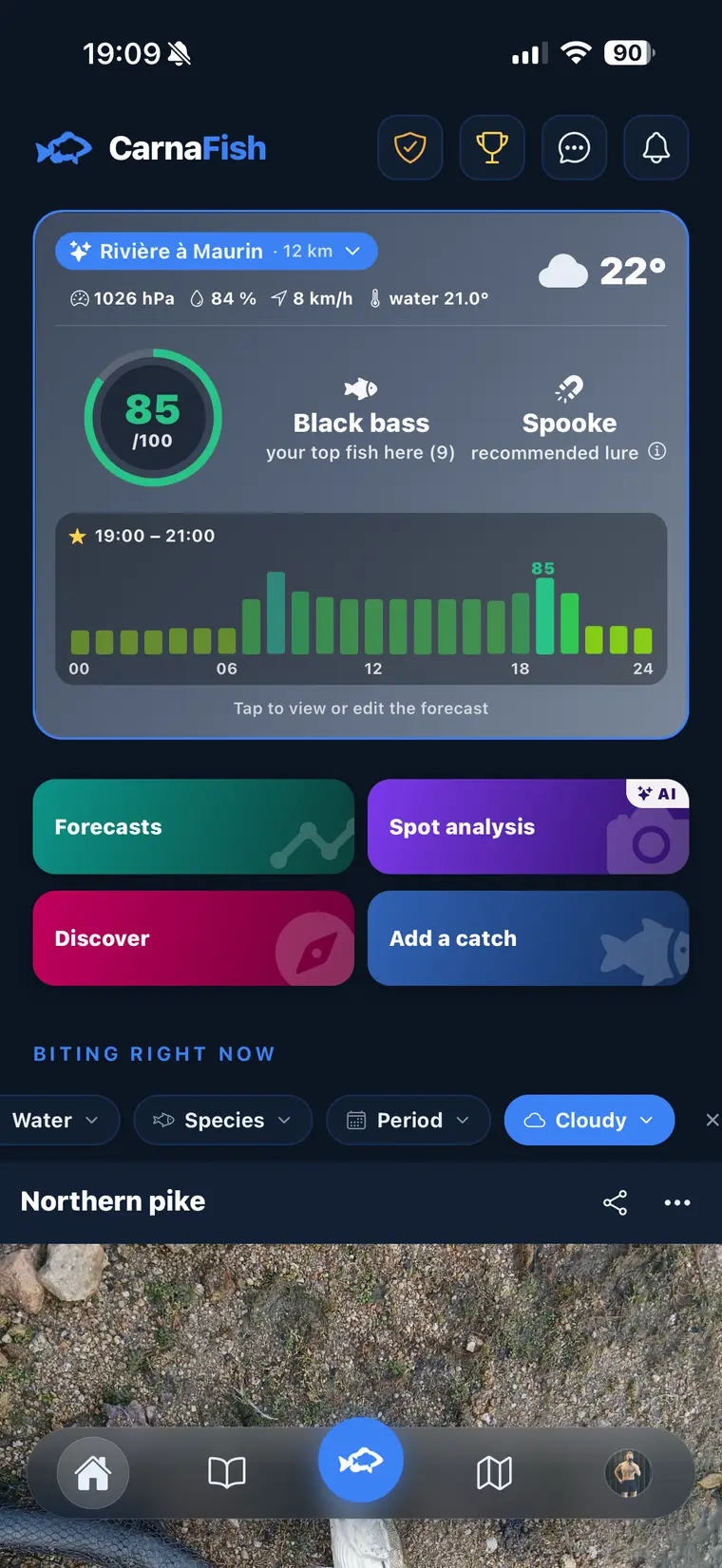
Not sure what to tie on?
Photograph your spot: CarnaFish reads the scene, cross-checks the conditions and gives you the zone, the lure and the retrieve. Free on iOS and Android.
Colours by water and forage
- Clear water: Pearl or Smokey Shad, translucent silvery tones — exactly the family of the lure photographed here, translucent pearl with a grey scaled back and a red eye.
- Larger forage: Gizzard Shad, a little darker on the back, which reads better at distance.
- Stained water or low light: Chartreuse Shad, to keep a point of contrast when visibility drops.
Where it sits among other small swimbaits
Against a shad you rig yourself, the Homing Minnow trades tuning flexibility for simplicity: you cannot change the head weight. In exchange, the balance is done for you and the bait tracks broadside without rolling out. If you want control over the weight, a Strike King Rage Swimmer on a jighead stays more adjustable, and the Strike King Final Copy Swimbait targets much larger forage. For a comparable approach in a very small profile on difficult perch, the 6th Sense Trace 5 plays the same restrained game.
A lure built for sonar steering is useless if you do not know where to look for fish. That is exactly where CarnaFish comes in: a photo of your spot, and the AI suggests the zone, the depth and the lure type that match the day's conditions — enough to decide whether a finesse approach like this one makes sense before you rig up. To go further on perch, our guide to perch fishing with lures details the structure and the sizes.
What to remember
- Flat sides and a vertical 90-degree line tie: two design choices aimed at sonar readability and steering precision.
- Supplied pre-rigged on a medium-wire single hook, so there is no rigging to do — but no weight to adjust either.
- No length, no weight and no fall rate are published: calibrate it yourself on the first drop.
- Exposed hook, bare point: keep it for open water, not for dense cover.
FAQ
What size is the Homing Minnow?
Strike King publishes neither a length nor a weight in its description, and there is no spec table at all. The manufacturer only mentions a compact, bite-size profile; check the packaging before ordering if the exact size matters to you.
What does the 90-degree line tie achieve?
It holds the bait broadside under the line, exposing maximum surface to the sonar beam, and it makes the bait easier to slow or lift precisely. That is the detail that separates this model from a conventional swimbait.
Do you need forward-facing sonar to use it?
No, it fishes perfectly well on a slow straight retrieve or vertically with no electronics at all. Sonar simply lets you make full use of the precise steering it was drawn for.
Does it catch perch and zander in Europe?
Yes, and that is one of its best uses here: a small pre-rigged swimbait dropped vertically on a fish pinned to the bottom is a deadly presentation in winter, when a bigger lure pushes fish away.
Will it come through vegetation?
No. The single hook rides out of the back point-up with no guard at all: it fouls the moment there is weed or wood. For cover, switch to a Texas-rigged conventional shad.
Should the factory hook be replaced?
The manufacturer states it is sharp and medium-wire, which is consistent with finesse fishing. There is no reason to swap it out of the box, but check the point after every fish and after any contact with rock.
The full bass lure guideSeason-by-season strategy: which family of lure, when, and why.Go from theory to fish
CarnaFish reads your spot from a photo and gives you the game plan: zone, lure, retrieve. Free on iOS and Android.