Strike King KVD Rodent 4: the creature bait for the thickest cover
Before tying this one on, it helps to know if the spot actually calls for it. CarnaFish reads the scene from a photo.
Fishing a tangle of flooded branches means accepting that you will lose baits and never see what is happening. The only way to find fish in there is to drop something that moves a lot of water, falls slowly, and does not hang up on the first twig. The Rodent is drawn for exactly that: a compact ten-centimetre body, two broad flat flappers that push water the moment it starts to fall, and a profile narrow enough to slip through where a bulky creature bait jams.
The published specs, and the one that is missing
The maker's table runs to two columns and two values: length and pack count — four inches, that is 10.2 cm, and six baits per pack.
There is no weight row, and we will not invent one. On this kind of bait the body weight actually matters a little more than on a conventional shad: it governs fall speed on a lightly weighted Texas rig. If you want that figure, weigh one on a kitchen scale; it is the only reliable number you will get.
The other facts are few but useful. The bait is aimed at heavy cover, the maker claims it creates a major disturbance underwater, and it recommends three rigs: Texas, Carolina, or jig trailer. The plastic is the house Perfect Plastic, heavily salted while staying soft, and coffee scented. Strike King states that the scent masks hand odours, increases bites and lengthens hold time — that is a claim from the brand, not a measured result. The scent itself, on the other hand, is entirely real.
What the photo shows, and what the name does not say
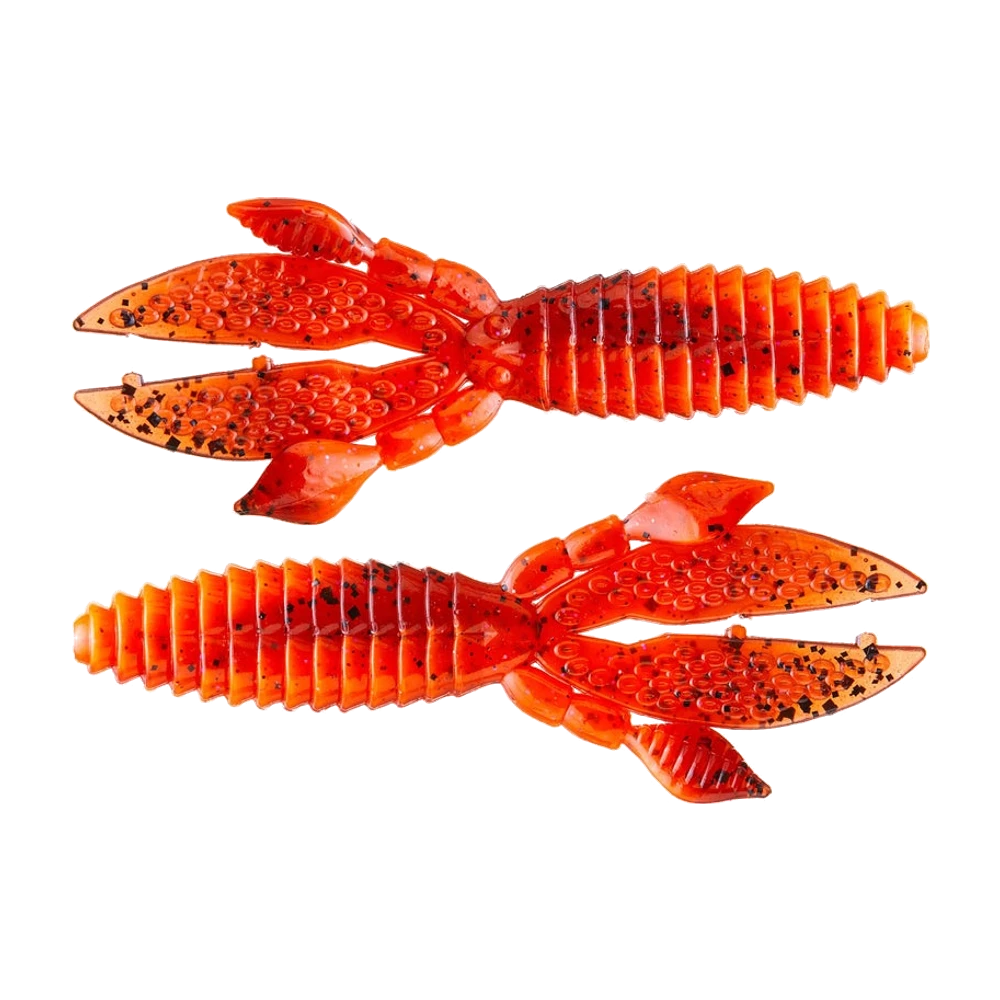
The mould is worth a close look. The product photo shows a ribbed body tapering towards the rear, two broad flat translucent flappers covered in dozens of raised round bumps, two ribbed antennae, two small eye-like nubs at the base of the flappers, and a short opaque central appendage. The edges of the flappers are very thin; the bumped centre is distinctly thicker.
That is an observation on a product photo, not a specification. It is interesting for two reasons. First, it explains the claimed disturbance: a broad flat flapper beats up and down as the bait falls, and the raised texture grips water instead of letting it slide past. Second, it puts the model name in perspective: for all the rodent imagery, the moulding is far closer to a crawfish than to a small mammal. A lure's name is never a source — the mould and the written description are.
Rig it flappers up, not down. In that position both flappers open out on the fall and do exactly the job they are drawn for. Rigged downwards they hit the bottom and pin flat, and you lose most of the action on the descent.
Three rigs, three uses
Texas weedless, the reference rig
A bullet weight, free or pegged, from 5 to 21 g depending on cover density and depth, and a 3/0 or 4/0 wide-gap worm hook. This is the rig for getting into a brush pile, a stump or a lily pad mat. The animation is simple: let it drop without tightening the line, wait until it is down, then give two short sharp pulls and pause for a long time.
Ninety per cent of bites come on the fall. If your line moves sideways or stops peeling before the bait has reached the bottom, set immediately.
Carolina, for searching hard bottom
Behind a 14 to 28 g weight and a 60 cm to 1 m leader, the Rodent planes and rights itself above the bottom on every stop. This is the rig for large rocky flats and drop-offs, when you do not yet know where the fish are and want to cover ground without rushing.
Jig trailer
The maker recommends it explicitly on a jig, and that is probably its most underrated use. Behind a Strike King Tungsten Football Jig it adds bulk and, above all, two flappers that keep working while the jig sits still. Trim a ring or two off the body if the whole thing looks too long.
The expensive mistake
Going too light on the weight out of fear of snagging. In dense cover a bait that falls too slowly settles on the branches instead of going through them, and you spend the session unhooking. The right weight is the one that penetrates the cover in a single move — often heavier than instinct suggests.
Not sure what to tie on?
Photograph your spot: CarnaFish reads the scene, cross-checks the conditions and gives you the zone, the lure and the retrieve. Free on iOS and Android.
When and where to use it
From spring to late autumn, as soon as the water passes fifteen degrees and bass hold in or against an obstacle. It is a contact bait: flooded timber, stumps, docks, reed edges, boulders. In open water over a flat bottom it offers nothing special over a shad or a worm.
Compared with a Strike King Rage Craw, that bait's nervous pincers give a faster, shorter beat; the Rodent's broad flappers displace water more slowly and more widely. Against a Zoom Brush Hog, the Rodent is more compact and slips through tight cover better, at the cost of a less bulky silhouette.
Colours by water clarity
- Stained water: the translucent orange with black flake from the photo, a moulting-crawfish tone that stays visible once visibility drops below a metre.
- Clear water: a conventional green pumpkin, discreet, which works anywhere over weed or rock.
- Low light or very dark water: black and blue, a silhouette combination read through contrast rather than colour.
Picking the right bait is worth nothing if you cannot read the cover in front of you, and that is exactly what CarnaFish does: from a photo of the spot it suggests the zone, the depth and the presentation that fit the moment. To learn which obstacles actually hold fish, our guide to reading a fishing spot sets out the method.
Key takeaways
- The maker publishes length, 10.2 cm / 4 in, and pack count, six baits. No weight is given.
- Two broad bump-covered flappers do all the work on the fall, with no reeling at all.
- Three recommended rigs: Texas in dense cover, Carolina on hard bottom, jig trailer for added bulk.
- The name suggests a rodent, the moulding looks like a crawfish: the mould and the description count, not the label.
FAQ
How much does a 4 inch Rodent weigh?
Strike King does not publish that figure: its table lists only length and pack count. Weigh one on a kitchen scale if you need the number to match a weight or a rod rating.
What weight for fishing flooded timber?
From 10 to 21 g on a Texas rig, depending on cover density and depth. Too light and the bait rests on the branches instead of going through them, which multiplies snags rather than avoiding them.
Should the bullet weight be pegged against the hook?
In very dense cover, yes, with a line stop: the whole rig stays compact and penetrates better. In more open water a free weight lets the bait glide for a moment after the weight lands, which often triggers the bite.
Can it be used as a jig trailer?
Yes, the maker recommends it explicitly. Behind a skirted jig it adds bulk and two flappers that keep moving through the dead time. Do not hesitate to shorten the body by a ring or two if the combination gets too long.
How many baits in a pack?
Six, according to the published pack count. That is not many when fishing timber, where a bait rarely survives more than three or four fish: budget accordingly.
Does the coffee scent really change anything?
Strike King states that it masks hand odours and lengthens hold time, which is a claim from the brand rather than a measured result. What is verifiable is that the plastic really is scented and stays that way for several sessions.
The full bass lure guideSeason-by-season strategy: which family of lure, when, and why.Go from theory to fish
CarnaFish reads your spot from a photo and gives you the game plan: zone, lure, retrieve. Free on iOS and Android.