Strike King Tour Grade Hair Jig: marabou that hovers mid-water
One lure, endless conditions. CarnaFish reads your spot from a photo so you are not just guessing.
A fish suspended in the middle of the water column, clearly visible on the screen, following everything you show it without ever opening its mouth: the situation has become ordinary since forward-facing sonar went mainstream. The reflex is to size down, then down again, until you are showing the same small jig head and minnow everyone else is. The hair jig offers something different: a volume that moves on its own, without the lure having to travel.
A northern technique that changed scale
Strike King presents this jig straight away as the tool of a technique that came from northern waters in the United States and moved south as real-time sonar arrived. That is context, not a specification, but it tells you what the lure is for: targeting suspended or roaming fish you have marked on a screen, rather than combing a bank.
The manufacturer also insists on one precise construction point, and it is the most interesting one: the jig is built around a 90-degree jig hook. That angle changes everything. On a conventional jig head the eye comes out in line with the shank and the lure hangs nose-down at an angle. With a 90-degree eye, the jig settles horizontally, like a small fish holding still in the water column. That is exactly what you want when a fish studies a bait for a long time before deciding.
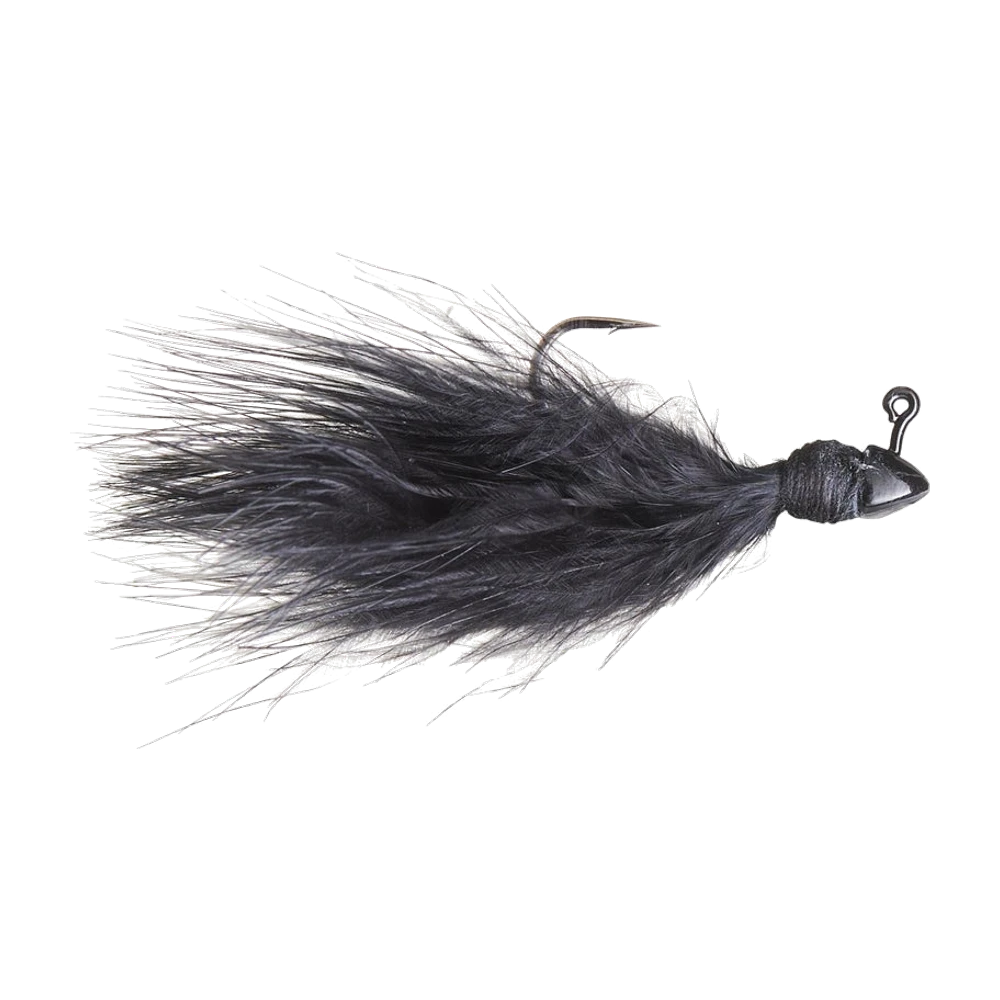
In the product photo the head is small, conical and entirely black, the eye emerges bent from the top, and the marabou is held by a tightly wound thread collar. The single hook is exposed, point up, with no weed guard — an observation from a product photo, not a specification. It also means this jig is not made to be pushed into wood or dense weed: it is an open-water lure.
Marabou, and why nothing replaces it
The manufacturer states the jig is hand-tied with premium marabou. Marabou plume has a property neither silicone nor plastic reproduces: each barbule is so soft that it moves in the slightest micro-current. A hair jig hanging motionless two metres under the boat keeps breathing, opening and closing, purely from the water and the micro-movements the line transmits from the boat.
That is the whole point of the slow fall Strike King highlights: a jig designed to sink slowly and hover in the strike zone. The slower it falls, the longer the marabou has to work in front of the fish's nose. A soft plastic falls faster and straighter and does not give that signal.
When a fish rises to the jig and stops ten centimetres short, do not pull. Do nothing at all. Let the marabou close on its own: nine times out of ten it is that collapsing moment, not a hop, that triggers commitment. The hardest discipline with this lure is doing nothing.
What the description does not give
Be clear about it: no weight, no length and no hook size are published, and there is no size chart in the description. The manufacturer speaks of finesse sizes, which is not a measurement but a usage category — read it as sizes meant to be cast on light spinning gear. How many grams, how many centimetres, the description does not say.
For this kind of lure that is a real gap, because weight directly sets the fall rate, which is the product's main argument. A 1.8 g jig and a 5 g jig do not fish at the same depth or on the same rhythm. Check the packaging when you buy and take several weights if you can: it is the most useful adjustment on this technique.
Not sure what to tie on?
Photograph your spot: CarnaFish reads the scene, cross-checks the conditions and gives you the zone, the lure and the retrieve. Free on iOS and Android.
How to fish it
On forward-facing sonar, on a marked fish
This is the use the manufacturer highlights. You mark a suspended fish, cast slightly past it and let the jig drop while controlling the slack — neither tight enough to brake it nor loose enough to lose contact. When the jig reaches the fish's level, you stop. All the work happens there, letting the lure hover.
Gentle vertical jigging under the boat
Even without a screen, the hair jig works vertically over a known spot: a drop-off, a bridge pier, a sunken tree. Go to the bottom, wind up a few turns, and shake the rod tip without ever moving the jig along. On perch and zander in winter, this almost motionless presentation is deadly, precisely because the fish does not have to chase.
Cast and very slow retrieve
Over clean bottom you can also crawl it back, just fast enough to feel the weight, with two to three second pauses. It is an alternative to the ned rig when fish refuse bottom contact and prefer prey off the deck. Compared to a Zman TRD Ned Rig, the hair jig works higher and for longer in the water column.
The classic mistake
Working it. A lot of anglers used to soft plastics cannot stand the inaction and give sharp hops, which flatten the marabou against the shank and remove the lure's only advantage. The hair jig does not need you to animate it; it needs you to leave it alone at the right depth.
Second mistake: line that is too heavy. A thick leader brakes the fall unpredictably and stiffens the horizontal attitude the bent eye is trying to achieve. On this lure, thin braid and a discreet fluorocarbon leader are not a luxury.
Colours by water clarity
- Dark water, deep fishing or against the light: black, the colour shown in this page's photo. In low light a black silhouette reads better than any pale colour, and black marabou keeps a visible volume even in shadow.
- Pale forage, moderately clear water: a silver white, which directly imitates a fry or a small roach.
- Clear water, wary fish: a natural olive brown, less legible for the fish but also less alarming when it comes in to look closely.
Picking the right depth matters more than picking the right colour, and that is exactly where CarnaFish helps: a photo of the spot, and the AI suggests a zone, a depth and a presentation consistent with the conditions of the day. For the basics of finesse mid-water fishing on European predators, our guide to getting started with lure fishing for zander sets out the useful reference points.
Key takeaways
- The 90-degree hook eye is the real technical point: it holds the jig horizontal instead of letting it nose down.
- Marabou works at rest, with no input: no soft plastic does that.
- Neither weight nor length is published; the finesse sizes mentioned are a usage category, not a measurement.
- Exposed hook, no weed guard in the photo: this is an open-water lure, not a cover lure.
FAQ
How much does the Tour Grade Hair Jig weigh?
Strike King publishes no weight, no length and no hook size, and the description contains no size chart. It only mentions finesse sizes, which describes use with light spinning gear rather than a measurement. Check the packaging, and take two different weights if you can.
What is the 90-degree eye for?
It comes out perpendicular to the hook shank, which makes the jig hang horizontally instead of nose-down. The lure then looks like a small fish holding still in open water, the attitude the manufacturer is after for suspended fish.
Do you need forward-facing sonar to fish this jig?
No, but it is the use the manufacturer highlights. Without a screen it remains very effective jigged gently over a known spot — a drop-off, a sunken tree, a bridge pier — or crawled back very slowly over clean bottom.
Is marabou really better than silicone?
For this kind of fishing, yes, because it moves without the lure travelling. A silicone skirt needs an impulse to open; marabou breathes from the water alone. On the other hand it is more fragile and soaks up water, so it casts shorter for a given weight.
Can you fish it in weed?
Not really. In the product photo the hook is exposed and there is no weed guard. For dense cover you need a jig built for it, with a guard. This model is an open-water, clean-bottom lure.
How does it differ from another hair jig on the market?
The differences come down to the eye angle, the density of the tie and the quality of the plume. Against a 6th Sense Flock Hair Jig or an Outkast Fighter Fly Marabou Jig, compare the profile once wet above all: a heavily dressed tie falls more slowly but collapses more on the strike.
The full bass lure guideSeason-by-season strategy: which family of lure, when, and why.Go from theory to fish
CarnaFish reads your spot from a photo and gives you the game plan: zone, lure, retrieve. Free on iOS and Android.