Z-Man ChatterSpike: the pintail trailer that wakes up a bladed jig
This lure shines under specific conditions. CarnaFish tells you in 10 seconds if today is one of them.
A bladed jig that catches nothing is rarely the blade's fault. Nine times out of ten the trailer is smothering it: a big paddle-tail shad adds its own swimming action, fights the blade's beat and turns a clean signal into mush. Z-Man's ChatterSpike attacks the problem from the other end. Instead of producing an action, it transmits one.
A trailer built not to compete with the blade
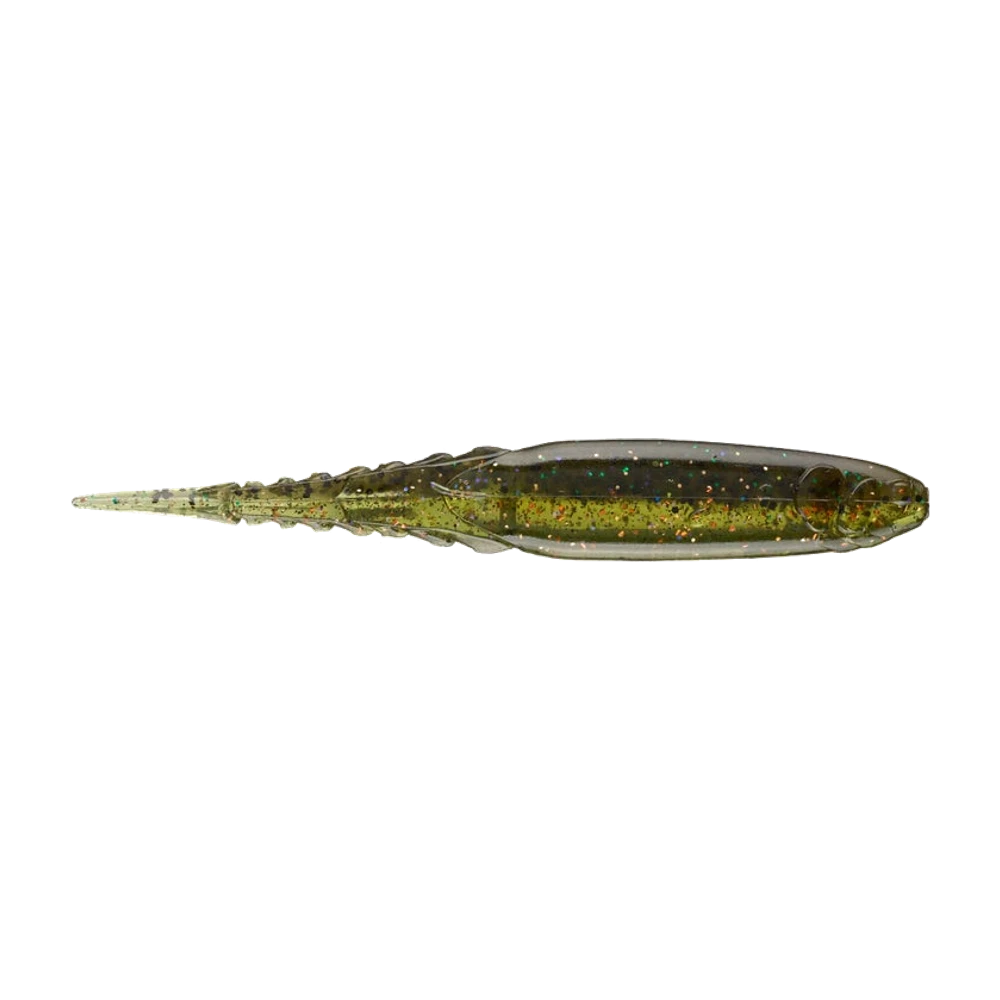
The ChatterSpike has a baitfish profile with a pintail — a tail that tapers to a point rather than ending in a paddle. That is an engineering choice, not a styling one. A paddle acts like a wing: it creates drag and wants to impose its own rhythm. A pintail simply vibrates in the wake of whatever drives it. On a bladed jig that is exactly what you want: the hex blade sets the tempo, the trailer extends it.
Z-Man pushed the logic further with a segmented body and a tail whose sections are cut with pyramidal cross-sections — sharp edges instead of rounded faces. Those sections pass the vibrating jig's energy all the way to the tip of the tail rather than absorbing it. Add pronounced V-shaped ridges on the top and bottom tail surfaces, which increase the volume of water displaced, and you get a trailer that quivers constantly as soon as the blade starts working.
Material matters as much as shape here. The ChatterSpike is moulded in ElaZtech, Z-Man's in-house superplastic, rated as up to ten times tougher than ordinary plastisol. In practice a single bait survives a run of strikes, pike teeth and trips through timber without tearing at the hook slot — the number one failure point on a trailer that slides back every time a fish eats it.
Rig the ChatterSpike so its backbone lines up exactly with the axis of the blade arm. A few degrees of twist and the bladed jig starts helicoptering after three turns of the handle, and you spend the day untwisting your leader without understanding why.
Rigging options beyond the bladed jig
As a bladed jig trailer
This is the intended use: Z-Man states the bait is sized to pair with most standard bass-sized bladed jigs on the market. Behind a Z-Man ChatterBait Jack Hammer or a Z-Man ChatterBait Elite, a 4.5 in body does not stretch the silhouette far enough to push strikes behind the hook point: the profile stays compact and most of the bulk sits ahead of the barb.
On a shaky head
The ChatterSpike carries both a dorsal and a ventral hook slot. On a shaky head you use the top slot to bury the point and get a weedless presentation. The bait then stands nose down on the bottom with its tail up, quivering at the slightest shake of the rod tip. It is a presentation for wary fish, the one to reach for once a bladed jig has been refused twice on the same spot.
Texas rigged and on a swim jig
The two slots also allow a plain Texas rig with the point tucked in, for working a weed edge or a brush mat. Z-Man also lists the scrounger head — a soft-bill head — and the swim jig. In every one of those cases the ChatterSpike plays the same part: it dresses a head that is doing the moving.
Where and when to use it
A pintail trailer earns its place when the water is cool or the fish are picky. In spring, on water still at twelve or thirteen degrees, a bladed jig dressed with a fat paddle shad often reads too loud: the signal is wide, slow and heavy. Swap the shad for a ChatterSpike and the same blade produces a tighter vibration, closer to a panicked baitfish than to a struggling carp. It is a finesse adjustment made with a single accessory.
Summer is the opposite case: you speed up, you cover weed edges in one or two metres of water, and the pintail's low drag lets you burn the lure without it blowing out. Across Europe this way of fishing reed lines in lakes and gravel-pit edges works on pike as well as on bass, as long as you add a thick fluorocarbon leader or a supple titanium one where pike are present.
The classic mistake
Pushing the trailer too far up the shank. Plenty of anglers shove the body until it butts against the silicone skirt, thinking that secures the rig. The result is a compressed skirt that no longer flares on the pause, and a trailer with no room left to quiver. Leave two or three millimetres of clearance between the base of the skirt and the nose of the bait. If the ChatterSpike still slides, the jig's trailer keeper is the problem, not the bait.
The second mistake is more expensive: storing an ElaZtech bait in contact with ordinary plastisol. The two materials react and end up dissolving each other. One dedicated compartment, and the problem disappears.
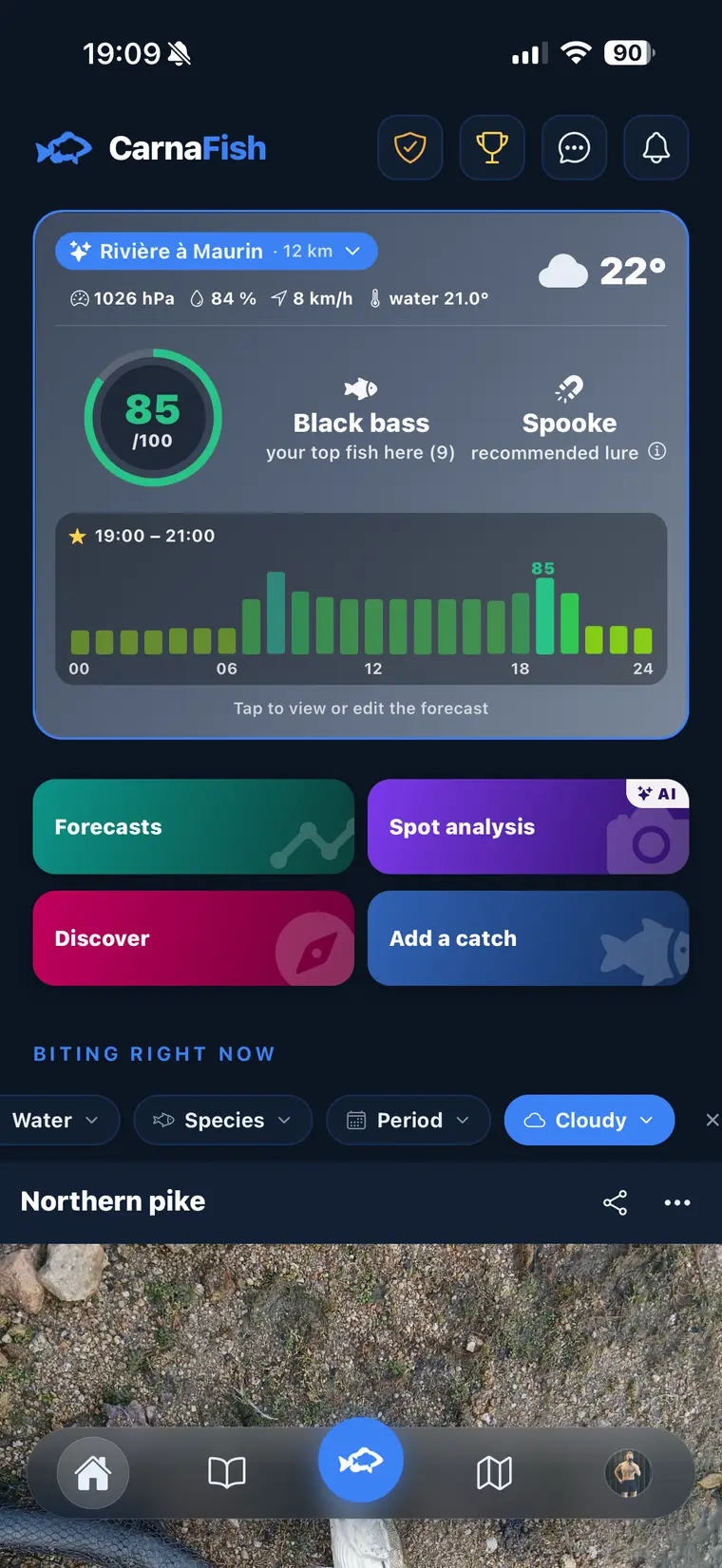
Not sure what to tie on?
Photograph your spot: CarnaFish reads the scene, cross-checks the conditions and gives you the zone, the lure and the retrieve. Free on iOS and Android.
Colors by water clarity
The manufacturer advertises a range of colors meant to match the most popular bladed jig schemes, without naming specific references. The sensible approach is therefore to think in families of shades tied to water clarity.
- Lightly stained water: translucent olive greens with flake, like the one in the photo with its green translucent body loaded with gold and green glitter. This is the all-round family, the one that reads as a small roach or a juvenile perch in a summer lake.
- Clear water: whites and translucent silvers, which let light through and avoid cutting too hard a silhouette under bright sun.
- Dirty water or low light: dark browns and blacks, which are not seen as colors at all but as a crisp shadow against what little light there is.
One reminder that applies to every trailer: the trailer color should extend the skirt, not contradict it. A white skirt with a black trailer breaks the silhouette instead of lengthening it.
An accessory that deserves as much thought as the lure
It is easy to spend an hour choosing between two bladed jigs and thirty seconds grabbing the first shad in the box to dress it. It should be the other way round. If the ChatterSpike appeals to you as a low-key trailer, also keep a Z-Man Scented Jerk ShadZ for straight soft-jerkbait rigs, and a Z-Man DieZel MinnowZ for the days when you actually want a paddle tail to amplify the swimming volume.
All of that still depends on reading the spot: knowing whether the bank opposite deserves a fast bladed jig or a slow presentation matters more than any trailer detail. That is exactly what CarnaFish is for: one photo of the spot, and the AI suggests a zone and a presentation suited to the conditions of the day. To place the bladed jig among the other lure families, our guide to choosing a pike lure gives the wider picture.
Key takeaways
- Pintail tail and pyramidal sections: the ChatterSpike carries the bladed jig's vibration instead of producing a competing action of its own.
- Dorsal and ventral slots: it rigs as a trailer, on a shaky head, Texas style or on a swim jig.
- ElaZtech is rated up to ten times tougher, but it must be stored away from ordinary soft plastics.
- The manufacturer publishes no unit weight: only the 4.5 in length and the five-bait pack count are given.
FAQ
What is the difference between a pintail trailer and a paddle-tail trailer?
A paddle tail generates its own action and adds drag, which widens the signal but can blur the blade's beat. A pintail like the ChatterSpike simply vibrates in the wake, so the signal stays tight and clean, closer to a small baitfish.
Will the ChatterSpike fit any bladed jig?
Z-Man states it is sized to pair with most standard bass-sized bladed jigs on the market, which covers the vast majority of models sold in Europe. On an oversized bladed jig the 4.5 in profile will simply look a little short.
How much does a ChatterSpike weigh?
The manufacturer publishes no unit weight: it gives the length, 4.5 in, and the pack count, five baits. To work out a total casting weight, put the jig and trailer together on a kitchen scale rather than trusting an estimate.
Can you catch pike on this trailer?
Yes, on a bladed jig worked along weed edges, provided you add an abrasion-resistant leader. The durability of ElaZtech is an asset once teeth are involved, even though no soft plastic is truly pike-proof.
Why does my bladed jig spin since I added a trailer?
In almost every case the trailer is rigged crooked. Take it off and re-thread it, checking that the body axis lines up perfectly with the hook shank, seen from above and from the side. A few degrees of twist is enough to send the lure helicoptering.
Does the ChatterSpike float or sink?
The manufacturer gives no density figure for this model, so there is no way to state it. In practice the question matters little: the bait is designed to dress a weighted head that imposes its own buoyancy.
The full bass lure guideSeason-by-season strategy: which family of lure, when, and why.Go from theory to fish
CarnaFish reads your spot from a photo and gives you the game plan: zone, lure, retrieve. Free on iOS and Android.