Zoom Fluke Stick: the fall that glides instead of dropping
The right lure in the wrong spot still catches nothing. CarnaFish spots the zone that works, from a single photo.
A laydown along the edge of a pond. You drop your stick worm right against the trunk, it sinks straight down, and it hits bottom forty centimetres from where it landed. You have fished a narrow column of water, over a spot that is three metres wide.
That is the limit of a classic stick worm. Its fall is superb — continuous shimmy, slow descent, nothing to complain about — but it is vertical. On a wide spot, you have to multiply casts to cover what one should be able to sweep.
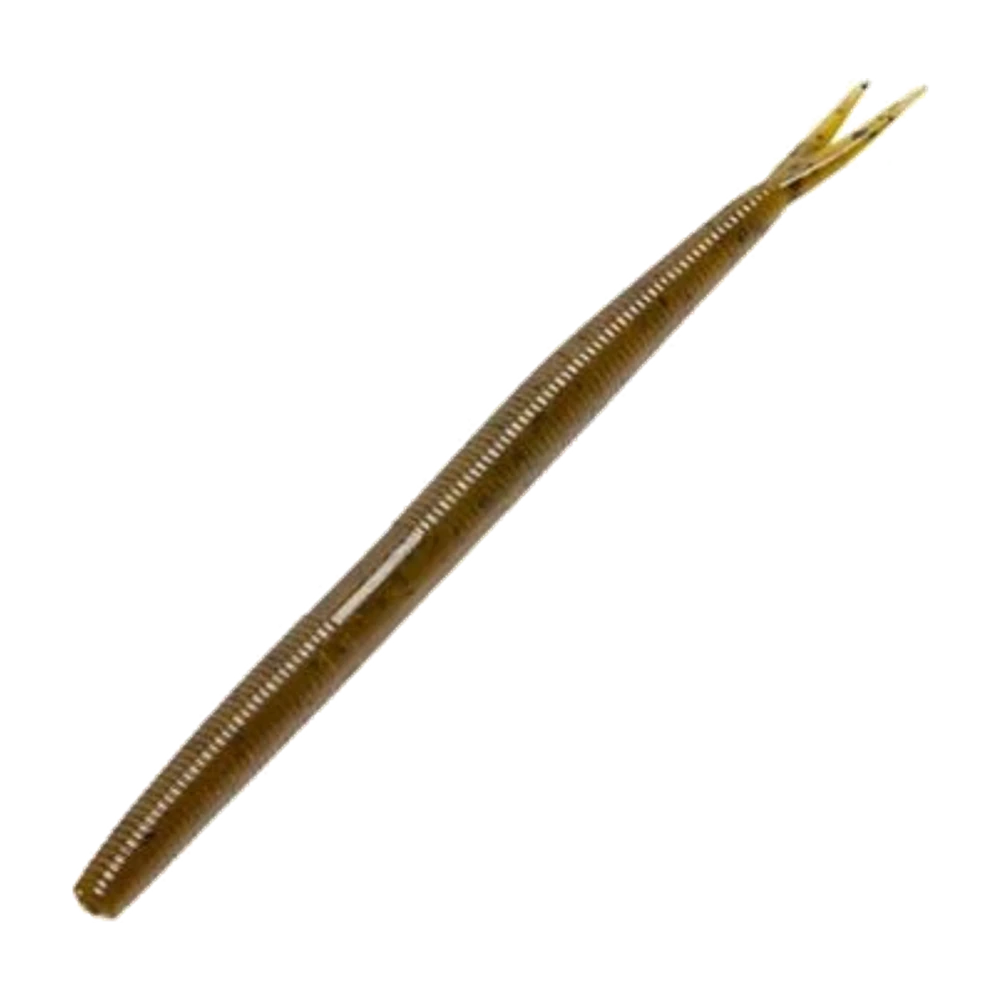
The Fluke Stick changes that path. By taking the tapered body and fine tail of a jerkshad and putting them on a stick profile, it gets a descent that planes off to the side instead of dropping on the spot. The same cast then covers a far wider zone, with nothing for you to do.
Why it drifts sideways as it sinks
Shape decides trajectory. A cylindrical stick worm with a constant section has no reason to go one way rather than another: it sinks flat, shimmering along its whole length, but broadly vertically.
The Fluke Stick has two geometric differences that change everything:
- A body that tapers towards the rear, with a tail clearly thinner than the middle. The centre of gravity is no longer central, and the bait naturally takes an angle as it drops.
- A tapered tail that acts as a rudder. As it shimmers, it pushes the bait slightly sideways on each oscillation, and those micro-pushes add up over the whole descent.
The concrete result, over a two-metre fall on a weightless rig, is a sideways drift of around fifty centimetres to a metre, in a direction that depends on how the bait landed. It is not a path you can predict to the centimetre — and that is precisely what makes it interesting, because it is different on every cast.
It also remains a genuine stickbait: the plastic is dense enough to sink without a weight, and the descent stays slow, in the few-tens-of-centimetres-per-second range that gives the fish time to come.
The retrieve: don't interrupt the fall
The classic mistake is tightening the line to "feel" what is going on. A tight line turns the gliding fall into a controlled arc, and kills the drift.
- Cast past the target area, aiming at the far edge of the spot.
- Open the bail or feed line, with the line properly slack. Do not take up the slack.
- Watch the line through the whole descent. It is your only bite indicator: it should keep paying out steadily.
- Let it drop all the way down or until the drift has crossed the spot, which takes five to fifteen seconds depending on depth.
- Gently take up the slack and give two small twenty-centimetre rod tip pops to lift the bait.
- Let it fall again on a second descent, usually in a different direction from the first.
- Repeat two or three times, then recast.
Wacky rigged, the hook through the middle of the body accentuates the fold and gives a slower fall with slightly less drift. Nose hooked — the hook through the head — you get maximum drift instead, because nothing constrains the body. That is the rig to favour when you really want to cover width.
On the water: when the line stops paying out before the bait has reached the depth you expected, do not tighten to check — set the hook. A premature stop means, nine times out of ten, that a fish has intercepted the bait mid-fall and is holding it without moving. By the time you tighten to make sure it is not a branch, it has spat it out.
Rigs and uses
| Rig | Hook | Effect on the fall | Situation |
|---|---|---|---|
| Nose hook | fine wire single 1/0 to 2/0 | Maximum sideways drift | Wide spots, laydowns, sight fishing |
| Wacky rig | wacky 1/0 to 2/0 + o-ring | Slower fall, moderate drift | Wary fish, very clear water |
| Weightless Texas | wide gap 3/0 to 4/0 | Moderate drift, clean passage | Weed beds, lily pads, thick wood |
| Lightly weighted Texas (2 to 5 g) | Texas 3/0 to 4/0 | Reduced drift, faster descent | Wind, depth beyond 3 m |
The o-ring on a wacky rig is not a detail: without it, a soft plastic of this density tears after two or three fish, whereas with a ring you easily get ten fish out of one bait.
For line, a 0.20 to 0.25 mm fluorocarbon leader is right: fine enough not to brake the drift, strong enough to pull a bass out of a laydown. Heavier and you block the descent; finer and you break on the first fish that buries in wood.
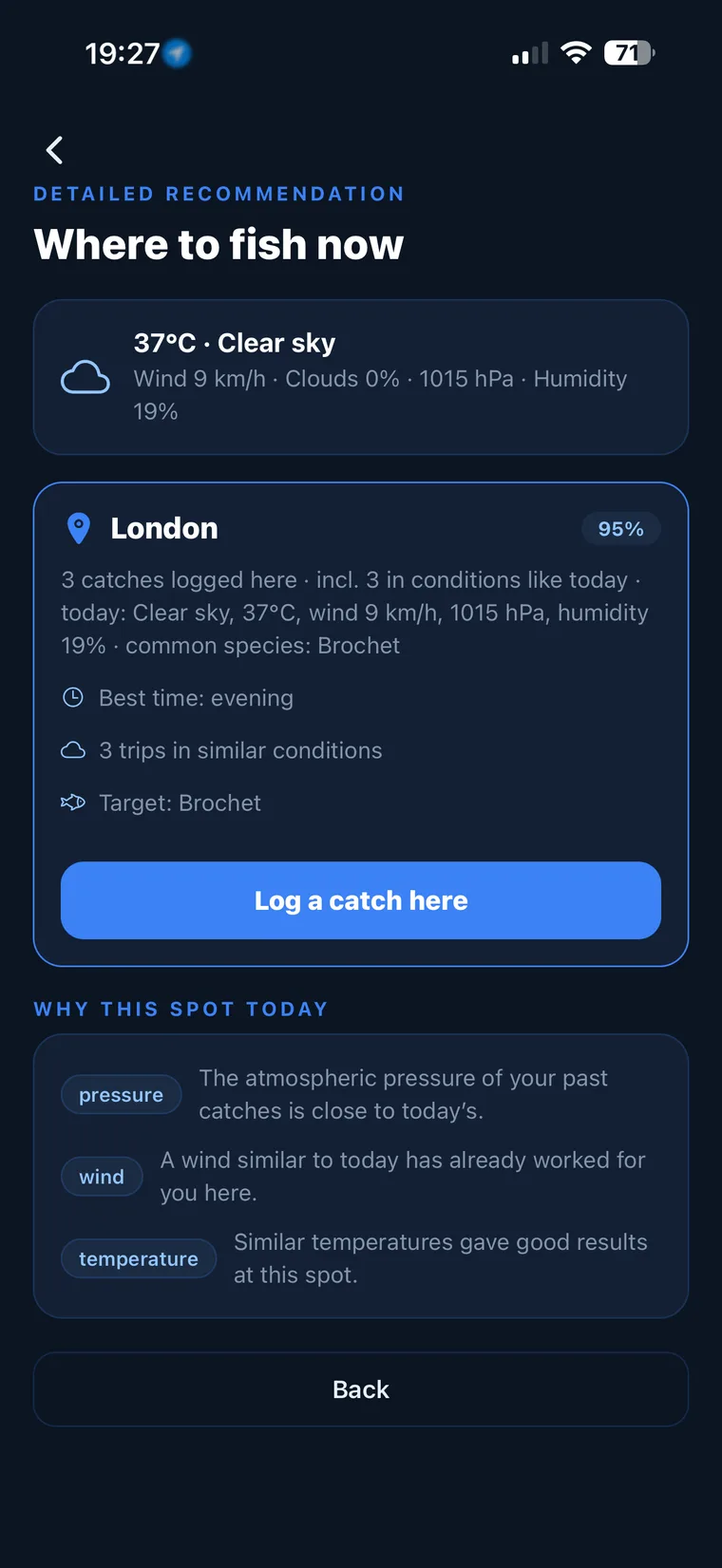
Not sure what to tie on?
Photograph your spot: CarnaFish reads the scene, cross-checks the conditions and gives you the zone, the lure and the retrieve. Free on iOS and Android.
Where it wins — and where it adds nothing
Its window:
- Wide vertical spots: a laydown, a bridge piling, a dam wall, the edge of a lily pad field you need to probe.
- Sight fishing, where you can see the fish and the sideways drift lets you swim the bait past it without casting right on top of it.
- Clear, calm water, which is the condition for the slow fall to be seen and followed.
- Fish suspended mid-column, neither on the bottom nor on top — a situation few baits handle well.
It adds nothing, on the other hand, in sustained wind: the line bellies, the free fall becomes impossible to control, and you lose both the drift and bite detection. It is also out of its depth beyond 4 to 5 m, where a weightless descent takes an unreasonable amount of time, and in current, where the flow imposes its own path. Finally, it is not a search bait: each cast takes a minute to fish properly.
Fluke Stick, Super Fluke or Senko
The Zoom Super Fluke shares the same tapered-tail DNA but works the opposite way: it is made to be worked in a zigzag near the surface, pushing a lot of water. It exploits the retrieve; the Fluke Stick exploits the fall. They are two complementary uses of the same profile.
The Yamamoto Senko 5 is still the benchmark for the pure fall: the shimmy of its constant-section body is finer and more regular, and on a fish watching in gin-clear water it often wins. But it drops vertically. The simple rule: Senko when you know exactly which point to fish, Fluke Stick when you want to sweep a width on every cast. The Zoom Trick Worm covers yet another angle, finer and longer, for fish refusing any bulk.
Our beginner's guide to bass fishing shows how to combine these three rigs over a single session. And if you are unsure which rig to tie on in front of a laydown, CarnaFish analyses a photo of the spot and answers.
Key takeaways
- Tapered body and fine tail: the fall planes sideways instead of dropping vertically.
- Reckon on fifty centimetres to a metre of drift over a two-metre weightless descent.
- Properly slack line throughout the fall, otherwise you kill the drift.
- A line that stops paying out is a bite: set the hook instead of checking.
- Unusable in strong wind, in current, and beyond 4 to 5 m without weight.
FAQ
What is the difference between the Fluke Stick and a Senko?
The Senko has a constant section and falls vertically, shimmying on the spot. The Fluke Stick tapers to the rear and its tail acts as a rudder, which makes it plane sideways as it sinks. The first fishes a point, the second sweeps a width.
Should I fish it wacky or nose hooked?
The nose hook gives maximum drift because nothing constrains the body: that is the rig to favour when covering width. The wacky slows the fall and cuts the drift slightly, which suits very wary fish in clear water better.
How do you detect a bite during the fall?
By watching the line. If it stops paying out before the bait has reached the expected depth, or if it moves off sideways, a fish is holding the bait. Set the hook immediately without tightening to check.
Why doesn't my bait drift sideways?
Almost always because your line is too tight. A tight line turns the free fall into an arc controlled by the rod and kills the drift. Let it run properly, even if you give up a little bite detection.
Do I need an o-ring for the wacky rig?
Yes. Without a ring, a bait of this density tears after two or three fish, whereas an o-ring easily gets you ten. It is the most obvious cost-benefit call in the whole rig.
Can it be weighted?
Yes, with a Texas rig and a 2 to 5 g bullet weight, to fish beyond 3 m or in wind. You speed up the descent and reduce the sideways drift, so you lose part of what makes it interesting: keep it for situations where the free fall is no longer controllable.
The full bass lure guideSeason-by-season strategy: which family of lure, when, and why.Go from theory to fish
CarnaFish reads your spot from a photo and gives you the game plan: zone, lure, retrieve. Free on iOS and Android.