6th Sense Clout Worm: the ridged stick worm that shimmies on the fall
This lure shines under specific conditions. CarnaFish tells you in 10 seconds if today is one of them.
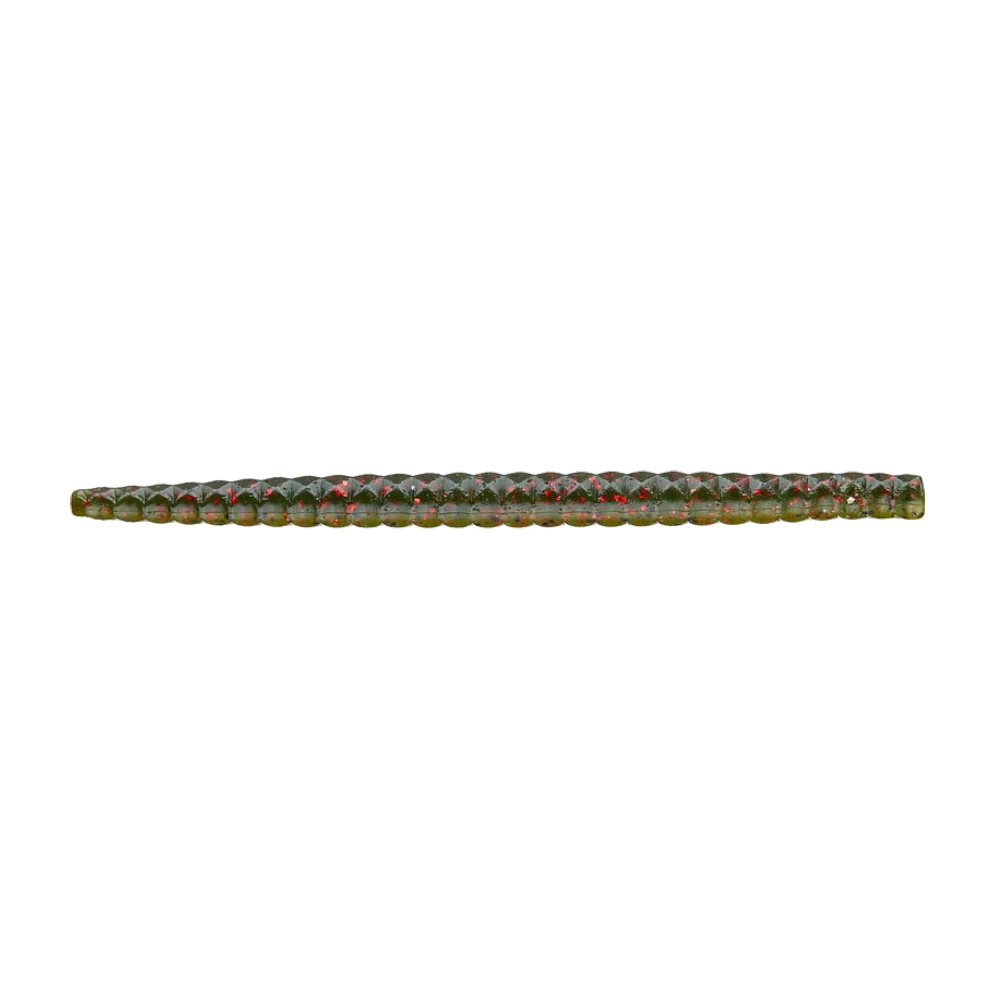
The stick worm is the dumbest lure in the world: a cylinder of soft plastic, no tail, no appendage, nothing. And yet it is one of the few families that keeps catching when nothing else does, because a cylinder falling slowly and rocking side to side imitates a dying baitfish better than any jointed lure. The 6th Sense Clout Worm starts from that principle and adds one idea: cover the whole body in moulded ridges.
Moulded ridges, and a fall that shimmies
Take a smooth stick worm, drop it in the water with no weight and watch it sink: it rocks slowly from one flank to the other, without much other signal. Do the same with the Clout Worm and the behaviour changes. The ring-shaped ridges that cover the body grab water along its whole length during the drop, which creates distributed resistance instead of a smooth one. The result is a tremble, a continuous shimmy running through the bait as it sinks.
It is a subtle difference but a usable one, because it acts precisely when a stick worm earns its fish: the fall. On a weightless rig, 80% of the bites come while the bait is dropping, not while you are working it. Anything that adds signal to the descent is therefore a direct gain.
The ridges have a second, visual role: they break the light into small regular bands and suggest the scales of a baitfish rather than the smooth, slightly artificial surface of a standard worm.
The texture that makes a fish hold on one second longer
An argument you rarely see on a soft plastic, and one that counts a lot in practice: a textured body does not feel the same in a fish's mouth as a smooth one. A bass that sucks in a perfectly smooth plastic cylinder often spits it very quickly; on a ridged body it holds on a little longer before making up its mind.
That extra second is exactly what you need when you are fishing a long cast, with some wind, on a weightless rig where the bite does not transmit clearly. It is often the time you need to drop the rod, take up the slack and drive the hook properly.
On a weightless stick worm, never strike on the feel of the first tap. Count two seconds, take up line until you feel the living weight of the fish, and only then sweep sideways into it. Anglers who miss half their stick worm bites are all striking too early.
Five rigs, and when to pick which
Weightless, hooked mid-body or through the nose
The reference rig. A wide gap hook through the middle of the body gives the classic wacky rock, the slowest and most expressive drop. Nose-hooked, the bait falls straighter and slightly faster, and retrieves better in short pulls. This is the rig for visible fish along banks, under docks, down reed lines and in shallow water.
Texas with a tungsten bullet
As soon as you need to go down or get through vegetation, switch to Texas with a 3 to 10 g bullet depending on depth and cover density. Point buried in the body: the bait becomes nearly snag-proof, but you lose some of the shimmy on the fall because the weight speeds the drop up. Stay with the lightest weight that reaches bottom.
Carolina
Sliding weight on the main line, swivel, then a 50 to 100 cm leader to the lure. The weight drags on the bottom and the worm follows above it, swimming freely. This is the deep-water search rig when you are hunting fish scattered across a big flat.
Shaky head
A small jighead with a fine hook, the worm rigged straight, and a presentation made of rod-tip shakes on the spot. Pure finesse, for fish you know are there but which refuse everything. The ridges work very well on this action because they react to the smallest quiver of the line.
Drop shot
Nose-hooked above a weight, the Clout Worm stays suspended at your chosen height and trembles without ever leaving the zone. Useful on a precise vertical spot or on fish located on sonar.
The classic mistake: trying to work it
This is the reflex to fight. A stick worm does not need to be worked, it needs to be left alone. The angler who pulls continuously stops it doing the one thing it is good at. Cast, let it sink without touching anything, wait until the line goes completely slack, give one or two slow pulls to start a new fall, then wait again. The days when it does not work are almost always days when it was over-worked.

Not sure what to tie on?
Photograph your spot: CarnaFish reads the scene, cross-checks the conditions and gives you the zone, the lure and the retrieve. Free on iOS and Android.
Colour by water clarity
- Clear water: green pumpkin, the do-everything colour of every bass soft plastic. Natural, discreet, credible as both a small baitfish and a crayfish.
- Stained water: junebug or a purple with flake. These dark colours with highlights keep a readable silhouette in water that eats the light.
- Dark water, after rain, low light: black and blue. The highest-contrast combination in the worm catalogue, the one you keep for the tightest conditions.
What it brings against classic stick worms
The Clout Worm plays the same ground as a Yamamoto Senko 5, the historical benchmark for slow-falling stick worms, and a Strike King Ocho, which uses an eight-sided body to break up light. The difference is mechanical: the Senko relies on the density of the plastic, the Ocho on facets, the Clout Worm on resistance distributed through ridges. On fish that have already seen fifty Senkos go past this season, that is a different signature, and often it is all you are looking for. For a slimmer, livelier approach on short pulls, a Zoom Trick Worm remains the logical companion in the same box.
A slow fall is worth nothing if it happens three metres from the fish. Knowing where to present the bait is still the real question, and that is what CarnaFish makes easier — a photo of the spot, and the app suggests the zone, the depth and the kind of presentation that suit the day. To put the stick worm back into a coherent fishing calendar, our guide to predator fishing season by season gives the framework.
Key takeaways
- The moulded ridges create a shimmy on the fall, exactly where a stick worm earns its fish.
- The texture makes a fish hold on longer, which buys you the time to set the hook properly.
- Five rigs cover the whole water column, from a shallow weightless to a deep Carolina.
- The worst mistake is working it continuously. A stick worm works while you do nothing.
FAQ
How long is the Clout Worm?
The manufacturer description we consulted does not state the length of this reference, and we would rather not put forward a figure we cannot verify. Check the listing for the size your dealer offers before choosing your hook, since body length determines the gape you need.
What hook should I use on a weightless rig?
A wide gap worm hook matched to the diameter of the body, rigged with no weight. For a wacky presentation, a shorter hook through the middle of the body is enough, usually protected by a rubber O-ring to stop the bait tearing on every fish.
Does the Clout Worm suit a drop shot?
Yes, it is one of the five intended rigs. Nose-hooked above the weight, it stays suspended and trembles on the spot, and the ridges respond well to the small vibrations carried down the line.
How long should I let it sink?
All the way, meaning until the line stops paying out. Weightless over two metres of water that can take ten to fifteen seconds, and it is the most productive part of the cast. Cutting the drop short is the most common mistake with this kind of lure.
Is a ridged stick worm more fragile than a smooth one?
The ridges do not weaken the body in themselves, but like every stick worm it tears at the hook hole after a few fish. A rubber O-ring on a wacky rig lengthens the life of each bait considerably.
Does it catch predators other than bass?
The description points this bait clearly at bass, and that is where it performs best. In Europe a stick worm on a light Texas rig will occasionally interest perch along the banks, but that is not the use it was drawn for.
The full bass lure guideSeason-by-season strategy: which family of lure, when, and why.Go from theory to fish
CarnaFish reads your spot from a photo and gives you the game plan: zone, lure, retrieve. Free on iOS and Android.