Manns Baby 1-Minus: fishing the top thirty centimetres
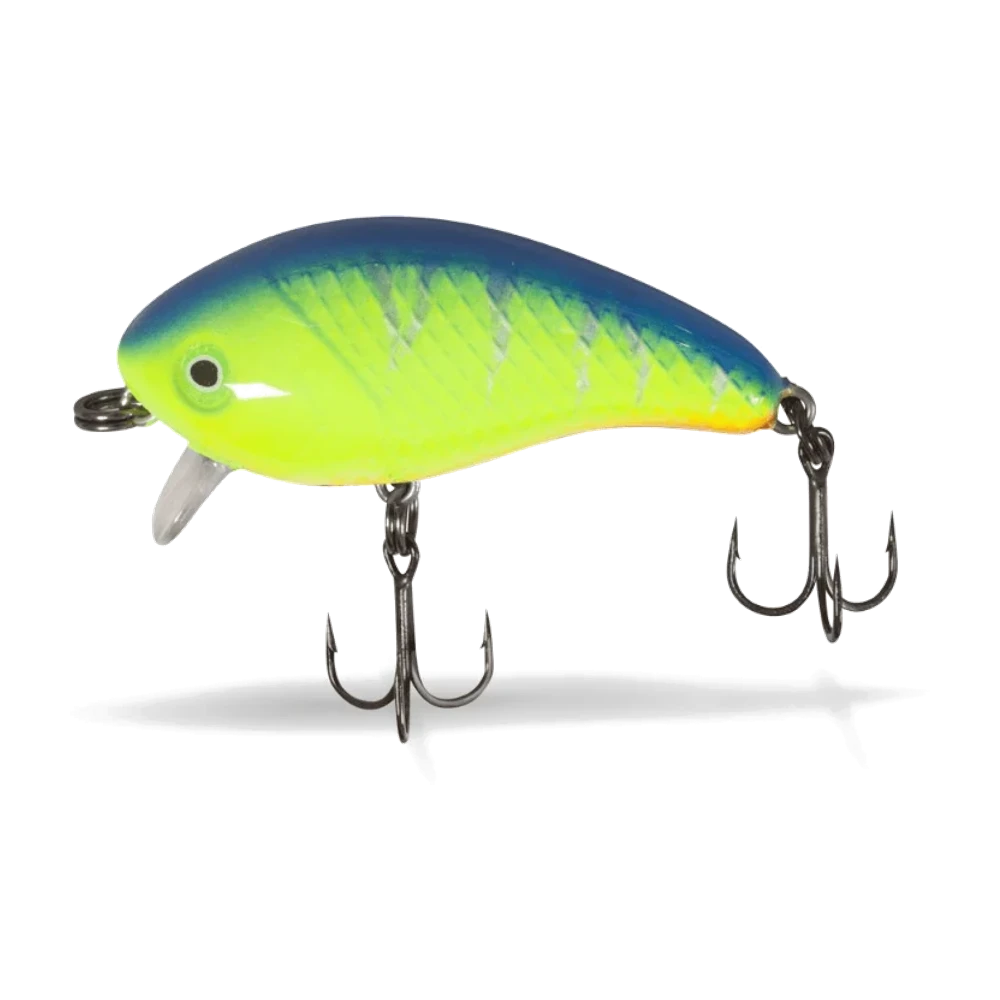
This lure shines under specific conditions. CarnaFish tells you in 10 seconds if today is one of them.
Look at a depth map of a pond and pick out the zones with less than fifty centimetres of water. Then ask yourself when you last fished them. For most anglers the answer is never — because a normal crankbait drags there, because a soft plastic snags, and because we assume there is nothing home.
Yet everything is there: warmth, forage, cover, and fish coming up to feed undisturbed. The only obstacle is technical.
The Baby 1-Minus solves that problem in a deliberately radical way: it does not go down. Its short, very wide lip holds it in the top thirty centimetres no matter how you retrieve it. So you can wind briskly over a carpet of submerged vegetation without ever touching it, which no other crankbait allows.
A lip that stops it diving
This lure is built backwards compared with the usual logic. Where most crankbaits try to convert pull into descent, this one converts it into lift.
- A very wide, very short, almost horizontal lip. It offers a large surface but a shallow angle of attack: the lure pushes water downwards and stays high.
- A short, floating body. At rest it pops straight back to the surface. Combined with the lip, that makes fouling on vegetation rare as long as you keep some speed.
- A wide roll for such a small frame. For a lure of four to five centimetres, the water it moves is surprising. At a sustained speed it even raises a slight visible bulge at the surface.
- A depth window you cannot change. Neither the line, nor rod position, nor speed will take it down to a metre. That is a constraint, and it is also what makes it reliable.
The retrieve: three to know
The sweeping retrieve. Medium, constant speed, rod low, along the whole length of a margin. That is the baseline: you want to cover as much bank line as possible in fifteen to thirty centimetres of water.
Vegetation contact. Over a carpet of weed sitting twenty centimetres under the surface, retrieve so that you brush the top of the growth regularly. Every time the lip catches a strand, give a sharp pull to rip it free. That rip is the main trigger.
The bulge. Speed up until the lure's back raises a visible hump of water without ever breaking the surface. On perch feeding up top and on bass in warm water, it is often the best of the three.
- Cast parallel to the margin, not at right angles to it: you stay in the right band for longer.
- Start the retrieve on impact, without letting the lure float.
- Hold a constant rhythm and build a rip into every contact.
- Do not set the hook too hard: small trebles, small lure, light rod.
On the water: on a shallow flat, fish it from the outside in, never the other way round. A cast that starts from the bank and goes out pushes every fish on the plateau ahead of it before the lure ever arrives. Position yourself out wide and retrieve towards the bank: you pick the fish up in the right order.
The right ground, and the wrong
| Context | Verdict | Why |
|---|---|---|
| Weedy flat under 50 cm | Ideal | It rides over without fouling |
| Reed bed margin | Ideal | Long sweeps, parallel to the edge |
| Back end of a pond in summer | Very good | Warmth, forage, fish riding high |
| Drop-off at 2 m | Useless | It will never get down there |
| Tangled dead wood | Bad | Small exposed trebles, frequent breakage |
| Cold water under 10 °C | Bad | The fish are no longer in that layer |
Its real season runs from late spring to early autumn, as soon as the water passes 16 to 18 °C and the fish ride up. In winter there is nothing doing in thirty centimetres of water and this lure has no purpose.
Why it is so good on perch
Its size matches a young-of-the-year fry exactly, and that is what perch hunt in shoals from July to October. When you spot a feeding frenzy — swirls, fry jumping, birds diving — the question is not which lure, but how fast you can get it in there.
The Baby 1-Minus is ready immediately: no sink time, no layer to find. You cast at the edge of the frenzy, wind fast, and you are in the right band from the first turn of the handle. On fleeting bursts that last twenty seconds, that detail decides everything.
Remember to go light: 0.22 to 0.25 mm fluorocarbon and fine trebles. Perch have fragile lips, and a lure this size with hooks that are too heavy loses fish.
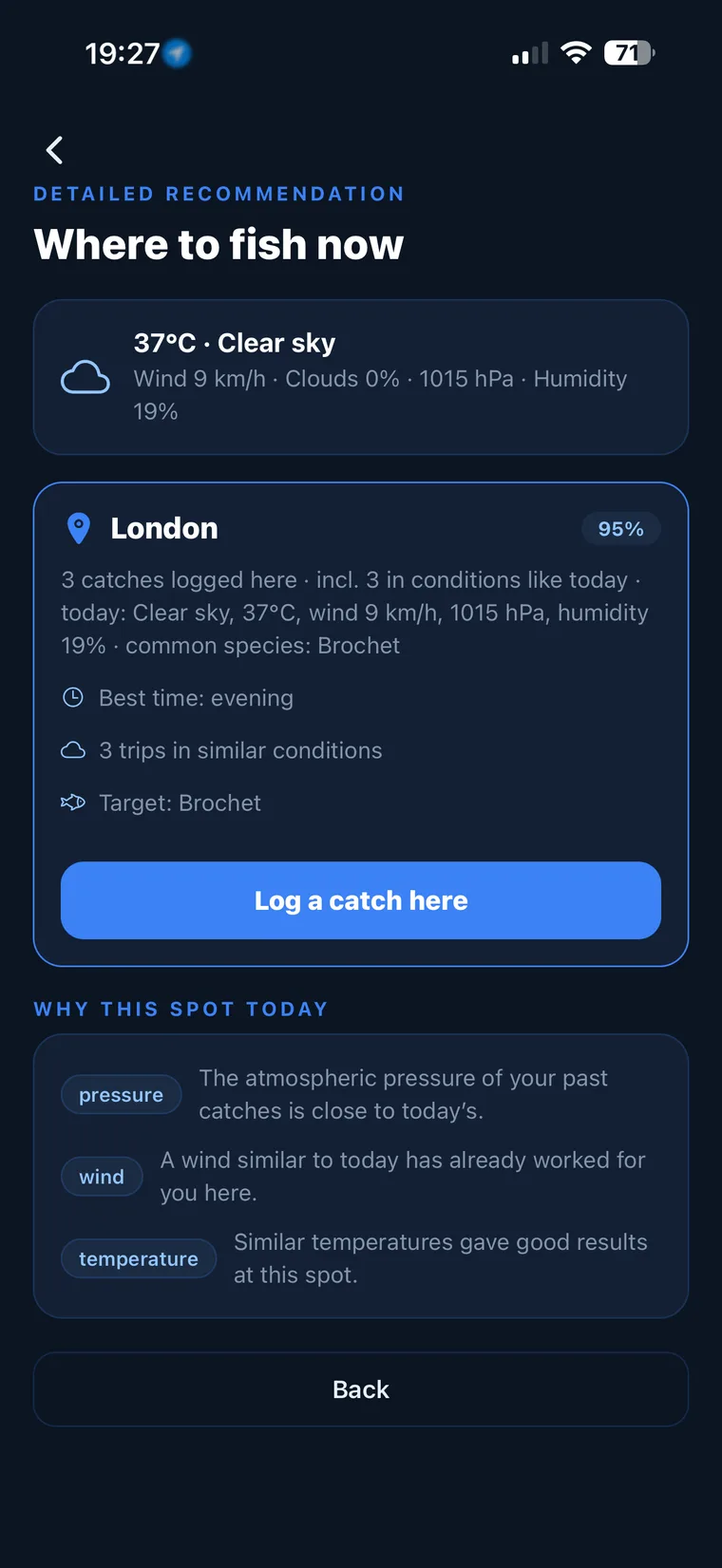
Not sure what to tie on?
Photograph your spot: CarnaFish reads the scene, cross-checks the conditions and gives you the zone, the lure and the retrieve. Free on iOS and Android.
Colours: think in silhouette
In thirty centimetres of water, the fish sees the lure from very close and often backlit. So colour choice comes down to contrast against the background, not realism.
- Over dark vegetation: chartreuse and white, or an orange belly. The lure has to stand out from the green-black of the weed.
- Over pale sand: natural roach or small perch tones, more subdued.
- Very clear water and full sun: reduce contrast and switch to translucent flanks — at that range, a lure that is too loud gets refused.
Baby 1-Minus or a classic small crankbait
An Illex Chubby 38 plays in the same size class but runs noticeably deeper, around a metre: it covers the zone just below, with a tighter, more vibrating action. The Baby 1-Minus does not replace it, it completes it — one works the ceiling, the other the floor below.
Against the Rapala Ultra Light Crank, which is slimmer and more discreet, the Manns has a distinctly wider roll and moves more water: it calls from further away, but it is less subtle in very clear water.
And if your shallow flat is dotted with stumps rather than weed, switch to the Bomber Square A: same shallow philosophy, but a lip built to deflect off wood. Our guide to perch fishing with lures explains how to work late-summer feeding frenzies. And if you are unsure which water layer to attack when you arrive, CarnaFish analyses a photo of the spot and answers.
Key takeaways
- It stays between 15 and 30 cm whatever you do: a constraint by design, not a flaw.
- It opens up a layer most anglers never fish.
- Contact with the top of the vegetation, then the rip, is the main trigger.
- On a shallow flat, fish from deep water towards the bank, never the reverse.
- No use in cold water, or as soon as the fish drop below a metre.
FAQ
How deep does the Manns Baby 1-Minus run?
Between 15 and 30 cm, and nothing will change that: not the line, not the speed, not the rod position. It is a lure designed for a single water layer, the one just under the surface.
Can it be fished over weed beds?
That is its main ground. As long as the top of the vegetation is twenty centimetres or more below the surface, it rides over. Occasional contacts followed by a sharp rip are something to look for, not avoid.
Is it suitable for perch?
Very much so. Its size matches a young-of-the-year fry and it is instantly in the right layer, which matters on surface feeding bursts that only last a few seconds. Lighten the line and the trebles to limit dropped fish.
What line diameter should I use?
Fluorocarbon of 0.22 to 0.28 mm. Diameter has no effect on depth here; choose it for the cover and the size of fish you expect, not for the water layer.
Does it work in winter?
No. Below 10 °C there is no reason for a predator to sit in thirty centimetres of water. This lure is a late spring to early autumn tool.
How do I avoid losing small fish?
A light rod with a soft action, a gentle hookset that follows through, and fine trebles in the stock size. A stiff setup combined with small hooks is the surest recipe for losing fish during the fight.
The full bass lure guideSeason-by-season strategy: which family of lure, when, and why.Go from theory to fish
CarnaFish reads your spot from a photo and gives you the game plan: zone, lure, retrieve. Free on iOS and Android.