Berkley Cane Walker: the walking bait that spits and clicks
Before tying this one on, it helps to know if the spot actually calls for it. CarnaFish reads the scene from a photo.
Some mornings the water is so flat that a discreet topwater is useless: the fish is out there somewhere along two hundred metres of bank, and you need to call it in. That is precisely the situation the Cane Walker was drawn for. Berkley calls it the topwater in its range that moves the most water, and that is not just a line: between the cupped mouth and the rattle chamber, it is louder than most stickbaits on the shelf.
Two sizes, and they do different jobs
The maker lists two versions. The Cane Walker 110 measures 4.3 in, or 10.9 cm, and is given at 5/7 oz, around 20 g. The 125 measures 5 in, or 12.7 cm, at 5/6 oz, around 24 g. Both are listed as topwater, so strictly floating.
Eighteen millimetres apart sounds like nothing on paper. On the water it is the difference between a bait you can still throw on a medium rod and one that wants serious power. The 110 is the all-rounder: bass on lakes, perch over big flats, and sea bass from the shore when fish are herding small baitfish. The 125 earns its place when there is chop, wind, or when you want a bigger silhouette to sort through fish.
Weight matters as much as length here. Twenty grams on an 11 cm bait is heavy: the density sits in the tail, and that is what explains the casting distance.
Why it almost walks itself
A classic walking bait wants a trained wrist. The Cane Walker cheats a little, in the right direction: the body is shaped for aerodynamics and heavily weighted at the tail. On the cast it flies straight and does not helicopter. In the water, that same tail weight swings the nose on every stroke without you needing to meter the input finely.
In practice you can get a clean walk with loose rod-tip strokes, rod pointed down, leaving slack in the line between pulls. That is far more forgiving than a Heddon Zara Spook, which punishes a tight line immediately. If you are learning to walk the dog, this is an excellent teaching bait.
The cadence that works
Two sharp strokes, a short pause, two sharp strokes. The pause is not decoration: that dead time is when a following fish commits. If a fish misses, do not restart straight away — leave the bait still for two seconds, then move it with a single soft pull. The second attempt is often the one.
Always keep a little slack between the rod tip and the bait. A Cane Walker dragged on a tight line travels in a straight line instead of zigzagging, and plenty of anglers conclude the lure does not work when it is the line stopping it from turning.
Noise, and what it costs you
Two sound sources work together. An internal chamber holds a ball that clacks on every change of direction, and the cupped mouth at the front throws a spray of water on every stroke. The combination makes the Cane Walker a long-distance caller: on a choppy lake or in stained water, it pulls fish that would never have noticed a silent stickbait going past.
But the opposite needs saying too, because it is true. On clear, flat water with fish that have already been cast at several times that week, that much noise can push them off instead of drawing them in. In that exact case, a quieter stickbait like a Lucky Craft Sammy 100 will get more bites. The Cane Walker is a tough-conditions bait, not a default one.
Hooks and rigging
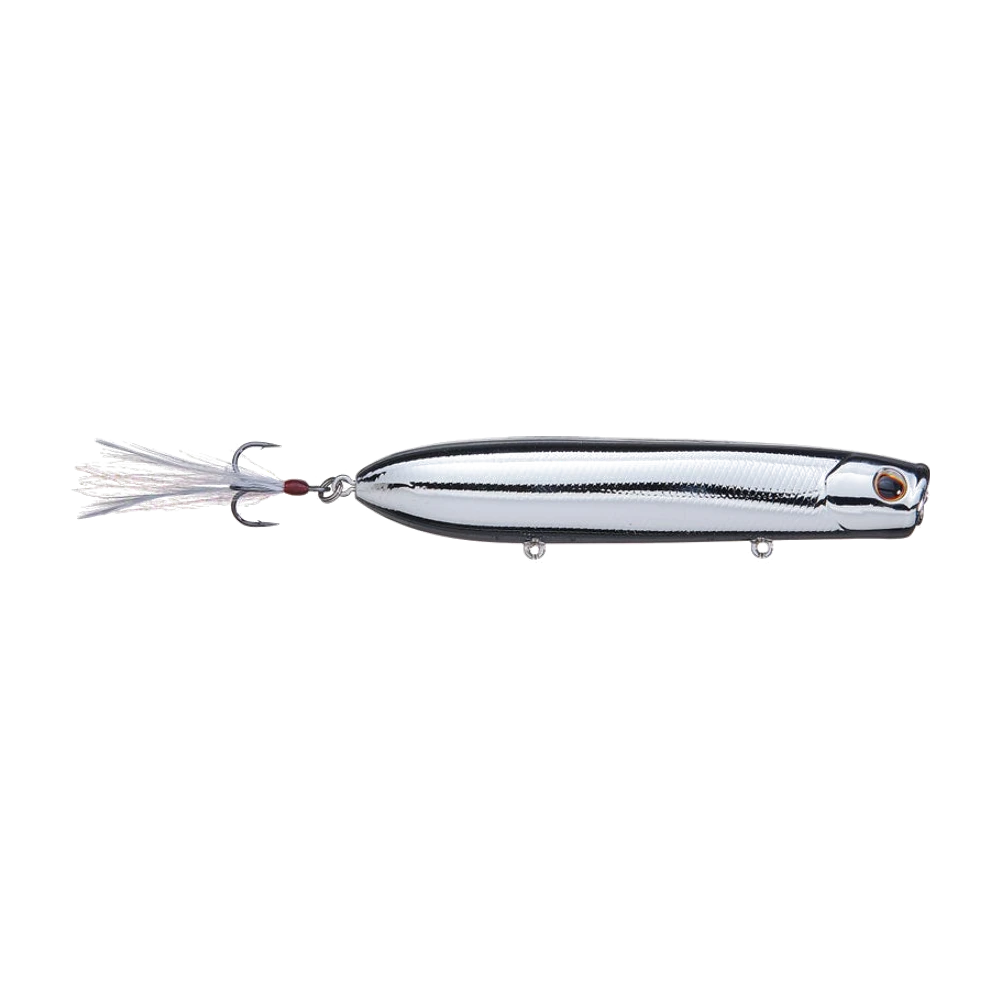
The lure ships from the factory with three Berkley Fusion19 trebles. On the sample photographed here only the rear treble is fitted, dressed with white feathers, and both belly hangers show bare — always look at what you are buying before you leave for the water.
That rear dressing is not cosmetic: it slows the tail slightly on the pause and keeps it from sinking, which holds the bait flat when you stop the animation. If you replace that treble, fit another feathered one of the same weight, otherwise the bait's attitude changes.
On the line side: floating braid as a main line is non-negotiable on a topwater, a sinking line pulls the nose down. Add a quick snap or a loop knot so the bait is free to pivot. And if the spot holds pike, a soft wire leader is compulsory — a 20 g bait with three trebles is exactly what a pike T-bones.
The classic mistake
Striking on sight. A surface take is spectacular and the reflex is to lift the rod the moment the water explodes. Nine times out of ten the fish does not have the bait yet and you pull it out of its mouth. Wait until you feel weight in the rod, then set sideways, never upwards.
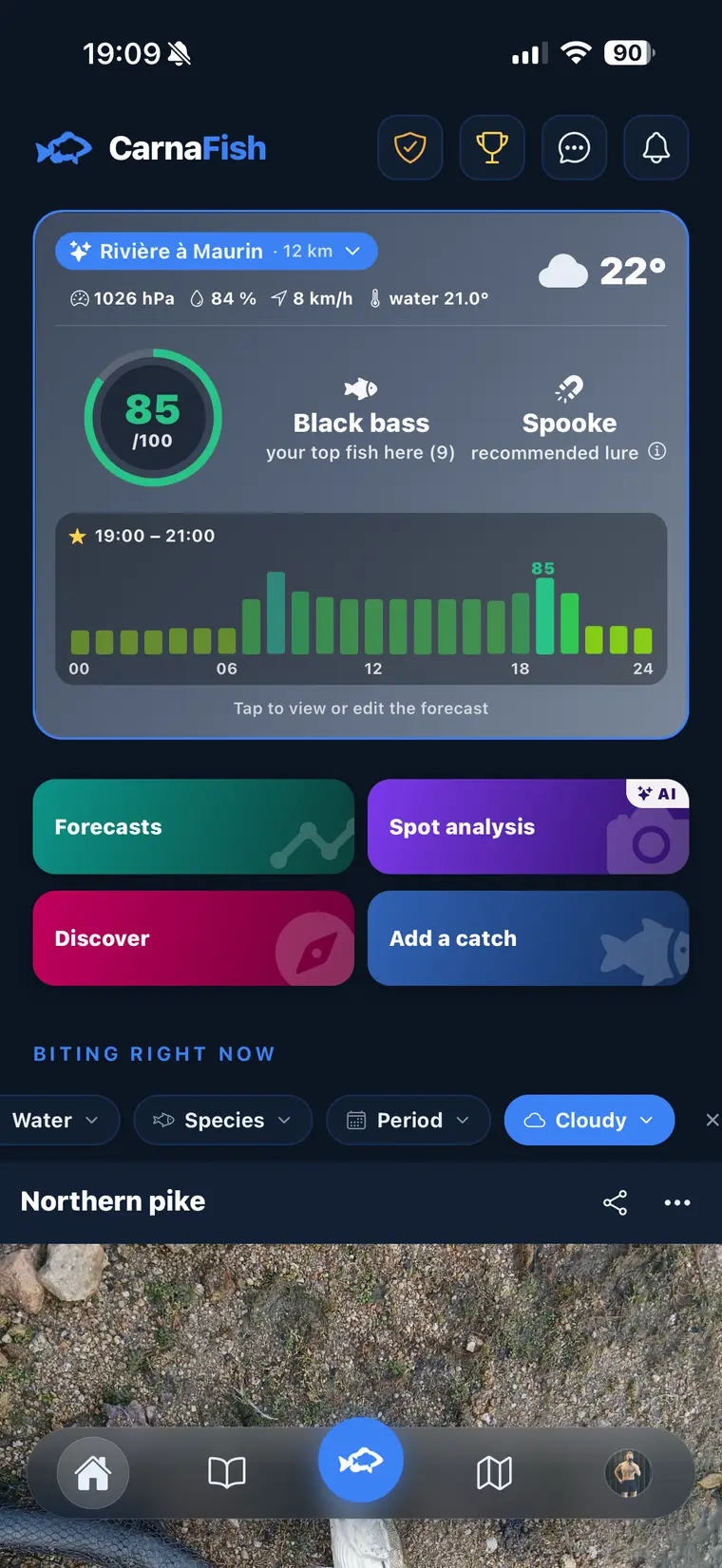
Not sure what to tie on?
Photograph your spot: CarnaFish reads the scene, cross-checks the conditions and gives you the zone, the lure and the retrieve. Free on iOS and Android.
Colors by light
- Clear water and bright sun: chrome with a black back, the finish in the photo. The mirror flank throws light on every pivot and carries a long way.
- Overcast or lightly stained water: a bone tone, matte and pale, that stands out against a grey sky where chrome goes flat.
- Dawn, dusk, after dark: solid black. Backlit, it is the full silhouette that reads, not the color.
Where it sits in the box
The Cane Walker fills a specific slot: the loud topwater, cast a long way, to cover a big stretch of bank fast. For a precise cast at a located fish, a more compact Berkley J-Walker is easier to place; to call from much further across broken water, a prop bait like the River2Sea Whopper Plopper 130 makes even more noise but loses the sharpness of a true walk.
That still leaves the question of whether the surface is the right call today, and that depends on temperature, light and the structure of the spot. This is exactly what CarnaFish is for: one photo of the spot, and the AI suggests a zone, a depth and a lure family matched to current conditions. For bank spots and feeding windows in salt water, our guide to sea bass fishing with lures rounds out the subject.
Key takeaways
- Only two sizes: 10.9 cm at around 20 g, 12.7 cm at around 24 g, both strictly floating.
- The tail weight does most of the work: very long casts and an easy walk even with an untrained wrist.
- Internal rattle plus cupped mouth make it a long-range caller, which makes it the wrong pick on clear water with pressured fish.
- Slightly slack line, and set on weight rather than on sight: the two habits that change your hook-up rate.
FAQ
Should I take the 110 or the 125?
The 110, 10.9 cm for about 20 g, covers most situations and casts fine on a standard medium-heavy rod. Move up to the 125 when there is wind or chop, or when you want a bigger silhouette to select larger fish.
Does the Cane Walker float at rest?
Yes, the maker lists it explicitly as topwater. It sits on the surface when stopped, slightly tail-down because of the weighting, which lets it move again on the very first pull.
Can it be used in salt water for sea bass?
Yes, and it is a good use for it: the weight buys distance from the shore and the noise carries through chop. Rinse it in fresh water after the session and watch the split rings, salt attacks them quickly.
Why does my lure track straight instead of zigzagging?
Almost always a tight line. Point the rod at the water and leave some slack between strokes — the bait needs that slack to pivot. A knot cinched directly onto the eye produces the same symptom.
Do I need a wire leader?
For bass or sea bass, a 0.35 mm / 18 lb fluorocarbon leader is enough. As soon as pike are around, switch to soft wire: the size and the noise of this bait attract exactly the sideways attacks that cut through mono.
What should I do when fish follow but will not commit?
Lengthen the pause between bursts, and try a single soft pull instead of two sharp ones. If that is not enough, swap to a quieter stickbait: on clear water, the sound level of the Cane Walker can be the reason for the refusal.
The full bass lure guideSeason-by-season strategy: which family of lure, when, and why.Go from theory to fish
CarnaFish reads your spot from a photo and gives you the game plan: zone, lure, retrieve. Free on iOS and Android.