Big Bite Baits Fighting Frog: the frog that works below the surface
The right lure in the wrong spot still catches nothing. CarnaFish spots the zone that works, from a single photo.
A hollow frog just got blown up against a pad line, you set the hook on nothing, and the fish went back under the mat. Your window to get it back is about thirty seconds long. That is exactly the scenario Dean Rojas designed the Fighting Frog around with Big Bite Baits — a bait that looks like a frog but never fishes on top.
A frog that is not a topwater
Let us be clear from the start, because the name misleads: the Fighting Frog has no hollow body, no double hook and no waterline. The manufacturer states plainly that it is meant to be flipped, pitched, Carolina rigged or used as a jig trailer, and fished below the surface. You are far closer to a flipping creature than to a topwater bait, "frog" label notwithstanding.
That is not a vocabulary quibble: it changes the whole setup. A true hollow frog like a SPRO Bronzeye Frog is fished with a stiff rod, a delayed hookset and heavy braid to walk mats. The Fighting Frog goes on a plain Texas hook with a bullet sinker, and gets hit instantly.
What the grooves change on the hookset
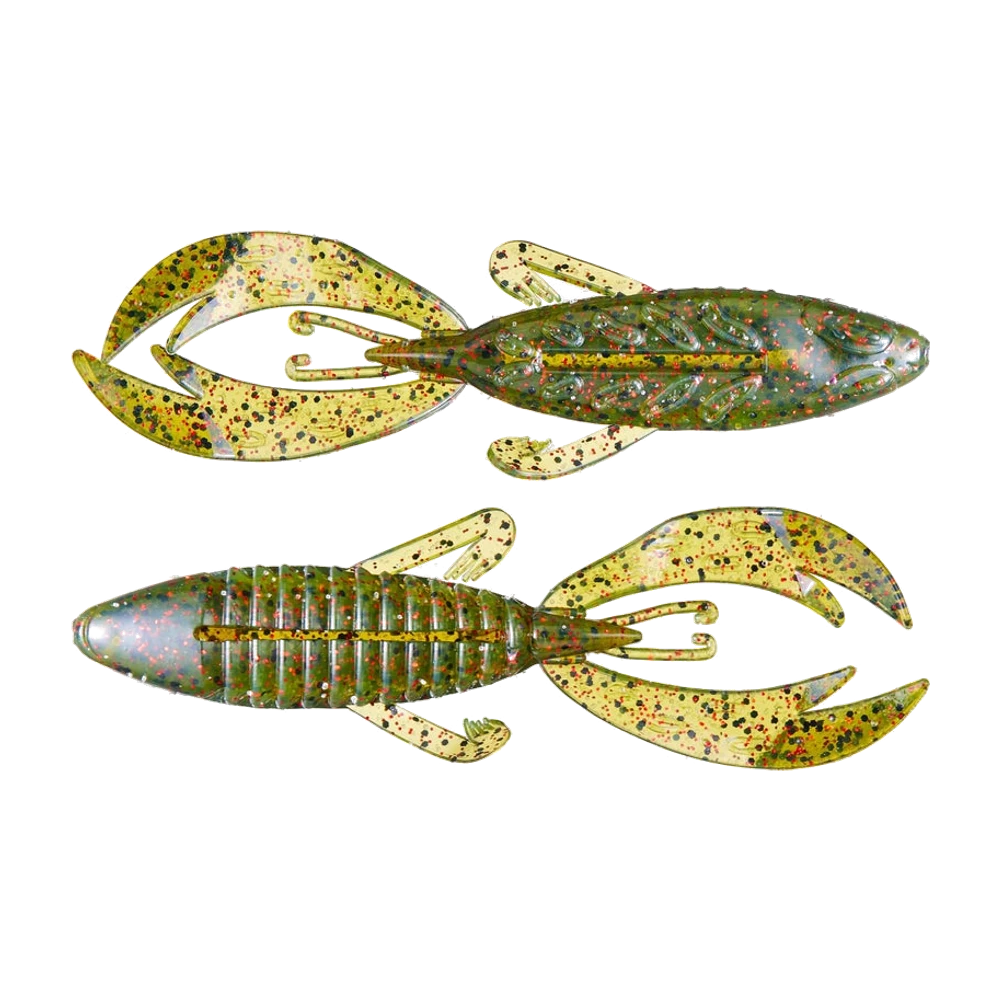
This is the bait's real innovation, and it is invisible on the shelf. The Fighting Frog has a hook pocket on top and one underneath, but above all it has extra grooves down the sides. In the photo you can see the dorsal groove on one bait and the ribbed belly cut by a central channel on the other.
What is that for? When you set the hook on a thick soft plastic, the body has to collapse for the point to exit. If the plastic has nowhere to go, it balls up around the hook and absorbs the set — the number one cause of lost fish on a bulky flipping bait. The side channels give the material somewhere to fold into. The body collapses instead of blocking, and the point drives through.
Rig the hook in the top pocket, not the bottom one, as soon as you are fishing wood. The point stays shielded by the bait's back on the way down, and the body folds the right way on the set. Plenty of anglers use the belly pocket out of plain Texas-rig habit and give up part of what the design offers.
The three sizes and their jobs
Big Bite Baits offers the Fighting Frog in three lengths, with different pack counts: 3 in (7.6 cm) ten per pack, 4 in (10.2 cm) seven per pack and 5 in (12.7 cm) five per pack.
The 3 in is a jig trailer and a finesse option in light cover — it is also the pick for tough days when a big profile backs fish off. The 4 in is the reference size, the one that covers nearly everything: flipping, pitching, Carolina. The 5 in is a big-fish search tool, for waters where you know the volume is there and you accept fewer bites.
Play with the weight rather than the retrieve
The Fighting Frog has a trait the manufacturer highlights and that holds up on the water: its behaviour depends more on the sinker than on how you work it.
With a light 3.5 to 7 g weight, the big back legs have time to swim through the whole descent, and the bait glides forward instead of dropping straight. That is the presentation for shallow water, on a fish sitting there watching it come down. With a 14 to 21 g weight, the glide disappears and the bait drops fast and hard: that is what you need to punch a mat or reach five metres at a dock post before the current pushes the line off track.
The small front legs are not there for propulsion. They add a subtle quiver once the bait has landed and the line has gone slack — the kind of signal that tips a fish that came to look without committing.
The classic mistake
Treating the Fighting Frog like a topwater and delaying the hookset. With a plain Texas hook already in contact with the fish's mouth, waiting two seconds does nothing but give it time to spit. Set hard the moment you feel weight, exactly as on any Texas rig.
Not sure what to tie on?
Photograph your spot: CarnaFish reads the scene, cross-checks the conditions and gives you the zone, the lure and the retrieve. Free on iOS and Android.
The follow-up bait after a missed frog bite
This is the use Dean Rojas pushes, and it is probably the bait's strongest argument. A bass that blew up on a hollow frog without getting hooked usually stays in the area, fired up, for a handful of seconds. Sending the same silhouette straight back, only this time sinking, often turns that missed bite into a fish.
So keep a rod rigged with a Fighting Frog while you fish a hollow frog. No need to swap baits or retie: you pitch, you let it glide, and in most cases the bite comes before it has reached the bottom.
Colour by water clarity
- Clear water: Watermelon Red Flake, the colour in the photo, with its translucent green base and red flake that stay subtle in bright light.
- Lightly stained water: Green Pumpkin, the safe call when visibility drops to a metre and you want to keep a natural tone.
- Under a thick mat or in dark water: Black Blue, because there is no light left under vegetation and all a fish reads is a silhouette.
A genuine complement, not a replacement
The Fighting Frog replaces neither a hollow frog nor a flipping craw. It fills a precise slot: the bait that goes down where the topwater frog stops. With a Big Bite Baits Craw Tube for rocky targets and a Reaction Innovations Sweet Beaver for punching fast, you cover most cover situations.
Even so, knowing which bank to work weighs more than the bait choice, and that is exactly what CarnaFish makes easier: a photo of the spot, and the app suggests the zone and the presentation suited to the day. To set those choices in the calendar, our season-by-season predator fishing guide gives you the framework.
Key takeaways
- Despite the name, it fishes below the surface, on a Texas rig, Carolina rig or as a jig trailer — never like a hollow frog.
- The side grooves let the body collapse on the set, which clearly raises the hook-up rate on a thick bait.
- The sinker makes the presentation: light for a forward glide, heavy to punch and drop straight.
- It is the best follow-up bait after a missed blow-up on a topwater frog.
FAQ
Can the Fighting Frog be fished on top?
No. Despite the name and the silhouette, it is a solid soft plastic designed to be flipped, pitched or Carolina rigged below the surface. To fish on top of mats you need a hollow frog with a double hook.
Which size should I start with?
The 4 in (10.2 cm), sold seven per pack. It covers flipping, pitching and Carolina rigs without being too bulky on average days. The 3 in is mostly a trailer, the 5 in a big-fish bait.
What hook and weight should I use?
A wide gap Texas hook, 3/0 for the 3 in, 4/0 for the 4 in, 5/0 for the 5 in, with a pegged bullet sinker. 3.5 to 7 g for a gliding fall, 14 to 21 g to punch a mat or get down fast.
What exactly are the side grooves for?
They give the plastic somewhere to fold on the hookset. Without them a thick body balls up around the hook and absorbs the point's penetration, which is the leading cause of lost fish when flipping.
Should I wait before setting the hook?
No, that is the most common mistake with this bait. Unlike a hollow frog, the hook is already in contact with the fish. Set as soon as you feel weight, as on any Texas rig.
Can it be used as a jig trailer?
Yes, that is one of the uses the manufacturer intends. The 3 in is the best fit: it adds two big legs that swim on the fall without doubling the jig's bulk.
The full bass lure guideSeason-by-season strategy: which family of lure, when, and why.Go from theory to fish
CarnaFish reads your spot from a photo and gives you the game plan: zone, lure, retrieve. Free on iOS and Android.