Illex Gigant Pike: showing a pike another pike
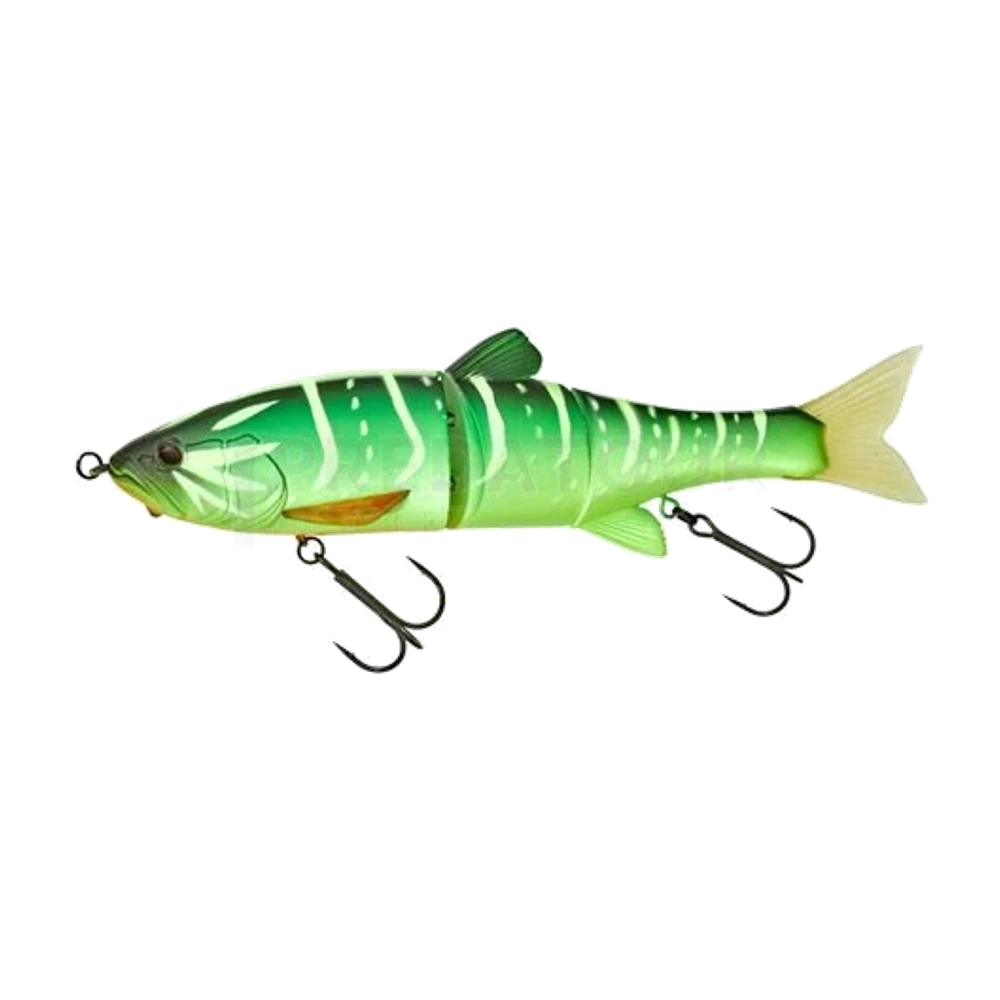
This lure shines under specific conditions. CarnaFish tells you in 10 seconds if today is one of them.
A ninety-centimetre pike does not feed on the same things as a fifty. It is not only a question of prey size: it is a question of return. Past a certain frame, chasing ten-centimetre roach costs more energy than it brings in, and big fish fall back on prey that is large, slow and scarce.
Among that prey there is one anglers hesitate to imitate even though it is everywhere: the pike itself. Cannibalism is routine in this species, and a thirty-centimetre pike is exactly the kind of mouthful a big fish will agree to chase.
The Gigant Pike starts there. This is not one more swimbait in a baitfish pattern: it is a lure built on a pike's silhouette, with everything that implies in terms of long profile, pronounced head and restrained swim. And it does not fish like a swimbait imitating a roach.
Why the silhouette changes the fish's behaviour
A roach or a bleak is schooling prey: fast, nervous, fleeing in a group. A lone pike is spot prey: slow, settled, moving little and holding close to structure. Those two images do not call up the same reaction.
In practice you see three differences when you move from a baitfish swimbait to a pike-shaped one:
- Follows are longer and slower. A fish that has identified a rival does not throw itself at it out of schooling reflex: it escorts, positions itself, and decides late. That means a lot of bites within five metres of the bank or the boat.
- Bite numbers drop, average size goes up. That is the basic trade-off of any big swimbait, but it is sharpened here: mid-sized pike show up far less on a profile this long.
- Placement becomes decisive. Spot prey is credible along a margin, a drop-off, a sunken tree. It is far less so in the middle of open water.
The swim follows the same logic: contained, without excess roll, with a steady tail beat that makes no attempt to simulate panic. This is a lure that has to look calm.
The retrieve: one speed, and the work happens at your feet
This is one of the rare lures where the right retrieve consists of doing almost nothing.
- Cast parallel to the structure, not across it. You want the lure to run along the margin, the drop-off or the tree, not cross it in two seconds.
- Let it sink according to the weighting and the depth you want, line semi-tight, counting.
- Wind slowly and steadily. Find the minimum speed at which you feel the tail beat in the rod tip, and hold it. No twitches.
- Change nothing through the whole retrieve. Rhythm changes, useful on a glidebait, break the impression of calm that gives this lure all its credibility.
- Get ready for the figure of eight. As soon as the lure is five or six metres out, watch the water behind it rather than the rod.
- Run a wide, slow figure of eight with the rod tip in the water, two or three full loops, before lifting the lure out.
The figure of eight is no gimmick on this kind of lure: it is where a meaningful share of the bites happens, because the follower has escorted for a long time without committing and the change of direction forces it to decide.
On the water: never set the hook on what you see. On a swimbait this size you will often watch the fish open its mouth before you feel anything, and the reflex to strike at that moment rips the lure away nine times out of ten. Wait for the weight to load into the rod tip — a full second, which feels endless — then set sideways, not upwards.
Hooks and depth setting
Hooking is the real technical subject with this kind of lure, because a big soft body easily masks the points.
| Set-up | Depth | When to use it |
|---|---|---|
| Light harness, minimal weighting | subsurface to 1 m | Summer, shallow margins, pike high in the water |
| Intermediate harness | 1 to 2 m | The default setting on most spots |
| Heavy harness or added jig head | 2 to 3 m | Drop-offs, deep gravel pits, cold water |
Three points not to neglect:
The stinger. A belly or back treble on a short link is all but essential: attacks across the body are the norm on prey this long. Our stinger rig for pike covers the possible positions.
The leader. Titanium or wire, no argument, and at least thirty centimetres long: this lure gets swallowed deep far more often than a short model.
The rod. A swimbait outfit able to handle 100 to 200 g on the cast. A rod that is too light is not merely uncomfortable: it does not transmit enough power on the hookset to drive a treble through a mass of silicone.
Not sure what to tie on?
Photograph your spot: CarnaFish reads the scene, cross-checks the conditions and gives you the zone, the lure and the retrieve. Free on iOS and Android.
Where it takes the lead, and where it is a bad idea
Its window is narrow and deliberately so:
- Known big-fish spots: a pronounced drop-off, an isolated sunken tree, the mouth of a bay, an inflowing stream.
- Late summer and autumn, when pike lock onto big prey before winter.
- Waters holding pike of every size, so where cannibalism is a daily reality — most gravel pits and lakes.
- Short, targeted sessions, where you accept making few casts on chosen spots.
It is, on the other hand, a very poor choice for a general searching day: you will get ten times fewer bites than with a twelve-centimetre shad, and if the aim is to catch fish, that is a strategic error. It is also unsuited to small waters holding average pike, where no fish has the frame to consider that mouthful. Finally, in strong wind and on the wrong rod, casting becomes dangerous before it becomes ineffective.
Gigant Pike or a classic imitative swimbait
The Westin Platypus answers the same family of problems but through movement: its multiple segments produce a continuous S-swim designed to remove the breaks that give a lure away. It stays on a baitfish silhouette. The Gigant Pike does not play on fluidity but on the identity of the prey.
The Megabass Magdraft is the reference straight-swimming soft swimbait in more contained sizes: more versatile, easier to cast, far more generous with bites. If you are starting out with big soft plastics, begin there. The Deps Slide Swimmer 250, finally, occupies different ground: it provokes with a spectacular glide where the Gigant Pike convinces with calm and silhouette.
Our guide to choosing a pike lure places these approaches across a full season. And if you are unsure which spot deserves a lure this size, CarnaFish analyses a photo of the spot and answers.
Key takeaways
- This is not one more swimbait: it is an imitation of a rival, and pike react to it as spot prey, not schooling prey.
- One speed, slow and steady, with no rhythm variation at all.
- The figure of eight at your feet is part of the retrieve and concentrates a real share of the bites.
- Never strike on sight: wait for the weight to load, then set sideways.
- A targeted spot lure, not a searching one. Few bites, high average size.
FAQ
Will a pike really attack a pike-shaped lure?
Yes. Cannibalism is common in this species, and a good fish sees a twenty to thirty centimetre pike as a perfectly normal meal. It is often one of the few mouthfuls worthwhile enough for a big fish to move for.
How many bites can you expect in a session?
Few, and that is the point. Over a day, one to three bites is a normal result with this kind of lure, against ten to twenty with a twelve-centimetre shad. What you lose in numbers you get back in average size.
Do you need a stinger?
Yes, in almost every case. On prey this long, attacks across the body are frequent, and without an extra treble you will miss a large share of the bites. A short link to a belly or back treble is enough.
What rod do you need to cast this lure?
A swimbait outfit able to handle 100 to 200 g. Beyond comfort, the power is needed for the hookset: driving a treble through a mass of silicone demands a reserve a standard predator rod does not have.
How do you set the hook on a swimbait this size?
Wait until you feel the weight load into the rod tip, about a second after seeing the attack, then set sideways with a long sweep. Striking the moment you see the fish open its mouth pulls the lure out before it is properly inside.
When is a smaller swimbait the better call?
As soon as you want to catch fish rather than a big fish, on water holding mostly average pike, or in strong wind. A twelve to fifteen centimetre swimbait is vastly more versatile and far less demanding on tackle.
The full pike lure guideSeason-by-season strategy: which family of lure, when, and why.Go from theory to fish
CarnaFish reads your spot from a photo and gives you the game plan: zone, lure, retrieve. Free on iOS and Android.