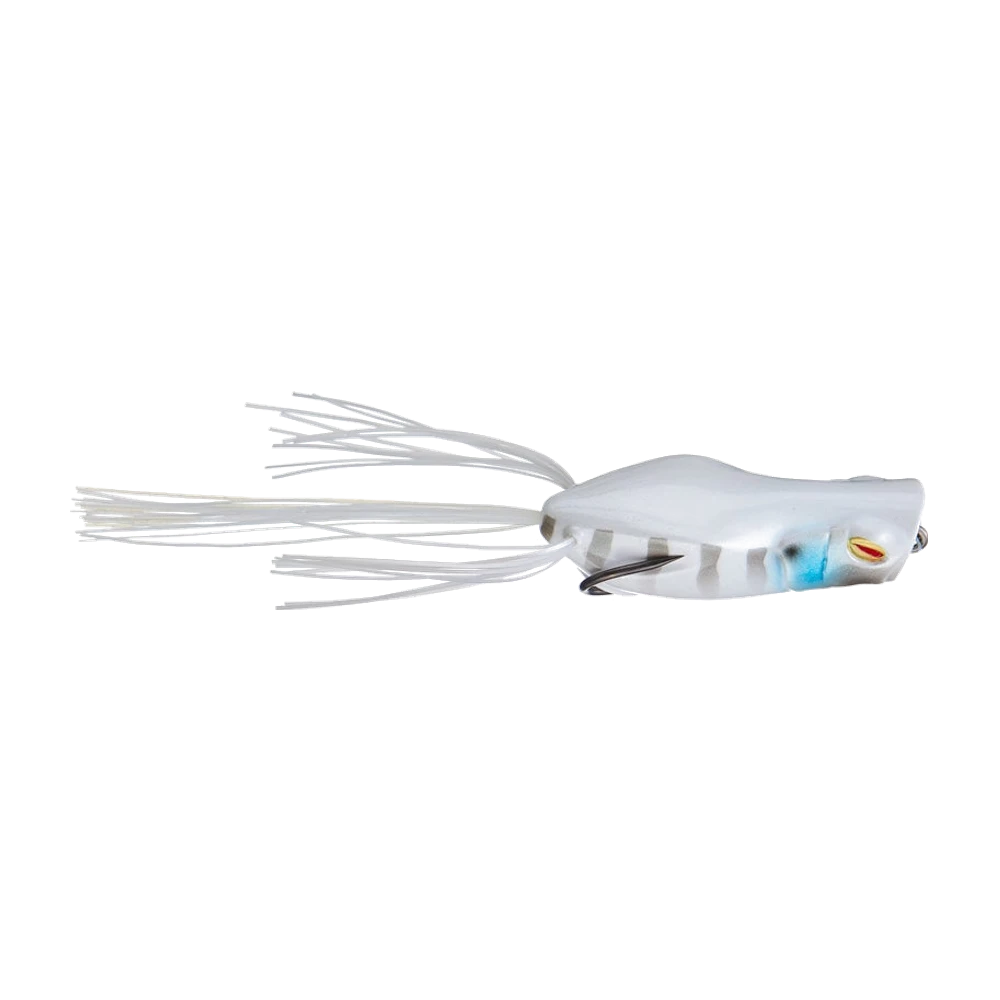
Jackall Gavacho Frog: the cupped-mouth frog that spits water
Before tying this one on, it helps to know if the spot actually calls for it. CarnaFish reads the scene from a photo.
A lily pad field in August, eleven in the morning, and not a fish in sight. Under the leaves there is shade, oxygen and prey, and the bass are sitting twenty centimetres below the surface. No ordinary lure goes in there: the only way to reach them is to walk a soft body across the mat itself. The Gavacho is drawn for exactly that, with one detail that sets it apart from most frogs — a cupped, spoon-shaped mouth that throws a fine spray of water on every stroke.
A cupped mouth, two very different effects
The front face of the Gavacho is not rounded like a classic frog's: it is scooped out, popper-style. That concave face catches water on the slightest rod stroke and throws it forward as a fine spray. It is not the deep bloop of a popper but a short, fairly sharp spit, clearly audible on calm water, leaving a small patch of bubbles behind.
The benefit runs two ways. First, that sound carries under the leaves: a bass sitting blind beneath a pad field does not see your lure, it hears and feels it. Second, that same cupped mouth lets you pick between two registers on a single cast, simply by changing how hard you work the rod. Small wrist twitches and the bait zigzags almost silently; a firm stroke and it spits and jumps a good twenty centimetres forward. That versatility is the real reason to carry a cupped-mouth frog alongside a pointed-nose model.
Walk or pop: choose by cover density
On a tight mat, where the spray would be swallowed by vegetation anyway, the zigzag walk stays the better approach: short, regular taps, rod low, always leaving a little slack so the bait pivots instead of tracking straight. The point is to cover the mat slowly and trigger fish by sound.
In an open pocket between two weed beds, or along the edge of a mat, switch to a hard pop. Two or three firm strokes, then a long pause — genuinely long, three to five seconds, until the rings close. Most strikes come on that pause, not during the action, and this is the single most common mistake among anglers new to the frog: they never stop moving it.
Count your pauses out loud, under your breath. Without counting you will think you waited four seconds when you waited one and a half. On a frog, the gap between those two numbers is half your bites.
The profile that goes where nothing else does
The Gavacho's body closes around the bend of its double hook: the points stay pinned against the back, nothing sticks out sideways, and the whole thing forms a smooth profile that slides over leaves instead of wedging into them. That is the very definition of a frog built for heavy cover, and the Gavacho was clearly shaped with that constraint in mind rather than with a pretty catalogue silhouette.
In practice it means you can drop it on a pad, slide it to the edge and let it fall into the next hole. This leaf-to-leaf approach brings far more fish off a continuous mat than a straight retrieve above the cover ever will.
The downside is well known: with the hook points pinned to the back, the body has to collapse on the hookset to free them. A body that is too thick or too stiff, or a dull hook, and you lose fish. Check the points after every session in the thick stuff, and squeeze the body between two fingers now and then to push out the water it has taken on.
Roughly 19 g on 7 cm: what that changes
Jackall's spec table gives 2.75 in, so 7 cm, and a weight of 2/3 oz. That fraction is unusual in the tackle trade, where 1/2 and 3/4 oz are the norm; take the order of magnitude rather than the exact decimal — we are around 19 g, which is a good deal heavier than the average frog of this length.
That mass-to-volume ratio has very concrete consequences. The bait casts a long way and cuts through wind without drifting, which matters when you have to land it twenty metres back in a pocket. It also holds its line better when you slide it over a leaf. On the other hand it demands a rod with real backbone: a light rod never loads properly with this weight, and above all it will not pull a fish out of the mat.
Line-wise, braid only, heavy, tied direct to the lure's eye. Fluorocarbon sinks and drags the frog's nose down, monofilament stretches and robs you of the hookset. With 40-50 lb braid you can bring in the fish and the armful of vegetation that comes with it, which is the normal outcome rather than the exception.
The classic mistake: setting on the sound
A frog blow-up is spectacular, and the reflex is to set the hook the moment the water explodes. Half the time the fish does not yet have the lure in its mouth: it engulfed the leaf, the water and the frog all at once, and you rip the lot straight back out. Wait until you feel the weight in the rod — a second, sometimes two — then set with a long sweep, not a wrist snap. That wait is counter-intuitive, and it is exactly what separates a consistent frog angler from one who tells stories about misses.
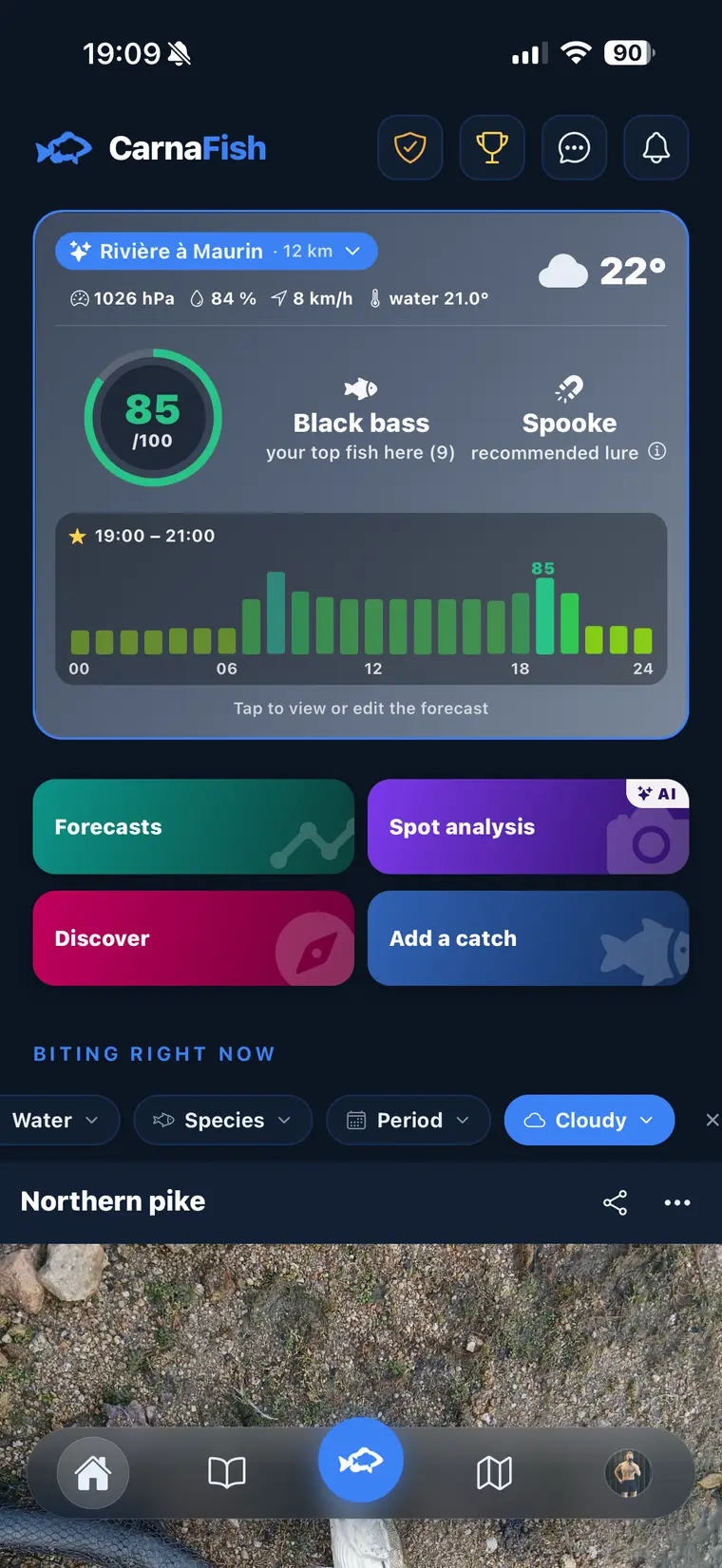
Not sure what to tie on?
Photograph your spot: CarnaFish reads the scene, cross-checks the conditions and gives you the zone, the lure and the retrieve. Free on iOS and Android.
Where and when to use it
The Gavacho works anywhere vegetation covers the surface: lily pads, filamentous algae mats, duckweed, reed edges, half-submerged brush. Its prime window runs from early summer to early autumn, when the water is warm and fish hold under cover all day. The best hours are not necessarily dawn: on a dense mat, bright midday concentrates fish underneath and makes the fishing very readable.
In Europe a frog this size also draws pike, which hold along exactly the same weed edges. The problem is not the strike but the hook-up, which is poorer on a big bony jaw than on a bass, plus the risk of a cut-off. If you know pike are present, accept losing a few baits or switch to a supple titanium leader, which tightens the walking action slightly but saves your day.
Colors by light
Frogs are chosen less on the color of the back, which the fish never sees, than on the contrast of the belly seen from below.
- Overcast skies or stained water: the pearl white of the photo, pale back and grey-barred flanks. In low light that bright tone stays readable against the sky.
- Clear water over pads: a natural green-brown that blends into the cover and reassures the wary fish of heavily pressured waters.
- Backlight and dusk: a black model. Seen from below it is the solid silhouette that counts, and black gives the sharpest outline against a bright sky.
Knowing which mat deserves thirty casts and which deserves none makes more difference than the choice of color. That is exactly what CarnaFish does: one photo of the spot, and the AI suggests the zone, the depth and the lure type that match the day's conditions. To sharpen that reading of the water, our guide to reading a fishing spot walks through the clues to look for before you even tie on.
Key takeaways
- The cupped mouth throws a fine spray of water: the same bait walks silently or pops hard depending on how firmly you work the rod.
- The body closes around the bend of the double hook, giving a smooth profile that slides over leaves instead of hanging up.
- Roughly 19 g on 7 cm: heavy for its length, which buys distance but demands a powerful rod and braid tied direct.
- Set the hook once you feel the weight, never on the sound of the surface blow-up.
FAQ
Does the Gavacho Frog float?
Jackall publishes no buoyancy class for this model, but everything the maker describes — walking, popping, spitting water — is strictly surface use. In practice it is fished sitting on the mat, and a body that takes on water is emptied by squeezing it between two fingers.
How does it differ from the Kaera Frog from the same brand?
The Jackall Kaera Frog is smaller, lighter and built on a flat-sided body aimed at pure walking. The Gavacho is bigger, heavier and adds the cupped mouth, so the popper's acoustic register. One searches quietly, the other calls from a distance.
What tackle do you need for frog fishing?
A powerful casting rod of 1.90 to 2.10 m, a high-speed reel and 40-50 lb braid tied direct. That is not overkill: you have to drag the fish out of the cover before it wraps itself up in it.
Why do I miss so many fish on a frog?
Two causes dominate. You set too early, on the sound rather than on the weight; or your hook points have been dulled by the vegetation and no longer pass through the body on the set. Check them systematically after a session in the thick stuff.
Can you fish a frog anywhere other than lily pads?
Yes, and it is underused. A frog runs beautifully along a vertical bank, under low branches or over grass topping out twenty centimetres below the surface. The only criterion is that an exposed-hook lure would hang up there.
Should you prefer a popping frog or a walking frog?
It depends on cover density. On a closed mat the quiet walk gives the best results; in open pockets and along edges the pop calls from farther away. A Booyah Poppin Pad Crasher or a Deps Buster K cover the same register as the Gavacho with different doses.
The full bass lure guideSeason-by-season strategy: which family of lure, when, and why.Go from theory to fish
CarnaFish reads your spot from a photo and gives you the game plan: zone, lure, retrieve. Free on iOS and Android.