Jackall Kaera Frog: the flat-sided frog that walks in place
The right lure in the wrong spot still catches nothing. CarnaFish spots the zone that works, from a single photo.
Late August on a heavily fished pond, and the bass have already seen three 7 cm frogs go by this week. They still come up, but they take short: a swirl, a slap, and nothing on the end of the line. That pattern — plenty of blow-ups, few fish — has two likely causes, a bait that is too big and a hook that does not find purchase. The Kaera attacks both at once: it is noticeably smaller than the average frog, and it is built around a deliberately wide hook.
Flat sides, and why that changes the walk
Most frogs have a rounded cross-section that rolls easily and slips through the water with little resistance. The Kaera takes the opposite approach: its sides are flat. Two consequences, and they pull in the same direction.
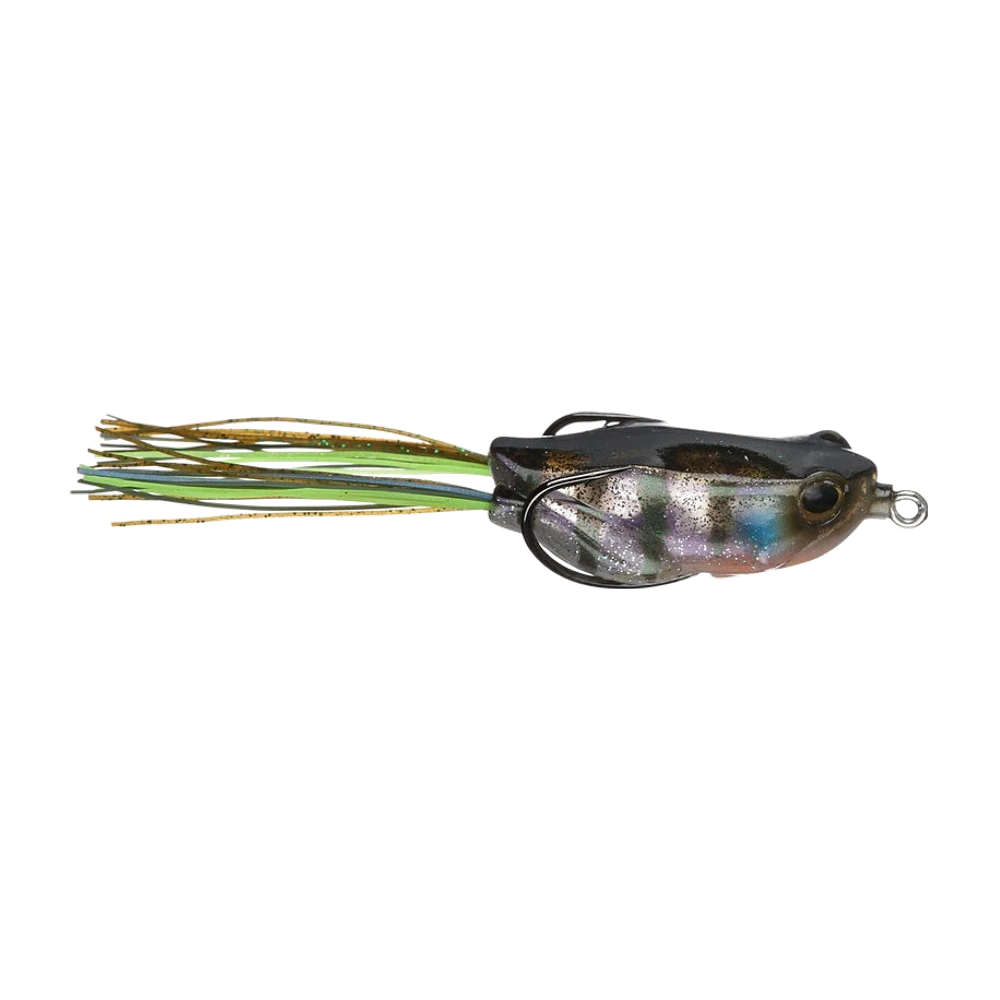
First the walk. A flat-sided body offers a definite lateral surface to push against: when you snap the rod tip, the bait catches water on one side and pivots cleanly to the other instead of sliding mushily. The zigzag gets tighter, sharper and above all easier to produce — you do not need a perfect stroke to make it work, which changes everything when you are learning to fish a frog.
Then the water it moves. On every pivot those flat sides shove a small mass of water sideways, and that pressure signal travels under the cover well beyond visual range. A bass sitting under an algae mat picks it up through its lateral line before it has seen anything at all. That is exactly the argument Jackall puts forward for this model, and it is consistent with its geometry.
Walk the Kaera slower than you think you need to, counting two beats between strokes. A frog that zigzags fast looks great from the boat; a frog that zigzags slowly gives the fish sitting under the leaves time to climb thirty centimetres.
A wide hook: the real answer to the frog problem
The historic weak point of the frog is the hook-up ratio. The points sit pinned against the back so the bait can travel through cover, which means the body has to collapse on the set to free them. On a badly proportioned body, the fish clamps down on a block of plastic and nothing goes through.
Jackall's answer on the Kaera is a deliberately wide double whose gap goes beyond what you usually find on a frog this size. Why it works: the wider the gap, the further the points sit from the body's axis when it compresses, so the better their chances of catching the roof of the mouth or the jaw hinge rather than sliding along the jaw. That is a mechanical take on the problem, not a catalogue claim.
How to set without wasting that advantage
A wide hook does not forgive a rushed hookset. The move stays the same as on any frog: you hear the explosion and do nothing; you drop the rod slightly to let the fish close; you feel the weight settle; only then do you set, with a long, loaded sweep, reeling all the while. A wrist-snap set does not compress the body enough and leaves the points where they were.
One detail that matters: keep the points sharp. A wide double that has rubbed through reeds for an hour hooks worse than a narrow double straight out of the pack. A hook file in your pocket and thirty seconds every half hour is all it takes.
5.7 cm for 14 g: the size that works when the big one stops
Jackall's table gives 2-1/4 in, so 5.7 cm, for half an ounce, which is roughly 14 g. Those are small-frog numbers, but the mass stays substantial for the size: the Kaera casts properly despite its reduced volume, and it cuts through a breeze without drifting, which is not true of every small topwater.
That size earns its place in two situations. The first is educated fish: on water where everyone throws a 7 cm frog, shrinking the silhouette often turns blow-ups into solid hook-ups. The second is late season, when the frogs and bank fry are small and bass key on that size. Conversely, if you need to call fish from a long way off across a big mat, a bigger, louder model like the Jackall Gavacho Frog covers the water better.

Not sure what to tie on?
Photograph your spot: CarnaFish reads the scene, cross-checks the conditions and gives you the zone, the lure and the retrieve. Free on iOS and Android.
Where and when to use it
The Kaera is made for dense vegetation: algae mats, duckweed, lily pads, grass topping out at the surface. Its compact profile and tucked points let it cross thick cover without hanging up. But it is just as good on hard cover where nobody thinks of a frog: under a dock, along a laydown, against riprap, right under a low branch. Anywhere an exposed-hook lure would bury itself on the first cast.
The useful season runs from mid-spring to late autumn, as soon as the water passes fifteen degrees or so and bass come up to feed on the surface. In summer, do not write off the hot hours: under a dense mat, shade and oxygen concentrate fish at midday.
In Europe a frog this size regularly crosses paths with pike along the same edges. The Kaera is not built for that: a 5.7 cm double hooks a bony jaw poorly, and there is no way to run a steel leader on a frog without killing the walk. If the spot is clearly a pike spot, change lures rather than persisting.
The classic mistake
Tying the Kaera on monofilament or fluorocarbon. Both sink or stretch, and either way the nose of the bait dives instead of pivoting: the walk vanishes and all you have left is a lure tracking straight. Braid, direct, full stop. And if you are fishing at distance, set the hook while still reeling to pick up slack before the fish buries itself in the weed.
Colors by light
Seen from below, a frog is first and foremost a silhouette. The back is only there for you, to track the bait across the mat.
- Clear water and bright sun: a dark glitter pattern like the one in the photo, black back and barred pearly flanks. The contrast stays sharp against a bright sky, and the flake throws short flashes as the bait pivots.
- Stained water: a chartreuse green, which keeps its visibility in loaded water without looking artificial under the leaves.
- Overcast or rain: a solid white. That is the color that reads best when the sky's light is weak and diffuse.
Picking the right mat counts for more than picking the right color, and that is exactly what CarnaFish offers: one photo of the spot, and the AI suggests the zone, the depth and the lure type that match the day's conditions. If you fish these edges from the water, our float tube and boat fishing guide covers how to approach a mat without spooking what is underneath.
Key takeaways
- The flat sides give a tighter walk that is easier to produce than on a round body, and move more water under the cover.
- The wide double hook is a direct answer to the poor hook-up ratio of frogs: it works, provided you keep the points sharp.
- 5.7 cm for 14 g: a reduced frog size that triggers educated fish but calls from a shorter distance than a big model.
- Braid tied direct and a long set once you feel the weight: the two non-negotiable conditions of this style of fishing.
FAQ
Does the Kaera Frog float?
Jackall publishes no buoyancy class for this model. Everything described about its use is surface fishing — walking over cover, working above vegetation — and that is how to treat it. Remember to squeeze the body empty once it starts taking on water.
Why pick a small frog over a big one?
Because on pressured water, shrinking the silhouette often turns aborted blow-ups into solid bites, and because late in the season surface prey is small. The trade-off is reach: on a big untouched mat, the bigger model remains more efficient.
What rod for a 14 g frog?
A medium-heavy to heavy casting rod of 1.90 to 2.10 m is plenty for that weight. The point is not so much throwing 14 g as being able to drag a fish out of the vegetation it has dived into.
Does the Kaera really hook better than other frogs?
Its design points that way: the wide double holds the points further out when the body compresses, which mechanically improves the chance of catching hold. But no hook makes up for an early set or dull points.
Can you fish it outside weed beds?
Yes. Under a dock, along a sunken tree, against riprap: anywhere an exposed-hook lure would snag on the first cast, a frog goes through. It is the most underused application of this lure type.
How does it differ from a classic round-bodied frog?
A round body slides more easily and asks for a more precise stroke to walk cleanly. The Kaera's flat sides grip the water and pivot more decisively: less glide, more pressure signal. To compare on the water, fish it alongside a 6th Sense Vega and a Gan Craft Dangoku, two benchmark frogs with different registers.
The full bass lure guideSeason-by-season strategy: which family of lure, when, and why.Go from theory to fish
CarnaFish reads your spot from a photo and gives you the game plan: zone, lure, retrieve. Free on iOS and Android.