Jika rig: the weight under the hook, with nothing sticking out
Not sure this lure fits YOUR spot today? CarnaFish tells you in 10 seconds, from a photo.
The Tokyo rig solves the problem of a bait lying flat on the bottom in an elegant way: a rigid stem hangs below the hook, the weight sits at its end, and the bait stays up. As long as the bottom is clean, it is perfect.
The day you take that rig into tight flooded timber, three casts are enough to show you its limit. The metal stem acts as a lever. It slides between two branches, turns sideways, and jams. What you gained in bait posture, you lost in your ability to move through the structure.
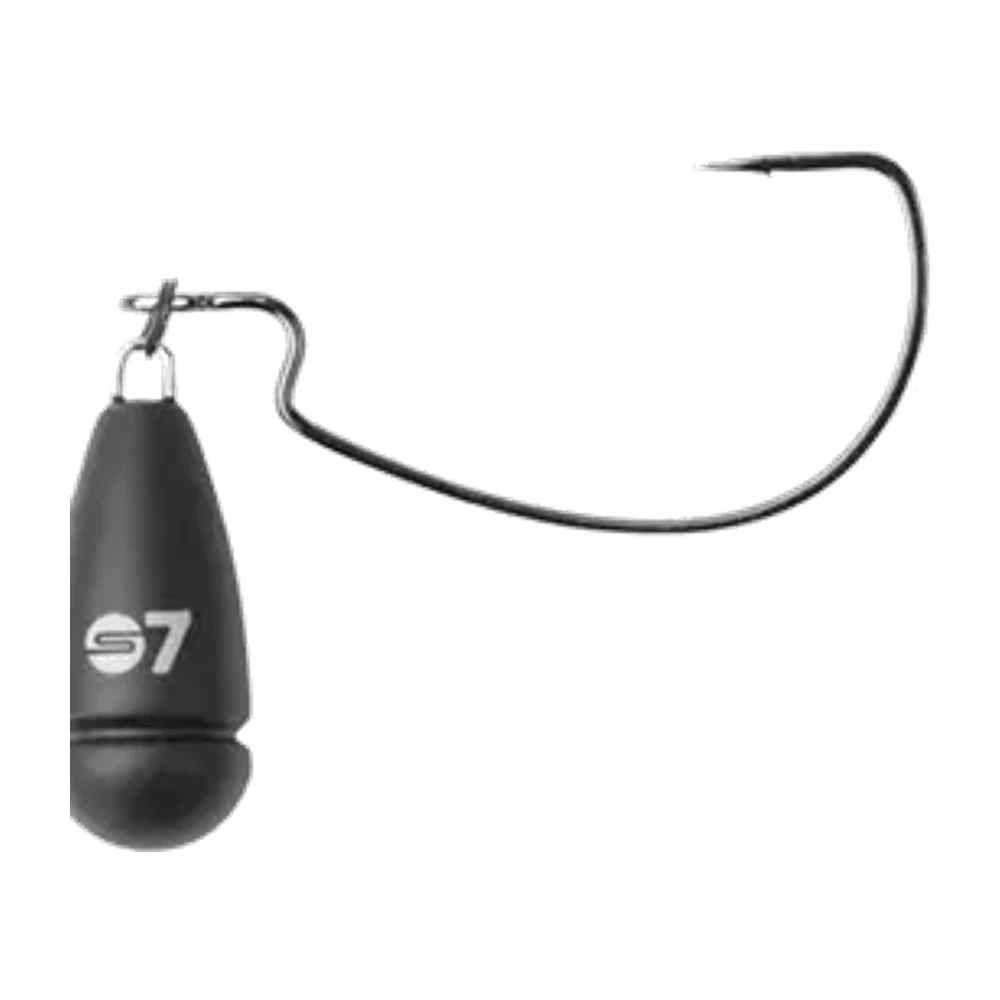
The jika rig applies the same idea — weight below, bait above — while removing exactly what catches. No stem: a split ring, and that is all. You thread the hook onto the ring on one side, the teardrop weight on the other, and you tie your line to it. The whole thing lives inside two centimetres, has no rigid part at all, and slips through where the Tokyo rig stops. "Jika", in Japanese, means "direct": the weight is directly under the hook, with nothing in between.
What being that compact changes
The difference with the Tokyo rig is easy to underestimate, because on the tackle table it looks tiny. On the water, it plays out on three points.
Getting through. With no rigid part, the rig folds and pivots around its ring. It threads between two branches, finding its own orientation, where a six-centimetre stem is bound to arrive sideways sooner or later. That is the whole reason this rig exists.
Stand-off height. It is far smaller: the bait sits two or three centimetres above the weight, not six or eight. So the jika does not lift the bait out of a thick layer of silt — it simply holds it nose up, in feeding position, which is enough on a normal bottom but not on a soft one. That is the one area where the Tokyo rig remains unbeaten.
Sensitivity. Because the weight is right on the ring, a few millimetres from the knot, you feel the bottom with a clarity few rigs offer. You read the gravel, the moment you cross a slab, the instant the weight slides into weed. This is a bottom-reading rig as much as a presentation rig.
Tying it in three minutes
- Use a strong oval split ring. The entire rig hangs on that one component, which carries the line, the hook and the weight. A thin round ring deforms under sideways pull.
- Thread the hook on, then the weight. An offset worm hook, and a teardrop weight fitted with its own ring. Mechanically the order makes no difference, but get into the habit of always building it the same way round: you will spot anything that has opened up much faster.
- Tie the line straight to the ring, between the two. No extra snap — it would only add a moving part to a rig whose whole quality is being compact.
- Rig the bait strictly Texas style. Point buried in the back, flush with the plastic, never poking out. A jika rig with an exposed point loses its entire point, since it is built to go into the cover.
Working it, in contact with the bottom
- Follow it down with the rod tip. The weight lands first, very distinctly, and you feel a sharp "tock".
- Do nothing for three to five seconds. The bait settles nose up above the weight and works on the current, or simply on the boat's drift.
- Slide it, don't hop it. A very short pull, ten to fifteen centimetres, keeping the weight in touch with the bottom instead of lifting it off. You are moving the rig along, not making it fly.
- Every three or four slides, take a longer pause of eight to ten seconds. That is the rhythm that converts settled zander and bass sitting under cover.
The wording matters here: a jika rig is dragged, it is not hopped. The moment you start jumping it like a jig head, you lose the nose-up posture for half of every sequence, and you multiply your chances of hanging up on the drop.
On the water: when you feel the weight go into something — weed, a branch, a crevice — stop everything and count three seconds before you pull. The rig pivots around its ring and almost always realigns itself with the direction of pull. Pull straight away and you wedge it for good. That one second of patience is the difference between leaving two rigs behind per session and leaving none.
Size the weight to the cover, not to the depth
| Situation | Weight | Rhythm | What to watch |
|---|---|---|---|
| Cluttered margin, under 2 m | 3.5 to 5 g | Fine slides, 5 s pauses | Slow fall under the branches |
| Flooded timber, 2 to 4 m | 7 to 10 g | Slides, 8 s pauses | Let the rig realign itself |
| Clean drop-off, 4 to 8 m | 10 to 14 g | Slow drag, constant contact | Read the change in bottom composition |
| Vertical or current, 8 m and more | 14 to 18 g | Short lifts, firm settling | Keep the line vertical |
Unlike the cheburashka, where weight is chosen by fall time, here it is chosen first by the density of the cover. In tight timber, a weight that is too light floats between the branches and hangs up instead of dropping to the floor; a decisive weight goes through and settles. Take the heaviest you can get away with, as long as the fall stays readable.

Not sure what to tie on?
Photograph your spot: CarnaFish reads the scene, cross-checks the conditions and gives you the zone, the lure and the retrieve. Free on iOS and Android.
Where it shines, where it is useless
It is built for flooded timber, root balls and riprap — in other words, everything that stops a Tokyo rig. It is excellent under docks and low structure, where its compact shape lets you skip it in flat. And it earns its keep in slow contact fishing, when you want to read the bottom metre by metre.
It is a poor choice in three cases, though. Over soft silt and leaf litter: two centimetres of stand-off are not enough, and the bait sinks in with the weight. When searching fast: this is slow-motion fishing, and you cover very little ground. In open water: with no bottom to touch, the rig makes no sense, and a cheburashka will do a far better job.
Jika, Tokyo or Texas
All three go into the cover, and the choice comes down to what you are willing to give up.
The Texas rig is the most snag-resistant of the three, no argument: a bullet weight sliding right against the bait, nothing sticking out, it goes through almost anything. But the bait lies down on the floor, like with any rig weighted at the front.
The Tokyo rig is the most precise on height, and the only one that really solves soft bottoms — at the cost of a stem that jams.
The jika rig is the compromise, and it is a genuine compromise, not a soft middle ground: you keep the bait nose up, and you get through almost everywhere. If you are fishing a cluttered spot with a hard bottom and you want your bait in feeding position on every pause, it is the right call. Our guide to reading a fishing spot helps you pick out the zones where this rig has the edge, and if you are torn between attacking a stump on a jika or a Texas, CarnaFish will read a photo of the spot and answer for you.
Key takeaways
- Hook and weight joined on a single split ring: no rigid part, so nothing that levers against the branches.
- The bait stays nose up two or three centimetres above the weight — not enough to clear soft silt.
- The rig is dragged in contact with the bottom, it is not hopped.
- When the weight goes into an obstacle, wait three seconds: the rig realigns itself.
- Weight is chosen by the density of the cover, not by the depth.
FAQ
What is the difference between a jika rig and a Tokyo rig?
The jika joins hook and weight with a simple split ring, the Tokyo with a rigid metal stem. The jika gets through cover far better, the Tokyo holds the bait much higher off the bottom.
How does it differ from a cheburashka?
The position of the weight. On a cheburashka it sits at the nose of the bait, on its axis, and the bait swims. On a jika rig it hangs under the hook, and the bait stays suspended nose up above the bottom.
What weight should I use on a jika rig?
A teardrop or cylindrical weight fitted with a ring: 3.5 to 5 g along the margins, 7 to 10 g in flooded timber, 14 to 18 g vertically or in current. Pick the heaviest that still gives you a readable fall.
Do I need a special hook?
A standard offset worm hook is enough. What matters is rigging the bait strictly Texas style, point flush in the back, since the rig is built to go into the cover.
How do I avoid losing the rig in the branches?
The moment the weight catches, stop everything and count three seconds. The whole rig pivots around the ring and usually realigns itself with the direction of pull. Pulling straight away is what wedges it.
Does it work for zander?
Yes, very well, dragged slowly along drop-offs and hard-bottomed plateaus. Bottom contact through the weight is very clear, which lets you read the changes in bottom composition where zander sit.
The full zander lure guideSeason-by-season strategy: which family of lure, when, and why.Go from theory to fish
CarnaFish reads your spot from a photo and gives you the game plan: zone, lure, retrieve. Free on iOS and Android.