Tokyo rig: the rig that keeps your bait off the bottom
This lure shines under specific conditions. CarnaFish tells you in 10 seconds if today is one of them.
There is one problem every classic weighted rig shares, and nobody talks about it much: the moment the bait touches down, it falls over. A jig head lands, tips onto its side, and the soft plastic ends up flat in the silt or wedged between two rocks. You can lift it by pulling, but between two drags it is lying on the ground — which means out of sight of a fish hunting on the horizontal.
Over clean, hard bottom that hardly matters. Over soft silt, a carpet of dead leaves or low weed, it is a deal-breaker: your bait literally disappears into the scenery on every pause.
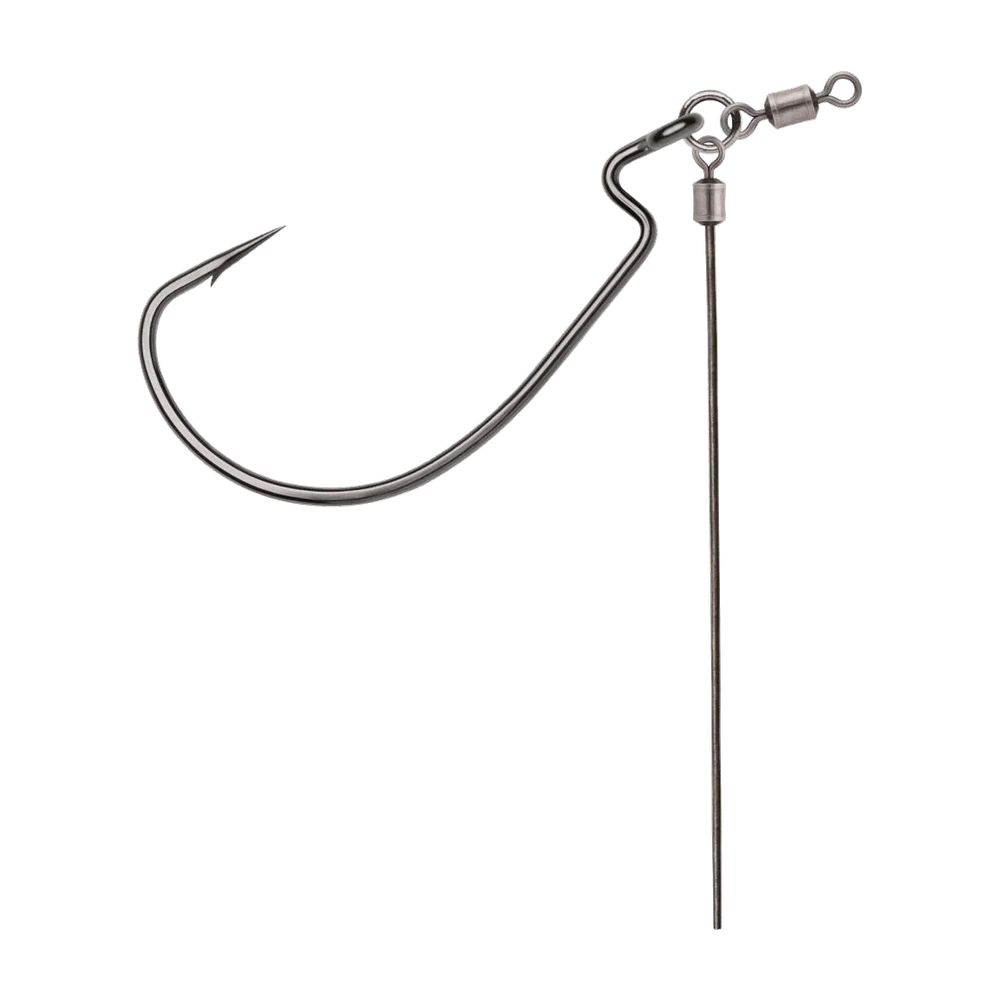
The Tokyo rig solves that with geometry. The weight is no longer on the bait, it sits at the end of a rigid wire stem hanging below the hook. The weight touches bottom, the stem stays straight, and the bait ends up suspended a few centimetres higher, upright and ready to work. It never lies down.
The geometry, and what it dictates
The rig comes down to three parts: a ring or clip where you tie your line, a hook mounted on that ring, and a wire stem welded to the same point, dropping vertically with the weight at its end.
The direct consequence is that the height of the bait above the bottom is fixed and known. It equals the length of the stem, no more and no less. Almost no other rig gives you that piece of information: with a jig head you never really know whether your bait is two centimetres off the bottom or fifteen.
The second consequence is the independence between weight and bait. The weight is down below, carrying the load and keeping contact; the bait is up above, with no lead on it at all. A shad on a Tokyo rig therefore swims as if it were weightless, with the full suppleness of its tail, but at a depth you control.
Third consequence, less pleasant: the rigid stem snags. In tight branches it acts as a lever and jams where a round weight would slip through. That is the price.
Tying the rig in four moves
- Pick the stem length to suit the bottom. Short, 3 to 4 cm, over hard clean bottom, when you want to stay right against the substrate. Long, 6 to 8 cm, over soft silt, leaves or low weed, to ride above the soft layer.
- Rig the hook weedless. Push the point into the nose of the bait, bring it out a centimetre further along, rotate it, and bury the point back in the back of the bait, just under the skin. A weedless setup is close to compulsory here, since the whole point of the rig is to go into the places where other rigs get stuck.
- Change the weight, not the stem. Most stems end in a section you bend over or in a clip: you can swap the weight in ten seconds without taking anything apart. Start with 7 g as an all-round freshwater size, drop to 3 g in skinny water, go up to 14 or 21 g deep or in current.
- Tie straight to the top ring. No extra clip: the rig already has one, and adding a second creates a hinge point that leaves the whole thing hanging crooked.
The retrieve: drag, pause, nothing else
This is a bottom rig, and the temptation is to overwork it. That temptation is wrong.
- Let it sink on a controlled line until contact. You feel the weight touch down, not the bait.
- Short drag of the rod tip, twenty to thirty centimetres, just enough to lift the weight and set it back down a little further on.
- Long pause, three to ten seconds. This is the key phase. The weight is on the ground, the stem holds the bait upright above it, and the bait works on its own with the slightest current or the slightest tremor in the line. On a shad with a supple tail, the tail keeps beating for several seconds after the stop.
- Pick up the slack without moving the bait, and start again.
The bite, on this rig, almost always shows up as a weight settling in during the pause, not as a knock. The fish inhales a bait that is barely moving and stays put. Set the hook on that sense of heaviness: first speed up half a turn of the handle to come tight, then lift.
On the water: when nothing is happening, lengthen the stem before you change bait or colour. Nine times out of ten, over soft bottom, the problem is not what you are showing them but the height at which you are showing it. Going from a 4 cm stem to a 7 cm one lifts the bait out of a layer of silt or a carpet of debris you cannot see from the bank — and changes everything, with the same bait and the same colour.
Setting the weight
| Situation | Weight | Stem length | Rhythm |
|---|---|---|---|
| Margins, under 2 m | 3 to 5 g | 3 to 4 cm | Fine drags, 3 s pauses |
| Flat, 2 to 5 m | 7 to 10 g | 4 to 6 cm | Drag, 5 s pause |
| Deep drop-off, 5 to 8 m | 14 to 21 g | 4 to 6 cm | Permanent bottom contact |
| Soft silt or leaves | 7 to 10 g | 7 to 8 cm | Very long pauses, 10 s |
The weight is set by depth and current; the stem length is set by the nature of the bottom. Those are two independent adjustments, and that is what makes the rig so flexible: you can go heavier without bringing the bait any closer to the bottom, something no jig head allows.

Not sure what to tie on?
Photograph your spot: CarnaFish reads the scene, cross-checks the conditions and gives you the zone, the lure and the retrieve. Free on iOS and Android.
Where it wins, and where you should leave it alone
It is unbeatable over soft bottom — silt, mud, leaf litter — where any other rig vanishes. It is excellent over low weed beds, worked just above the layer. And it is very effective fishing slowly for settled fish, when you want to let a bait work for five to ten seconds without moving it a centimetre.
Avoid it in three cases, though. In dense branches: the rigid stem acts as a lever and jams, and a classic Texas rig will come through far better. When searching fast: this is spot fishing, not covering water, and you get through very little ground per hour. Over big boulders: the stem locks between two blocks and you leave tackle behind.
Tokyo rig, jika rig or cheburashka
All three answer the same question — how do you weight a soft plastic without weighting it — and all three answer it differently.
The jika rig is the flexible version of the Tokyo: same idea of a weight hanging below the hook, but on a split ring instead of a rigid stem. The bait is held less firmly and the height is less precise, but the rig comes through cover markedly better.
The cheburashka rig plays a completely different game: the weight sits at the nose of the bait, in line with it, not underneath. That is a swimming rig, not a suspension rig.
The Tokyo rig is the most rigid and the most precise of the three, and that is both its strength and its limit: you know exactly where your bait is, but you cannot take it everywhere. If you want to see how these rigs divide up a single day, our beginner's guide to zander fishing lays out the basics, and if you are unsure which stem length to tie on in front of a particular spot, CarnaFish reads a photo of it and answers. On the hardware side, the VMC Tokyo Rig is the model this article is built around.
Key takeaways
- The weight sits below the bait at the end of a rigid stem: the bait never lies down on the bottom.
- Stem length is set by the nature of the bottom, weight by the depth. Two independent adjustments.
- The retrieve comes down to a short drag and a long pause; the tail works during the stop.
- When you get no bites over soft bottom, lengthen the stem before you change bait.
- Avoid it in dense branches and over big boulders, where the stem acts as a lever.
FAQ
What does a Tokyo rig do that a jig head doesn't?
It keeps the bait off the bottom and upright, instead of letting it fall over on every pause. Over silt, leaves or low weed, that is the difference between a visible bait and a buried one.
What stem length should I choose?
Three to four centimetres over hard clean bottom, six to eight centimetres over soft silt or leaf litter. It is the adjustment that matters most on this rig, well ahead of the colour of the bait.
What weight should I use?
Seven grams as an all-round freshwater base, three to five grams in under two metres, fourteen to twenty-one grams deep or in current. You can swap the weight without taking the rest apart.
Should the bait be rigged weedless?
Yes, in almost every case. The rig is built to go into cluttered bottom, and an exposed point snags there straight away.
What does the bite feel like?
Like a weight settling in during the pause, rarely like a sharp knock. Speed up half a turn of the handle to come tight, then set the hook by lifting the rod.
Does it work in rivers?
Yes, by going heavier to keep contact. In strong current, though, the stem tends to lie over in the flow and you lose part of the height advantage.
The full bass lure guideSeason-by-season strategy: which family of lure, when, and why.Go from theory to fish
CarnaFish reads your spot from a photo and gives you the game plan: zone, lure, retrieve. Free on iOS and Android.